Why One Family Can Have Different Surnames
How surnames and names work around the world: from Icelandic patronymics and Spain's two family lines to protective names in Asia and curious cases of namesakes.
- Date
- Reading
- 33 minutes
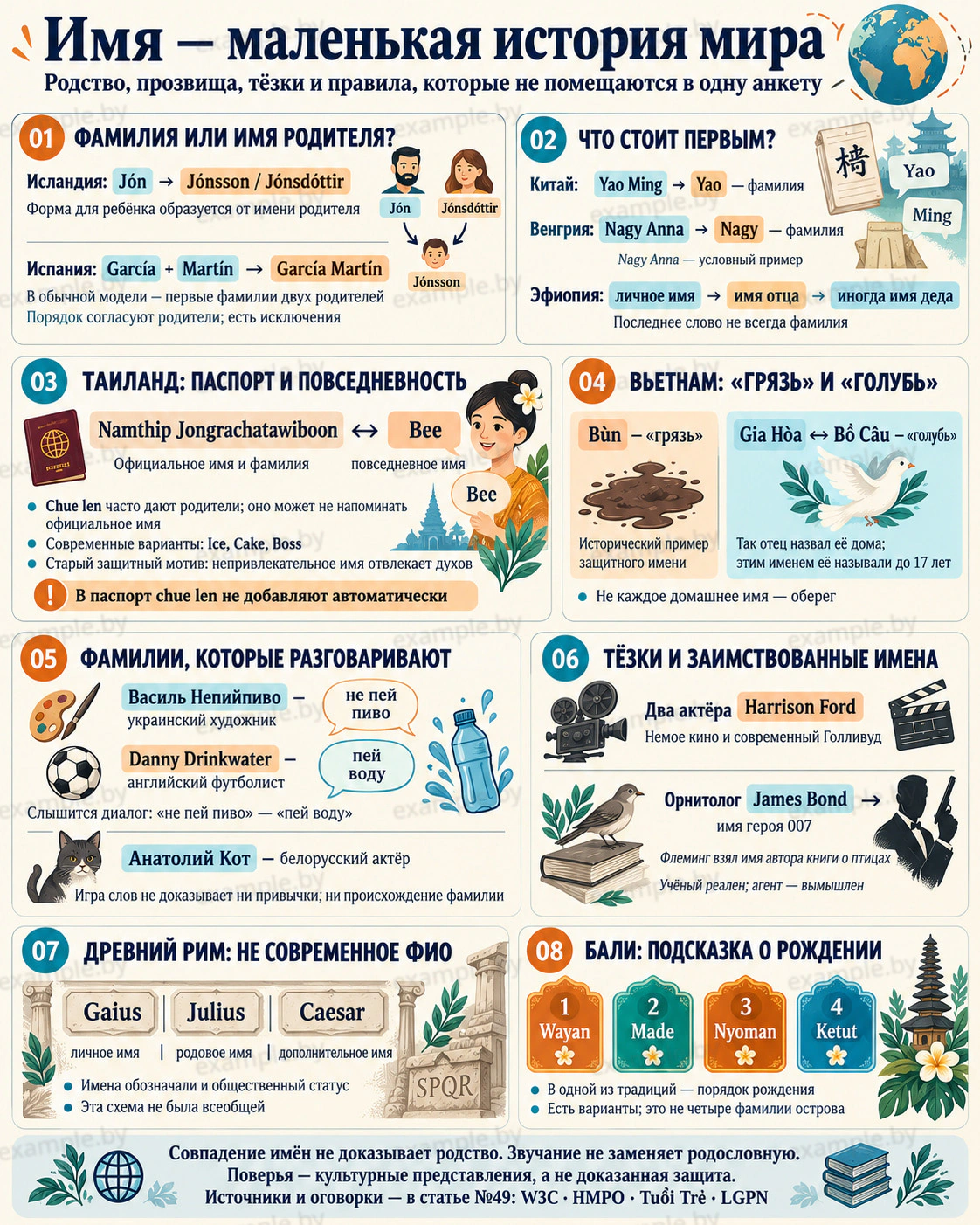
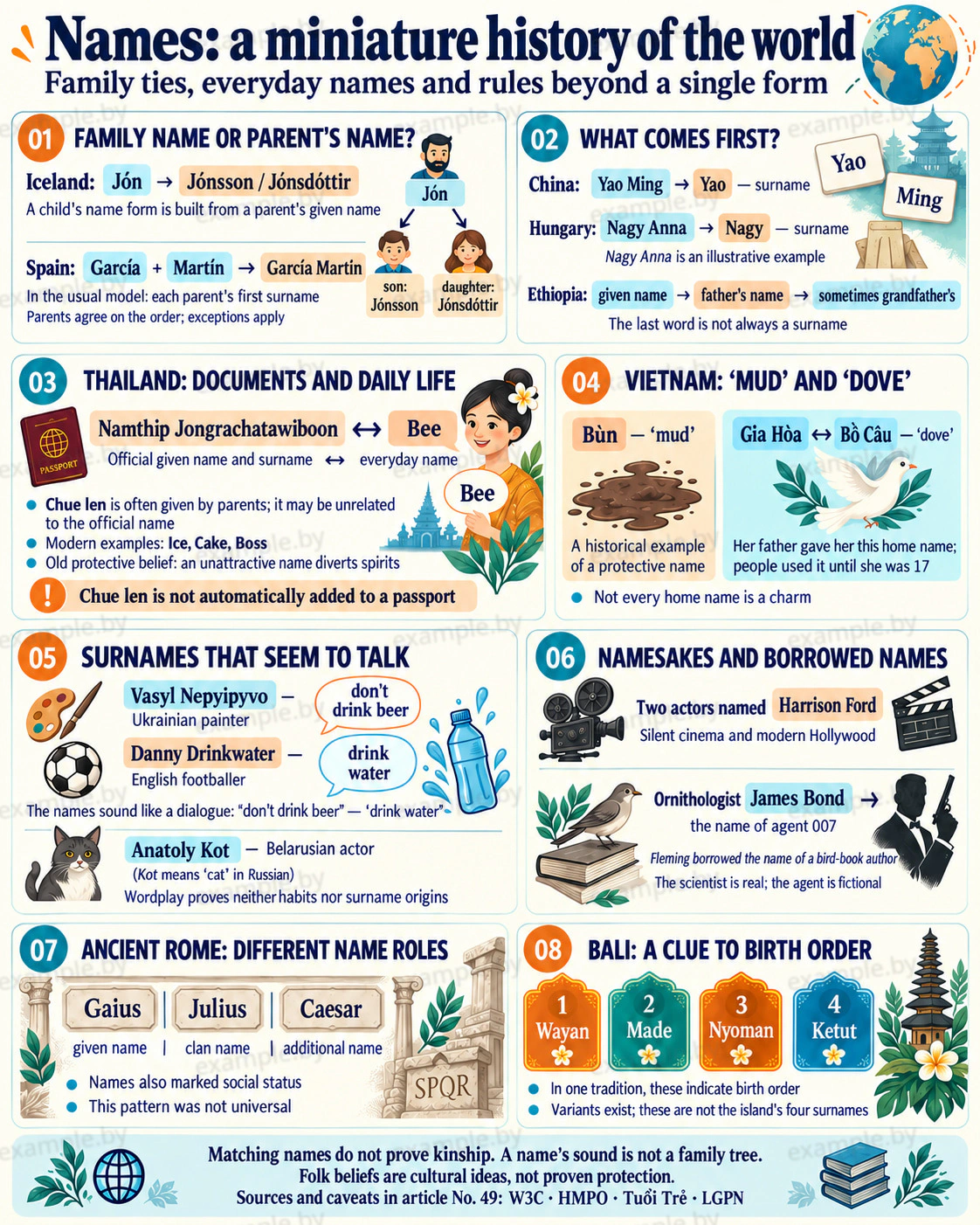
Imagine a family filling in an international form. The parents have different surnames, the son's and daughter's final name parts differ too, and the software insists on a single “shared family surname.” This is a thought experiment, but the reason behind it is real: a developer took the naming habits familiar to them for the way the whole world works.
Surnames differ because societies have tied a person to family, parents and state documents in different ways. A hereditary clan name, a reference to the father or mother, two surnames from different lines: these are different solutions to the problem of how to tell people apart and mark kinship. Even word order is not universal. The W3C specifically warns form designers not to assume that a person necessarily has a surname, or that all members of a family share one. W3C: personal names around the world.
How a description of a person becomes a surname
In a small community, two Roberts can be told apart by occupation or place: one is a baker, the other lives by the forest. At first such an addition characterizes a particular person. The decisive shift comes when it stays with his children, even though they are no longer bakers and live somewhere else.
According to an English Heritage overview, hereditary surnames spread in England after the Norman Conquest of 1066; by the poll tax records of 1381, most English families already used them. This was a gradual consolidation, not a one-off invention. The convenience of telling people apart explains where an additional name comes from; passing it on to children turns it into a family mark. English Heritage.
Researchers identify several common sources: occupation, place, a parent's name, a description of the bearer. Smith is linked to metalworking, Hill to a feature of the landscape, Jackson to a father's name. But the meaning can be misleading: even a descriptive nickname was sometimes ironic. A modern bearer of a surname need not match its original sense. UWE Bristol: study of surname origins.
It helps to separate three questions here: where the word came from, when it became hereditary, and how it is passed on today. The answer to one of them does not answer the others.
So who bore the first surname in history?
To name one person and an exact year would be to hide a problem of definition. Should any second name count as a surname? Only a hereditary one? A clan name? A mandatory entry in documents for the whole population?
Roman naming systems existed long before the medieval English model. They distinguished a personal name, a family name and an additional designation. Yet even the famous three-part scheme was not universal among the Roman elite. This is evident from the open-access introduction to Paul Gallivan's study; the full paywalled text was not used for this article. Gallivan, Antichthon, 1992.
So 1066 cannot be passed off as “the birth of surnames on Earth.” Comparing sources supports a more cautious conclusion: we are dealing with several historical systems, not a single technology that somebody once patented. The oldest surviving record does not necessarily mark the first use either: some documents simply have not come down to us.
Iceland: the last part of the name is renewed with each generation
In the common Icelandic model, the last part of a name points to a parent. The UK Passport Office gives an example: the son of Jón Einarsson can be designated Jónsson, and the daughter Jónsdóttir. These are formed from the name Jón, not by copying Einarsson. A line through the mother is also possible. At the same time, Iceland also has family surnames: the formula “Icelanders have no surnames at all” is too crude. HM Passport Office: Iceland.
A well-known example is the singer Björk Guðmundsdóttir: the second part points to the name of her father, Guðmundur. It does not work like a fixed surname handed down through many generations. The W3C's analysis of Björk's name.
Two schemes can be imagined. In a hereditary model, the family designation itself is passed on. In a patronymic one, what is passed on is the rule for forming a new designation from a parent. Outwardly both sit at the end of the full name, but they carry different information. That is why different endings for a brother and a sister are neither a registrar's error nor a sign of different families.
Spain: two lines, but not an endless chain
In the ordinary case, where a child's parentage is established through both parental lines, Spanish law provides for passing on the first surname of each parent. The parents agree on the order before registration. This provision contains no automatic requirement to put the father's surname first. If there is no agreement, the registrar decides, taking the child's interests into account. For later children with the same parents, the established order is retained. Law 20/2011, Article 49.
A hypothetical example: a child of Ana García López and Luis Martín Pérez may receive García Martín or Martín García, in the agreed order. This illustrates the general rule; it is not an analysis of a special case of citizenship or adoption.
Surnames do not have to double in each generation: in the model described, the first surname is passed on from each parent. So two surnames help mark both lines without turning the full name into a list of all ancestors.
Fame, however, can single out one part. Pablo Ruiz Picasso signed his works “P. Ruiz Picasso” and later began using his mother's surname, Picasso, in his signature. The Instituto Cervantes describes this on the basis of the artist's early publications. An artistic signature, though, cannot automatically be taken as evidence of a legal change of name. Instituto Cervantes.
Why a wife does not always take her husband's surname
Because a child's surname and a spouse's surname after the wedding are governed by different rules. Marriage does not have to mean a person moving under a new family designation.
In Quebec, both spouses keep their birth surnames when exercising civil rights, for example when signing a contract or obtaining a driver's licence. In public life, a spouse's surname may be used. There is a historical exception for a certain group of women who married before 2 April 1981. This is a Quebec rule specifically: it cannot be extended to the whole of Canada. Government of Quebec.
For a marriage between two Japanese citizens, a different approach applies: the spouses choose a single shared surname, either the husband's or the wife's. An official explanation from the Nishinomiya municipality separately notes that marriage to a foreign national is governed differently. Municipal answer on Article 750.
The comparison shows that even the task of designating a married couple admits opposite legal solutions. A match in surnames cannot reliably establish a marriage, nor can a difference establish its absence. This is a conclusion from comparing rules, not a statement about the “strength” of a family.
Digits, bans and rare surnames
There is no single worldwide list of forbidden surnames. One has to specify the country and the procedure: naming a child, changing an adult's name, obtaining a passport and registering a pseudonym are different actions.
For example, the GOV.UK guidance on changing a name by deed poll requires a pronounceable name without digits or symbols; it allows a hyphen and traditional punctuation such as the apostrophe in O’Hara. The name must not be offensive or contrary to the public interest. These are the conditions of one particular procedure, and for those born in Scotland the guidance sets out separate rules. It would be wrong to conclude that “digits in a surname are banned everywhere.” GOV.UK: deed poll.
In Sweden a different principle looks unusual: a common surname that is lawfully borne by at least 2,000 people can be chosen by application under the procedure the law provides. Rare existing surnames are protected more strongly. But this is not an absolute ban on acquiring them: the law provides, in particular, for family grounds and exceptions. Swedish Names Act, §§ 15–18.
A newly invented surname is checked too. Skatteverket assesses its admissibility and the risk of confusion with existing names, organization names or trademarks. Changing a surname turns out to be both a personal choice and a question of identification among other people. Skatteverket.
Three facts more interesting than a list of “ridiculous surnames”
“Twelve trees” may be a translation trap. The English surname Twelvetrees looks like an easily understood combination of words. But the researchers behind the surname dictionary consider it probably the result of a reinterpretation of an earlier form linked to the place name Wheldrake. An amusing modern reading does not prove an equally amusing origin. UWE Bristol.
Different spelling does not necessarily mean different ancestors. The Folger's Shakespeare Documented project explains that in the early modern period spelling was not standardized, and a person could write their own surname differently in different documents. So the modern habit of treating every letter as a fixed identifier gets in the way of reading old records. Folger: transcription conventions.
Even a future pension influenced surnames. The Swedish Institute for Language and Folklore explains that the authorities encouraged more distinctive family names, partly because people had to be identified reliably when pension provision was being prepared. What seems a purely family tradition is also tied to the way the state is organized. Isof: history of name legislation.
Is the given name always written first?
No: “the first word” and “the given name” are different things. In China, Korea and Japan the traditional order puts the surname before the given name; the usual Hungarian order works the same way. When switching to another language, a person may rearrange the parts while keeping the name itself.
| Example | Surname | Given name | What is easy to confuse |
|---|---|---|---|
| China: Yao Ming | Yao | Ming | The last word here is not the surname |
| Korea: Hong Gildong | Hong | Gildong | Gil-dong and Gildong can render the same name |
| Japan: SUZUKI Haruko, a hypothetical example | Suzuki | Haruko | Capital letters help mark the surname |
| Hungary: Nagy Anna, a hypothetical example | Nagy | Anna | The “surname → given name” order exists in Europe too |
The examples and models are supported by the W3C, the Korean Institute for Basic Science and the HM Passport Office profile of Hungary. A 2019 inter-ministry agreement in Japan recommends the “surname → given name” order for Latin-script writing in official documents too; where necessary, the surname is set in capitals. This is a recommendation for a particular kind of official use, not an obligation for every Japanese person to sign the same way in every country. Official document.
So on an international form it is more reliable to distinguish given name from family name than to guess them by position. The IBS gives a telling case: one person may write the name as Hong Gildong on a business card and Gildong Hong on a résumé. Same person, different order.
Four more ways to see a familiar name differently
Ethiopia: the second word may be the father's name. In the model described by the passport service, a name consists of the person's own given name, the given name of their father and sometimes the given name of their paternal grandfather. The last part is not necessarily a hereditary surname. To a foreign reader the name looks long, but its parts mark a sequence of generations. HM Passport Office: Ethiopia.
Bali: part of a name may indicate birth order. In a widespread tradition, Wayan is linked to the first child, Made to the second, Nyoman to the third and Ketut to the fourth; there are variants such as Putu, Kadek and Komang. These are naming elements, not four universal surnames of the island. A study by anthropologists at Udayana University shows one more interesting detail: the Muslim community of Pegayaman combines Balinese birth-order markers with Islamic names. One system can unite several cultural traditions. 2023 study.
The Malay model: bin is not a surname of its own. In the example Isa bin Osman, it means “Isa, son of Osman.” Parsing such an entry as “given name Isa, middle name bin, surname Osman” would be imposing a foreign scheme. W3C.
Korea: different Latin spellings do not necessarily mean different original surnames. The IBS explains that the Korean 이 appears in Latin script as Lee, although systematic romanization gives I. Likewise Kim and Gim can render 김. But a match in the Korean spelling cannot prove close kinship: transliteration and family genealogy are different questions. IBS: standardization of names.
Two names: one for the paperwork, another to confuse the spirits?
Introducing yourself by a name that acquaintances will not find in the official record does not necessarily mean hiding your identity. In Thailand, the everyday name chue len (ชื่อเล่น, literally “play name”) exists alongside the official given name and surname. Parents often give it at birth; further names may later come from friends. It may bear no resemblance to the name in the passport. Mingkwan Wongsantativanich's study describes this practice and its modern English-language variants. Kasetsart University study, 2013, pp. 135–137.
Thailand: an acquaintance named Bee
This is a perfectly real example: the actress and model Namthip Jongrachatawiboon is known as Bee. Her agency uses both designations, and her biographical card labels the full name and the chue len, บี, separately. But the English spelling Bee, which matches the word for the insect, does not in itself establish why the family chose this name or what meaning they put into it. One Connection agency profile, Sanook: full name and everyday name.
This system also has a protective folkloric layer. The Thailand Foundation describes a custom of giving two names to confuse malevolent spirits, as well as naming a child something unattractive, for example “pig” or “dog,” so that the spirits will not want to take it. Within the belief, the name works as a disguise: the child seems less noticeable or less desirable. This describes a cultural notion; it does not confirm that such a danger exists. Thailand Foundation, 2024.
However, a present-day name such as Ice, Cake or Boss should not automatically be decoded as an amulet. The 2013 study discusses fashion, foreign words and the image of the modern person. The habit itself can persist after the original explanation no longer determines the choice of a particular family. Wongsantativanich, 2013.
What is more, explanations differed even within the traditional setting. The ethnographer Barend Jan Terwiel recorded a conversation in 1968 in which participants placed the deceiving of spirits mostly in the distant past, and linked their own choice of simple animal names to the hope that the child would be easy to raise. One field conversation does not represent a whole country, but it shows why a single origin story oversimplifies the custom. Religion in Rural Central Thailand, 1971, p. 69.
And are both names actually written in the passport? Usually not. The official given name and surname are distinct from the chue len; the Thailand Foundation separates these categories explicitly. The UK passport service's profile of Thailand describes the official model as one given name and one surname. So the formula “Thais necessarily have both a real and an everyday name in their passport” is wrong: the everyday name does not automatically become a second passport entry. Thailand Foundation, HM Passport Office, 2025 version.
Vietnam: “mud” for protection and “dove” for loved ones
For Vietnam, too, the protective motive is documented. Lê Thi Minh Thao and Lê Van Thanh of Hanoi Open University cite Bùn, “mud,” as an example of an unattractive name meant to protect a child from evil forces. This is a historical and cultural description; it does not show what share of modern families hold such a belief. Some Cultural Features of Vietnamese Personal Names, 2015, p. 1913.
Meanwhile the home name, tên ở nhà, can express something quite different. In a 2021 Tuổi Trẻ article, a woman named Gia Hòa says that until she was seventeen her family, friends and teachers called her Bồ Câu, “dove”: her father gave her that name. Recalling her family, she contrasts the old ugly names meant to distract the spirits with the new affectionate ones. This is one personal story, not proof of the same custom throughout Vietnam. Tuổi Trẻ, 2021.
Does knowing a name mean gaining power?
This motif really does exist in research on name magic: a name is thought to be closely tied to the person, so knowing it supposedly gives power over its bearer. But concealing a name and choosing an unattractive protective name are related, not identical, practices. The sources on Thailand and Vietnam above confirm above all the protection of a child from spirits; they give no grounds for declaring all residents adherents of the belief that “anyone who learns my name can harm me.” Comparative survey by Anya Collazo, 2019, pp. 137–140.
Nor is this only an Asian story. The same survey cites historical protective names in the German Palatinate (Pfalz): before baptism an infant could be called by words meaning something like “little frying-pan handle,” to protect against demons. Researchers call such names apotropaic, that is, averting evil. A similarity of function does not mean that different societies shared the same beliefs or a single source of the custom. Collazo, p. 140.
From Nepyipyvo to Goodenough: ten real stories
The comic effect comes in different kinds: a surname sounds like an instruction, unexpectedly matches a profession, or changes appearance when moved into another language. Below are real people. A modern pun does not by itself establish the origin of their family surnames.
1. Ian Nepomniachtchi: a surname that suggests “not remembering,” in a game that demands remembering a great deal. The Russian grandmaster won the Candidates Tournament twice in a row; he clinched his 2022 victory a round before the end. What is funny is the contrast between how the surname sounds to a Russian speaker and the chess preparation, not any actual forgetfulness on the player's part. FIDE, 2022.
2. Anatoly Kot: a Belarusian actor with a three-letter surname. He was born in Minsk, graduated from the Belarusian Academy of Arts, worked in Minsk theatres and performed in Germany. The word that a Russian-speaking reader takes for the name of an animal (“tomcat”) is here the surname of a real performer. His international career is also a reminder that a surname that is short and clear at home need not carry the same meaning for a foreign audience. Biography of a performer on Ticketland.
3. Vasyl Nepyipyvo and Danny Drinkwater: an almost ready-made dialogue. The Ukrainian artist Vasyl Nepyipyvo really existed: his painting “Duby” is in the catalogue of the Mariupol museum. The English footballer Danny Drinkwater took part in Leicester's title-winning 2015/16 season. To a modern reader the first surname reads as “don't drink beer,” the second as the English “drink water.” The result is a playful exchange between two genuine surnames, with no claims about the habits of the artist or the footballer. Museum catalogue card, Leicester's official history.
4. Petro Perebyinis: a menacing sound for a poet. The Ukrainian surname sounds like “break a nose,” but its best-known bearer is the poet and journalist Petro Perebyinis, a Shevchenko Prize laureate for the collection “Pshenychnyi hodynnyk.” The surname describes neither his profession nor his character. Encyclopedia of Modern Ukraine.
5. Gerold Belger: a German name in Kazakhstani literature. The Kazakhstani writer and translator of German origin worked with Russian, Kazakh and German. This story is interesting without any comic translation: the sound of the surname does not let you guess the author's single country, literary milieu or language. Literary portal of Kazakhstan.
6. Miroslav Šatan: one mark over a letter changes the reading. The Slovak hockey player Miroslav Šatan played in the NHL for many years and won the Stanley Cup with Pittsburgh in 2009. Without the diacritic, the surname turns into Satan, a spelling that an English-speaking viewer reads quite differently from the Slovak “Shatan.” In 2005 TASR described real newspaper jokes about how striking a move to the New Jersey Devils would look. But the jocular suggestion was not a completed transfer: according to the list of clubs in his Olympic biography, he never played for the Devils. Olympic biography, TASR report.
7. John Goodenough: “good enough” turned out to be Nobel-level. The surname John Goodenough recalls the English phrase good enough. The University of Texas researcher received the 2019 Nobel Prize in Chemistry together with colleagues for the development of lithium-ion batteries. This is wordplay in modern English, not a story about why his ancestors were given such a surname. University of Texas.
8. Will Power: “willpower” behind the wheel. The Australian driver Will Power competes in the North American IndyCar series; he won the championships of 2014 and 2022 and the Indianapolis 500 in 2018. His first name and surname together sound like the English willpower. The joke is built on the combination of the two parts of the name, not on the surname Power alone. Official IndyCar page.
9. Eisenhauer → Eisenhower: the European surname of an American president. The presidential library traces Dwight Eisenhower's paternal line to Hans Nicholas Eisenhauer, who arrived in America in 1741. According to its explanation, the modern spelling Eisenhower apparently came into use in the nineteenth century. Here the link is confirmed by genealogy; there is no need to invent a scene in which a border official suddenly rewrote the surname. Eisenhower Presidential Library.
10. Huber → Hoover: another presidential transformation. An editorial note to a letter by Herbert Hoover in the university-hosted American Presidency Project archive states that his ancestors moved from Switzerland to Germany, and that after arriving in America around 1750 the surname Huber was anglicized to Hoover. Different spellings can conceal a documented family link, just as an identical spelling does not guarantee kinship. Letter and editorial note.
These examples span Russia, Belarus, Ukraine and Kazakhstan, European countries and the North American setting. Behind the surnames lie stories of people on the move and of names passing between languages.
Namesakes: film, Parliament and the real James Bond
First, a note on terms. A match in first name and surname does not always mean a match in every middle name or patronymic. Below it is stated exactly what matches; identical passport identity is not implied.
Two Harrison Fords, two actors. Before the star of Star Wars and Indiana Jones, there was a silent-film actor named Harrison Ford. His separate star is recorded in the official catalogue of the Hollywood Walk of Fame. And in the AFI catalogue, the future Indiana Jones is listed as Harrison J. Ford in the 1967 film A Time for Killing. Walk of Fame, AFI: film credits. The added letter helped distinguish him from the silent-film actor of the same name. The Independent's story.
Two John Smiths sat in the British Parliament at the same time. This is not an invented “typical English name”: the House of Commons reference work has separate entries for John Smith, the MP for Monklands East and future Labour leader, and John Smith, the MP for the Vale of Glamorgan. Their periods as MPs overlapped in 1989–1992; both represented Labour. Even at one workplace and in one party, first name and surname were not enough: the constituency and other details helped tell them apart. This is a conclusion from comparing two entries, not an account of documented mix-ups in correspondence. House of Commons Library, page 211 by printed numbering.
James Bond existed before agent 007. The ornithologist James Bond worked on the birds of the Caribbean and wrote Birds of the West Indies. Ian Fleming took the name of the author of that book for his hero. Here one man is real and the other fictional: the story is interesting precisely for the deliberate borrowing. The Academy of Natural Sciences of Philadelphia also tells how the scientist's wife received late-night calls from people who confused her husband with his literary namesake. Academy of Natural Sciences.
But a popular story about “complete namesakes” needs correcting. Kelly Hildebrandt and Kelly Hildebrandt met through Facebook. Their middle names differed: Katrina and Carl. AP report. They married in 2009, and in 2013 announced their separation and filed for divorce. NPR. The match in first and last names here is genuine, but a claim of fully identical names would be inaccurate.
And how do Indigenous peoples name their people?
There is no general answer along the lines of “this is how Indigenous peoples do it.” The Lakota, the Māori and many other peoples have different languages, histories and rules. They are also our contemporaries: their traditions should not be taken for a living reconstruction of a single prehistoric past.
Among the Lakota, a name could change with life events. The US National Park Service says that the future Sitting Bull, after his first military distinction at the age of fourteen, received his father's name, Tatanka-Iyotanka. The English “Sitting Bull” renders a single whole name, not a personal name “Sitting” combined with a surname “Bull.” From this biography it cannot be concluded that all Lakota received new names in the same way. NPS: Sitting Bull.
Among the Māori, kinship is not reduced to a shared surname. An important role is played by whakapapa, a system of genealogical connections. Te Ara describes how knowing the names of parents or ancestors made it possible to establish a person's place in a wider kinship network. Tauranga City Libraries note that hereditary surnames in the European sense mostly spread after European settlement. In documents, a European name could be kept in its original form or rendered in Māori: for example, Dickson, Rikihana. Te Ara, Tauranga City Libraries.
So the absence of a surname as we know it does not mean an absence of knowledge about ancestors. Sometimes that knowledge is expressed far more fully than a single hereditary word can manage.
Ancient societies: surnames were optional
Ancient Greece. In the common model, a person had a single personal name; for clarification, the father's name was added, and, depending on the situation, a place of origin or membership of a deme, a local civic unit. The Oxford LGPN project gives Alcibiades: in Athens he could be designated as the son of Cleinias from the deme of Scambonidae, and outside the city as an Athenian. The last word changed with context, although it was the same person. LGPN: Greek naming practices.
Ancient Rome. In the form Gaius Julius Caesar, the personal name, the family designation and the additional name perform different functions. The order is not the same as a modern form's “first name, patronymic, surname.” The acquisition of Roman citizenship could be accompanied by adopting Roman elements of a name while keeping the former Greek name as an additional one. This is another way of showing that a name also reflected social status. LGPN: Roman influence.
Ancient Egypt. A king had a birth name distinguished from his other royal names. UCL shows this with authentic objects bearing the names of rulers. Such a multi-name royal designation cannot be mechanically turned into a modern full name, nor can the practice of kings be extended to all Egyptians. UCL: the king's birth name.
Viking Age Scandinavia. A name could be supplemented with a reference to a parent, an origin, a distinctive quality or an object. The National Museum of Denmark gives the example of Asgot Red Shield. On the Jelling stone, Harald is named together with his father Gorm and his mother Thyra. This is material evidence of particular names and kinship; the modern system of a mandatory hereditary surname was not needed for such identification. National Museum of Denmark.
For societies that left no readable records of names, the limit of knowledge is much harsher. From the layout of a grave or from tools, one cannot reconstruct how a person's name sounded. Attributing a single system to all prehistoric people would be a guess, not the result of comparing these sources.
More questions with a whole history behind them
Can two actors be forbidden to use the same name? A professional name and a legal name are different things. SAG-AFTRA tries to avoid duplicate professional names but states plainly that it cannot prevent a member from using their legal name; in such a case, additional confirmation of awareness of the risk of confusion is required. SAG-AFTRA rules.
Can a brother and sister differ in the last part of their name? Yes: it depends on the naming model. The Icelandic example shows why one must first understand the rule of formation, and only then judge kinship.
Why does the same name look different in two countries? Because of a change in the order of parts, in the writing system and in the method of transliteration. The examples Hong Gildong / Gildong Hong and Lee / I show different mechanisms that should not be confused with a change of identity.
For further independent research, these questions are also interesting:
- Why do some surnames become very common while others disappear?
- How did surnames change with migration and the work of registrars, and which popular stories about this turned out to be myths?
- How does a name affect hiring, dating and first impressions: what do experiments show, and what is only anecdote?
- Why does the form of a surname change with gender among some peoples, while among others it stays the same?
- How do passport and airline systems handle long, single-word and multi-component names?
- Which methods of identification are more reliable than a name and date of birth, and at what cost to privacy?
- When does an everyday name become more important than the official one, and how do school, work and documents take this into account?
- How can you tell a secret name, a protective childhood name and an ordinary family nickname apart if they look alike on the outside?
How to check the history of your own surname
Start with the nearest established ancestor and work backwards through documents. Compare not only the surname but also dates, places of residence, spouses, children and occupations. Record spelling variants without correcting the original to a modern form.
Then check the etymology against a historical dictionary and the geography of the early records. The meaning of a word is a hypothesis about the origin of a name; a pedigree is a proven chain of specific people. The UK Society of Genealogists warns that a surname alone does not establish a family's national origin, and that dictionaries require cautious use. Society of Genealogists.
A useful home exercise is to make a table covering three generations: “full name in the document → date and place → parents → source.” Leave an unclear link unclear. This is more reliable than a pretty legend about a noble founder that is not connected to your family by documents. A match in surnames serves as a pointer for searching, but does not replace verification of kinship.
For forms, the practical conclusion is different: keep the spelling from the relevant document and check the requirements of the particular service. Form designers should support spaces, hyphens, apostrophes and different scripts, and justify the need for separate fields by the task at hand. W3C recommendations.
What a surname can tell us, and what it cannot
A hereditary surname does often preserve a family connection. The mistake begins when one model is made mandatory for everyone, or when the meaning of a word is taken for the bearer's biography.
Historical records have survived unevenly, general linguistic explanations do not establish the fate of an individual family, and laws have exceptions and change. The legal examples here were checked against the official pages available at the date of publication; for a particular application, citizenship, place of registration and the procedure currently in force all matter.
The family from our imaginary form does not have to bend its history to the expectations of a single field. A surname helps society recognize a person, but by itself it exhausts neither their kinship, nor their origin, nor their identity.
Sources and what they are used for
- Wongsantativanich, 2013, Thailand Foundation, 2024 and HMPO: Thailand: modern chue len, protective explanations and the difference from the official name. One Connection and Sanook confirm the Bee / Namthip example.
- Lê Thi Minh Thao and Lê Van Thanh, 2015: the protective motive in Vietnamese names; Tuổi Trẻ, 2021: a personal story of the home name Bồ Câu. These sources do not measure how widespread the beliefs are today.
- A. Collazo, 2019: a comparative survey of name magic and various protective practices, including the Palatinate.
- B. J. Terwiel, 1971, p. 69: primary ethnographic evidence of differing explanations for simple children's names; a local observation that cannot be generalized to the whole country.
- English Heritage and Gallivan, 1992: English history and the limits of comparison with Roman names; for the scholarly article, the open introductory excerpt was read.
- UWE Bristol, 2016: a report from the authors' research project: sources of surnames and a cautious etymology of Twelvetrees.
- HM Passport Office and W3C: the Icelandic model, the Björk example and recommendations for forms.
- BOE, Article 49: the current consolidated text of the Spanish law on the transmission of surnames.
- Government of Quebec and Nishinomiya: official explanations of marriage rules.
- GOV.UK: the conditions for changing a name by deed poll.
- Riksdag, Skatteverket and Isof: Swedish law and its history.
- Instituto Cervantes and Folger: Picasso's signatures and the historical variability of spelling.
- Society of Genealogists: the limits of etymology and practical genealogical research.
- IBS, HMPO: Hungary, HMPO: Ethiopia and the 2019 Japanese agreement: the order and functions of name parts.
- Budarsa and co-authors, 2023: Balinese naming and the study of the Pegayaman community.
- Walk of Fame, AFI, The Independent, House of Commons, Academy of Natural Sciences, AP and NPR: checking the namesake stories; the borrowing of Bond's name and the incomplete match in the Hildebrandts' names are noted separately.
- NPS, Te Ara and Tauranga City Libraries: specific Lakota and Māori traditions.
- LGPN: Greece, LGPN: Rome, UCL and the National Museum of Denmark: ancient naming systems and surviving evidence.
- SAG-AFTRA: restrictions on professional names and the exception for a legal name.
- Real unusual surnames and linguistic echoes: FIDE, Ticketland, Mariupol museum, Leicester City, Encyclopedia of Modern Ukraine, Literary portal of Kazakhstan, Šatan's Olympic biography, TASR, University of Texas and IndyCar.
- The passage of European surnames into American ones: Eisenhower Presidential Library and the American Presidency Project.
Liked it? Save it for later.
 Culture · 18.10.26
How PR Works: Mechanisms, Limits and Trust
 Society · 18.10.26
Cypriot Pound or Lira: A Currency with Two Names
 Body · 18.10.26
The Art of the Pause: How to Speak Calmly and Confidently
 Culture · 13.10.26
How Iconic Bands and Artists Got Their Names
 Medicine · 05.10.26
How Helicobacter pylori Survives Stomach Acid
 Medicine · 03.10.26
What DNA Tests Can Actually Reveal
 Biology · 19.10.26
Why Cats Purr and What the Sound Really Means
More Than a Cap: The Hidden Network Beneath Your Feet
Biology · 17.10.26
More Than a Cap: The Hidden Network Beneath Your Feet
 Technology · 16.10.26
The Life Cycle of a Star: From Nebula to Black Hole
 Body · 15.10.26
Who Pays for Heat: Why a Lizard Can Be Hotter Than a Bird
 Technology · 15.10.26
How Vector Search Works: Chroma, pgvector and Qdrant
 Technology · 13.10.26
How Smart Scales Track Muscle and Water