How Iconic Bands and Artists Got Their Names
The stories behind 27 famous musical monikers: how accidents, existing songs, typos, and online generators created world-renowned brands.
- Section
- Culture
- Date
- Reading
- 18 minutes
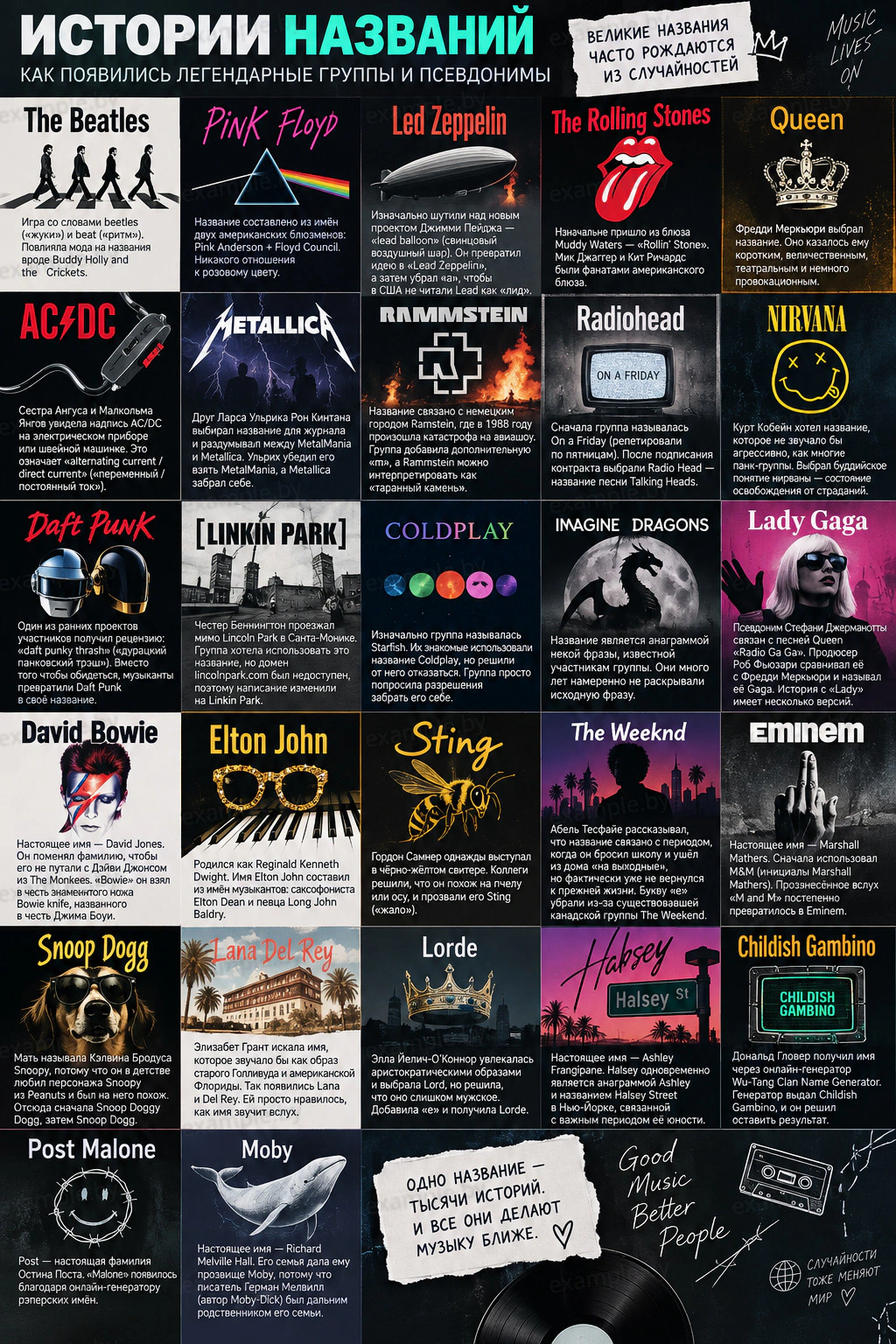
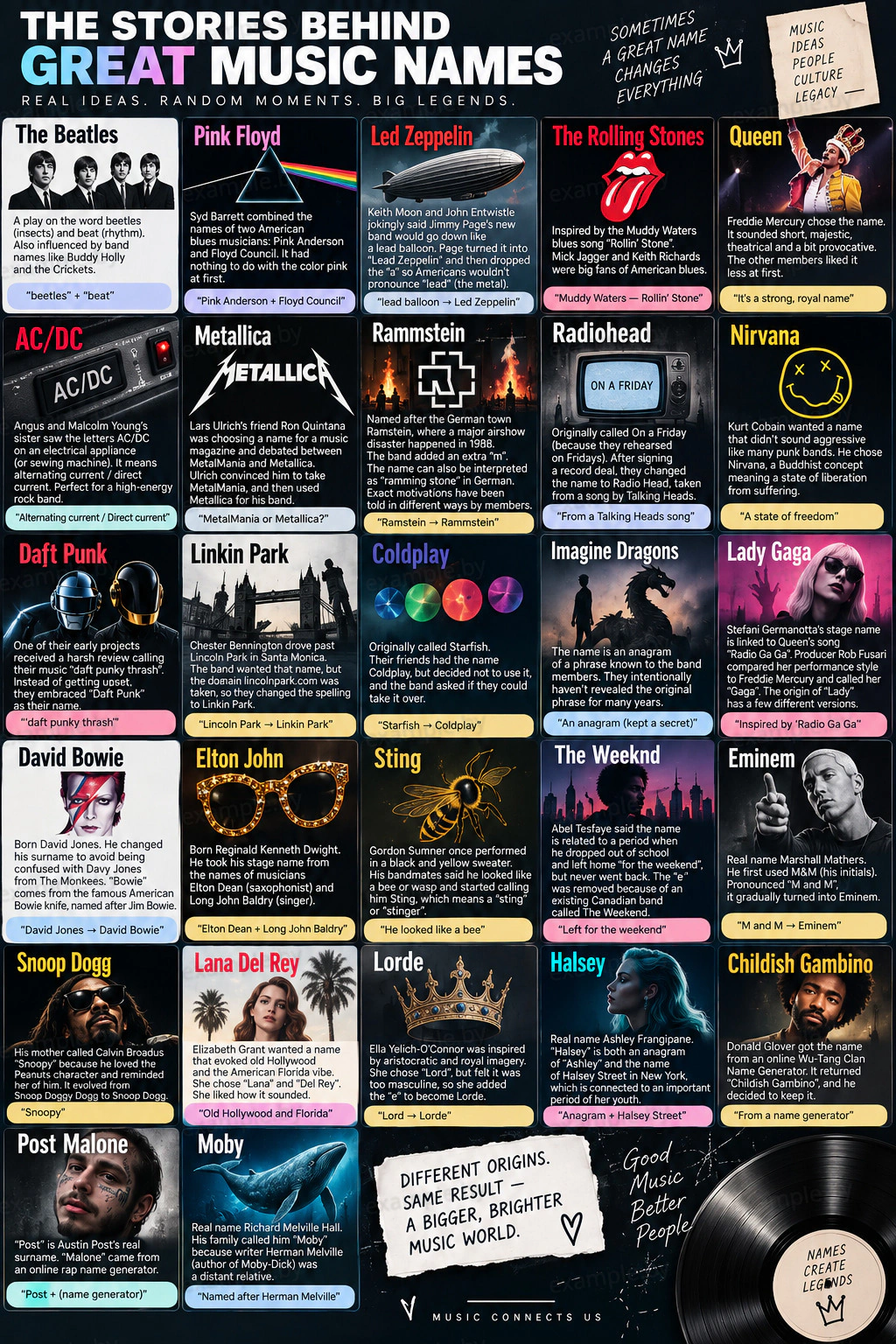
Sometimes a legend begins with a single random word
Picture a young band that nobody has heard of yet. They have no millions of listeners, no world tours, and no recognizable logo. They might not even have a name.
Yet they still have to choose one.
That is precisely when extraordinary things happen. Someone glances at a label on an appliance. Someone recalls an old bluesman. Someone reads a scathing review. Someone borrows a song title. And someone gets an answer from an online name generator.
Twenty years later, that random word is printed on millions of T-shirts.
The origins of musical names illustrate one thing very clearly: a brand often acquires its meaning long after it is conceived.
1. The Beatles: A pun that became a near-perfect brand
Before becoming The Beatles, the future band members cycled through several names. In 1960, John Lennon and Stuart Sutcliffe settled on The Beatles. The Liverpool Beatles Story traces the choice to their late-night conversations and wordplay. (The Beatles Story Museum, Liverpool)
There is a simple linguistic trick at work here:
beetles = insects beat = rhythm, pulse
In other words, the familiar English word beetles was transformed into the novel word Beatles.
The name evoked the driving rock-and-roll beat while simultaneously nodding to animal-named groups like Buddy Holly and the Crickets.
Today, the word Beatles feels entirely natural. Yet it is, in fact, an invented word.
That is precisely what made it so powerful: it is short, easy to pronounce, easy to spell, and practically impossible to confuse with anything else.
2. Pink Floyd: Two obscure bluesmen inside a global brand
This is one of the most elegant stories in rock history.
Syd Barrett was an avid fan of American blues. His record collection included the names of two musicians:
Pink Anderson and Floyd Council.
He simply joined them together:
Pink + Floyd → Pink Floyd.
The band's official history confirms that Barrett suggested the name in tribute to these two American bluesmen. (Pink Floyd Archive)
The resulting pairing proved astonishingly evocative.
Without knowing the name's origins, Pink Floyd sounds psychedelic, abstract, and almost surreal.
Yet there was never any literal "pink Floyd."
It was merely two first names.
And so, a chance juxtaposition of two blues artists turned into one of the most recognizable monikers of the twentieth century.
3. Led Zeppelin: A band destined to crash
The story of Led Zeppelin is almost the exact opposite.
Before the band formed, musicians were discussing the concept of a supergroup featuring Jimmy Page. According to widely circulated lore, Keith Moon and John Entwistle of The Who joked that such an endeavor would:
“go down like a lead balloon”
In English, the idiom denotes a catastrophic failure. (Wikipedia)
Jimmy Page loved the imagery.
Lead balloon became Lead Zeppelin: the modest balloon was replaced by a colossal airship.
Then another challenge arose.
The English word lead can be read in different ways. To prevent people from mispronouncing it as leed, the letter a was dropped:
Lead Zeppelin → Led Zeppelin.
The irony is delightful.
A name coined to signify a crushing disaster became the banner of one of the most successful rock bands in history.
4. The Rolling Stones: A casual glance at a record
British musicians in the early 1960s were captivated by American blues.
When the band needed a name, Brian Jones, according to the widely told story, caught sight of a Muddy Waters record lying on the floor. Among the tracks was:
“Rollin’ Stone”.
Thus emerged the original The Rollin’ Stones, which later evolved into The Rolling Stones. (Radio X)
It created a graceful chain of cultural transmission:
American blues ↓ Muddy Waters ↓ “Rollin’ Stone” ↓ The Rolling Stones ↓ a new British rock culture.
In this sense, the band's name stands as a small monument to the profound influence of the blues on rock music.
5. Queen: Freddie Mercury envisioned a stage
Before Queen, there was a band called Smile.
When Freddie Mercury joined, he proposed an entirely new persona and an entirely new name:
Queen.
Mercury explained that he loved how grand, universal, and visual it sounded. In his words, the name was “very regal” and possessed enormous visual potential. (Everand)
Mercury's design instincts are obvious here.
He was not just choosing a word.
He was, in effect, selecting an entire universe:
crowns, crests, theatricality, splendor, grandeur, irony.
Within a few years, all of this became an indelible part of Queen's visual language.
6. AC/DC: One of the finest discoveries on a household appliance
The name AC/DC looks as though it was engineered by a branding agency tasked with naming the most electrifying rock band on earth.
The reality is far more mundane.
Angus and Malcolm Young's sister noticed the label AC/DC on an electrical appliance—most commonly remembered as a sewing machine.
The acronym stands for:
AC, Alternating Current DC, Direct Current.
The brothers embraced the raw connotation of electricity and power. (Wikipedia)
A technical specification thus turned into an ideal metaphor for the band.
The lightning bolt between AC⚡DC only heightened the effect.
7. Metallica: The name Lars Ulrich essentially intercepted
A friend of Lars Ulrich, Ron Quintana, was brainstorming titles for a metal fanzine.
Among the candidates were:
MetalMania and Metallica.
Ulrich liked the second option so much that he encouraged Quintana to use MetalMania, reserving Metallica for his own band.
Metallica's official history confirms that the name originated from Ron Quintana's suggestion. (Metallica)
It turned out to be an almost flawless term.
Metal → Metallica.
It sounds like an elemental substance, a sovereign state, or an entire civilization built on metal.
8. Rammstein: A name cast in a dark historical shadow
The German band's name is tied to the town of Ramstein and the 1988 air show disaster that occurred there.
An early version of their name appeared as Rammstein-Flugschau, with the extra m later becoming a permanent fixture. Band members have offered slightly differing accounts of the name's origin over the years, so it is more accurate to speak of an established historical association with Ramstein rather than a single uncontested narrative. (Wikipedia)
There is another dimension as well.
In German, Rammstein feels almost like a compound noun, evoking something massive, battering, and industrial.
The spelling came to mirror the very sound of the group.
9. Radiohead: Without a record deal, they might have stayed On a Friday
Imagine albums like OK Computer or Kid A released by a band called…
On a Friday.
That was indeed Radiohead's original name, chosen simply because the musicians rehearsed on Fridays.
After signing a contract, EMI asked them to change it.
The band turned to a song by Talking Heads:
“Radio Head”
from their 1986 album True Stories.
Thus came Radiohead. (Wikipedia)
It is a compelling demonstration of how profoundly a name alters perception.
On a Friday sounds like a student outfit.
Radiohead immediately conjures ideas of technology, information, signals, and consciousness.
10. Nirvana: A deliberately gentle name for a noisy band
Before settling on Nirvana, the band tried out a string of far more conventional punk names.
Kurt Cobain explained that he wanted something beautiful and pleasant instead of a typically abrasive punk moniker.
That led to Nirvana. (Wikipedia)
The term itself originates in the Buddhist tradition, denoting liberation from suffering and the cycle of craving.
The contrast was striking:
a wall of abrasive sound + a serene, spiritual word.
It is precisely such contradictions that often make a name unforgettable.
11. Daft Punk: Turning an insult into an iconic brand
Before Daft Punk, Thomas Bangalter and Guy-Manuel de Homem-Christo played in an indie rock band called Darlin’.
The British magazine Melody Maker ran an unenthusiastic review characterizing their music as:
“daft punky thrash”
The musicians were far from offended.
In fact, they loved it.
From that slight, they lifted two words:
Daft Punk.
This account is corroborated by a retrospective in The Guardian. (The Guardian)
It offers a memorable lesson in pop culture: sometimes your sharpest critic has already coined your greatest name.
12. Linkin Park: Reshaped by the internet
The band initially performed under the name Hybrid Theory.
Chester Bennington subsequently suggested a moniker inspired by Santa Monica's Lincoln Park.
However, the early 2000s were an era when having your own website was becoming indispensable for music promotion.
The corresponding domain name with the traditional spelling was either unavailable or prohibitively expensive.
And so:
Lincoln Park → Linkin Park.
Mike Shinoda explained directly to the Los Angeles Times that the altered spelling allowed the band to secure its own web domain and made them easier to find online. (Los Angeles Times)
This is an early instance of domain availability altering a global brand's name.
Today, that is second nature for tech startups.
In the year 2000, for a rock band, it was uncharted territory.
13. Coldplay: A moniker gifted by friends
The members of Coldplay originally performed under the name Starfish.
A group of friends had been using the name Coldplay, but chose to abandon it.
The name was passed along to the other band.
Thus Starfish became Coldplay. The original inspiration is commonly traced to Philip Horky's poetry collection, Child's Reflections, Cold Play. (Coldplaying)
It presents a curious alternate timeline:
one of the biggest stadium acts of the twenty-first century could easily have been touring the world as Starfish.
14. Imagine Dragons: A secret the band still guards
Here, the story turns into an enigma.
Imagine Dragons is an anagram of an entirely different phrase.
The band rearranged the letters of their original phrase to arrive at:
IMAGINE DRAGONS.
Bassist Ben McKee noted that while the initial phrase held personal meaning for the band, the members mutually agreed never to reveal it. (Medium)
Fans have spent years trying to crack the cipher.
The secrecy itself has become an integral part of the brand.
Pseudonyms: Crafting a second self
With a band, the challenge is straightforward: find a label for the collective.
For solo artists, the dynamics are far more intriguing.
A pseudonym offers the freedom to construct an entirely new identity from scratch.
15. Lady Gaga: From Queen to modern pop stardom
Stefani Germanotta was collaborating with producer Rob Fusari.
He compared her theatrical vocal style to Queen and began associating her persona with one of their tracks:
Queen, “Radio Ga Ga”.
From that connection came Gaga.
The singer later recounted that prefixing it with Lady helped crystallize her stage identity. (PopEntertainmentblog.com)
The result is a neat lineage across pop history:
Freddie Mercury ↓ Queen ↓ “Radio Ga Ga” ↓ Lady Gaga.
16. David Bowie: Prompted by another Davy Jones
David Bowie was born David Jones.
The dilemma was plain: the music industry already had a prominent Davy Jones, fronting The Monkees.
The young musician resolved to adopt a new surname.
Bowie himself linked his new moniker to the Bowie knife, named after the American frontiersman Jim Bowie. The artist's official website confirms this origin for his professional name. (David Bowie)
What is most telling is that this initial moniker was merely the prologue to a lifelong transformation.
Bowie would repeatedly fabricate new stage personas: Ziggy Stardust, the Thin White Duke, and beyond.
Changing his name was the first step toward treating the artist as an ever-shifting persona.
17. Elton John: Assembled from musical comrades
The future Elton John was born:
Reginald Kenneth Dwight.
While performing with the group Bluesology, he decided he needed a stage name.
He drew inspiration from two fellow musicians:
Elton Dean and Long John Baldry.
Combining the two gave him:
Elton + John → Elton John.
He would later legally change his name to Elton Hercules John. (Wikipedia)
The alias serves almost as an enduring tribute to the figures who shaped his formative years.
18. Sting: It all started with a black-and-yellow sweater
Sting's birth name is:
Gordon Sumner.
In his youth, he played in a jazz outfit and showed up to a gig wearing a striped black-and-yellow sweater.
The bandleader quipped that he looked like a bee, and the nickname Sting stuck.
The label took hold so firmly that today "Gordon Sumner" sounds unfamiliar to most music fans. (Sting)
19. The Weeknd: A missing vowel courtesy of another band
Abel Tesfaye has described leaving home and dropping out of school alongside a friend at around age seventeen.
He traced the concept to that pivotal weekend after which he never returned to his former life.
However, a Canadian outfit called The Weekend already held the trademark.
To bypass the conflict, he dropped a letter:
The Weekend → The Weeknd.
Tesfaye himself has confirmed this rationale for the idiosyncratic spelling. (Sporting News)
The result is a word that looks instantly familiar yet subtly off-kilter.
In branding terms, that is an enviable combination.
20. Eminem: Spelled out phonetically
His given name:
Marshall Mathers.
His initials:
M.M.
Pronounced aloud in English:
M and M.
His earliest rap handle was indeed M&M, which subsequently shifted into a phonetic spelling:
M&M → Eminem.
Accounts of Mathers's early career confirm the use of M&M derived directly from his initials. (The Guardian)
It is a rare instance of a world-famous name emerging almost entirely out of pure phonetics.
21. Snoop Dogg: A childhood nickname that eclipsed his real name
As a boy, Calvin Broadus was fond of the character Snoopy from the Peanuts comic strip.
His mother began calling him Snoopy at home, and the moniker never left him.
Over time, it morphed into his performance aliases:
Snoopy → Snoop Doggy Dogg → Snoop Dogg.
Snoop has recounted the story in numerous interviews, and it is documented across his official biographical profiles. (Esquire)
One of hip-hop's most enduring global brands originated as an affectionate domestic nickname.
22. Lana Del Rey: The name set the mood before the music did
The singer's legal name is:
Elizabeth Grant.
Her approach stands out for its deliberate intentionality.
She was not merely looking for an attractive stage name.
She wanted a name around which she could build a sonic world.
Lana Del Rey explained to British Vogue that she visited Miami frequently, spent time with Cuban friends, and sought a name that evoked the sunlit allure of coastal glamour.
She captured her method with striking precision:
“I wanted a name I could shape the music towards.”
This is branding in its purest creative form.
First, an aesthetic is brought into focus.
Then, the music is composed to fulfill it.
23. Lorde: A single letter reimagined the persona
As an adolescent, Ella Yelich-O’Connor developed an interest in royalty and the aristocracy.
She was drawn to the word:
Lord.
Yet the title struck her as overtly masculine.
Her solution was to append a silent vowel:
Lord + e → Lorde.
The singer explained that the additional e lent the word a feminine nuance and made it visually compelling. (NZ Herald)
It was a minimal intervention.
Yet it produced an unmistakable brand.
24. Halsey: An anagram that is also a geography
Her given name:
Ashley Frangipane.
Rearrange the letters:
ASHLEY → HALSEY.
There is also a second layer.
Halsey is tied to Halsey Street in Brooklyn, a location closely bound up with her adolescence and artistic awakening.
Halsey has affirmed both origins in interviews. (Nylon)
Her pseudonym is therefore simultaneously:
an anagram of her birth name and a geographical coordinate in memory.
25. Childish Gambino: Coined by an internet generator
This is arguably one of the most delightful artifacts of twenty-first-century culture.
Donald Glover was a college student.
He and his friends were messing around with an online gimmick:
The Wu-Tang Clan Name Generator.
He typed in:
Donald Glover.
The screen returned:
Childish Gambino.
He decided to run with it.
The Los Angeles Times detailed this exact origin back in 2010. (Los Angeles Times)
An artist who would go on to win multiple Grammy Awards and build a multifaceted career found his identity through a viral web joke.
It could hardly be more emblematic of its era.
26. Post Malone: Another victory for the generator
The artist's legal name is:
Austin Post.
The first component of his stage name is straightforward:
Post.
As for Malone, he has explained that it was generated by an online rap-name tool.
He entered his surname, and out came:
Post Malone. (VICE)
It makes for an amusing pair:
Childish Gambino via generator Post Malone via generator.
Two titanic contemporary music brands that might never have existed in their current form without casual internet novelties.
27. Moby: A pseudonym assigned almost at birth
His legal name:
Richard Melville Hall.
His family claimed ancestry tracing back to Herman Melville, the author of Moby-Dick.
According to the musician, his parents felt that Richard Melville Hall sounded far too solemn for a baby.
So they gave him the childhood nickname:
Moby. (CBS News)
Decades later, that domestic pet name seamlessly suited the minimalist electronica scene.
What do all these stories have in common?
Categorizing them reveals several recurring paths through which great musical names are born.
From other music
Pink Floyd ← Pink Anderson + Floyd Council The Rolling Stones ← Muddy Waters Radiohead ← Talking Heads Lady Gaga ← Queen
Music literally begets new music.
From sheer accident
AC/DC ← a label on an appliance Led Zeppelin ← an offhand joke Daft Punk ← a dismissive review Metallica ← an unused suggestion for a zine
No focus groups or months of market research were involved.
From practical necessity
David Bowie ← Davy Jones was already taken Linkin Park ← web domain constraints The Weeknd ← a preexisting band called The Weekend
External limitations force a sharper, more distinct identity.
From personal history
Eminem ← Marshall Mathers Halsey ← Ashley Snoop Dogg ← a childhood handle Sting ← a friend's tease Moby ← a family nickname
Here, the pseudonym does not conceal the person; it distills an element of their story.
From an engineered persona
Queen Lana Del Rey Lorde Lady Gaga
In these cases, the name acts as a foundational piece of art.
The artist writes not only songs,
but an entire character.
The most revealing takeaway
We routinely view legendary names through the lens of hindsight.
From today's vantage point, it feels self-evident that:
Queen had to be named Queen.
That Pink Floyd sounds unmistakably like Pink Floyd.
That the name Metallica was destined for Metallica.
Yet that is an illusion.
Had a few casual conversations steered in another direction, we might well be streaming:
Starfish instead of Coldplay,
On a Friday instead of Radiohead,
or an entirely different moniker in place of Led Zeppelin.
The meaning came later.
At the start, there was only a word.
Then arrived the music, the album art, the concerts, the lore, the fans, and decades of cultural memory.
Gradually, the word transformed into an icon.
Perhaps that is why the most enduring names are rarely devised as "masterpieces of branding."
Sometimes, they simply happen to be there at the right moment.
Music does the rest. :::
Liked it? Save it for later.
 Culture · 27.10.26
Why One Family Can Have Different Surnames
 Culture · 18.10.26
How PR Works: Mechanisms, Limits and Trust
 Society · 18.10.26
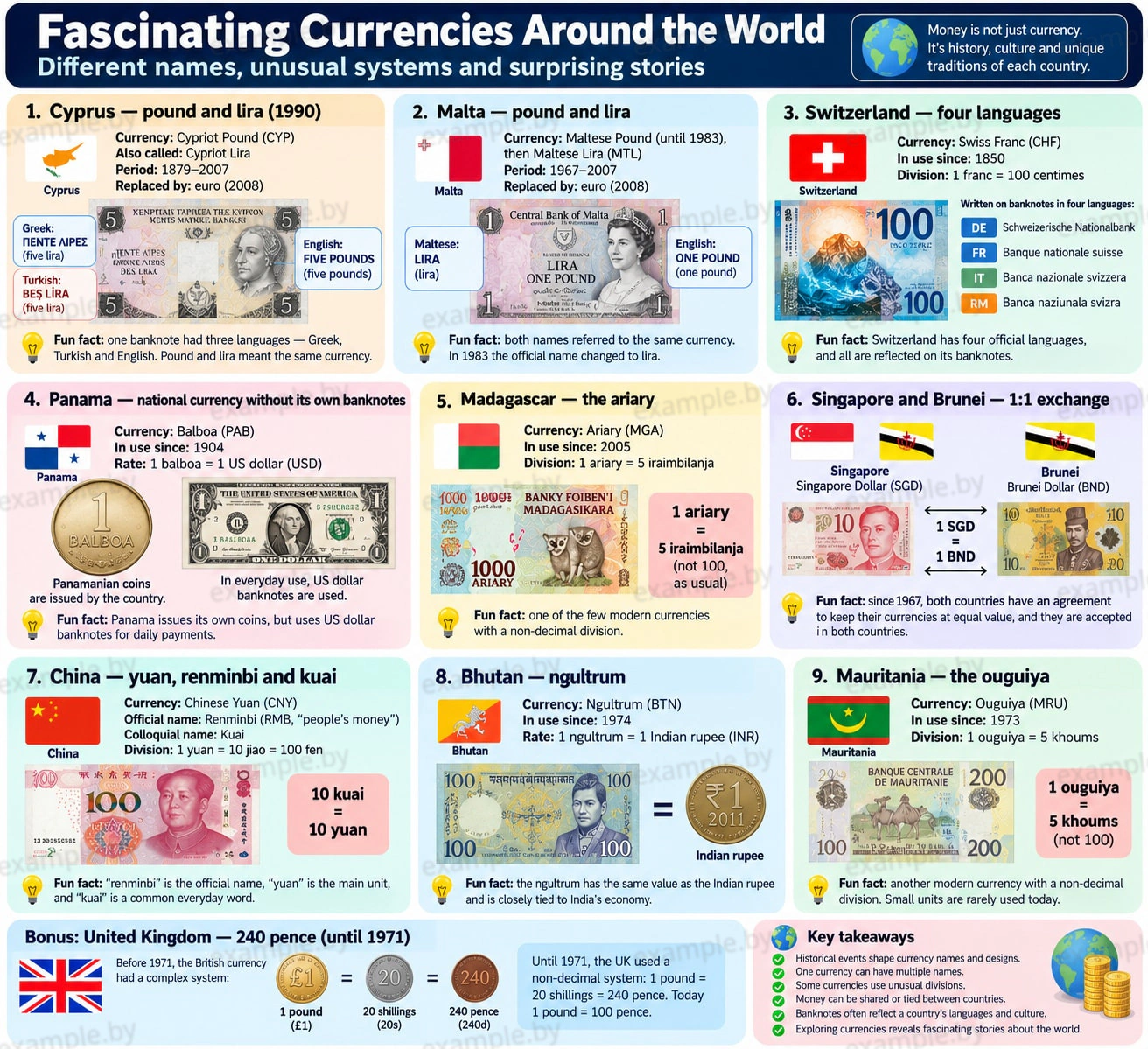
Cypriot Pound or Lira: A Currency with Two Names
 Medicine · 05.10.26
How Helicobacter pylori Survives Stomach Acid
 Medicine · 03.10.26
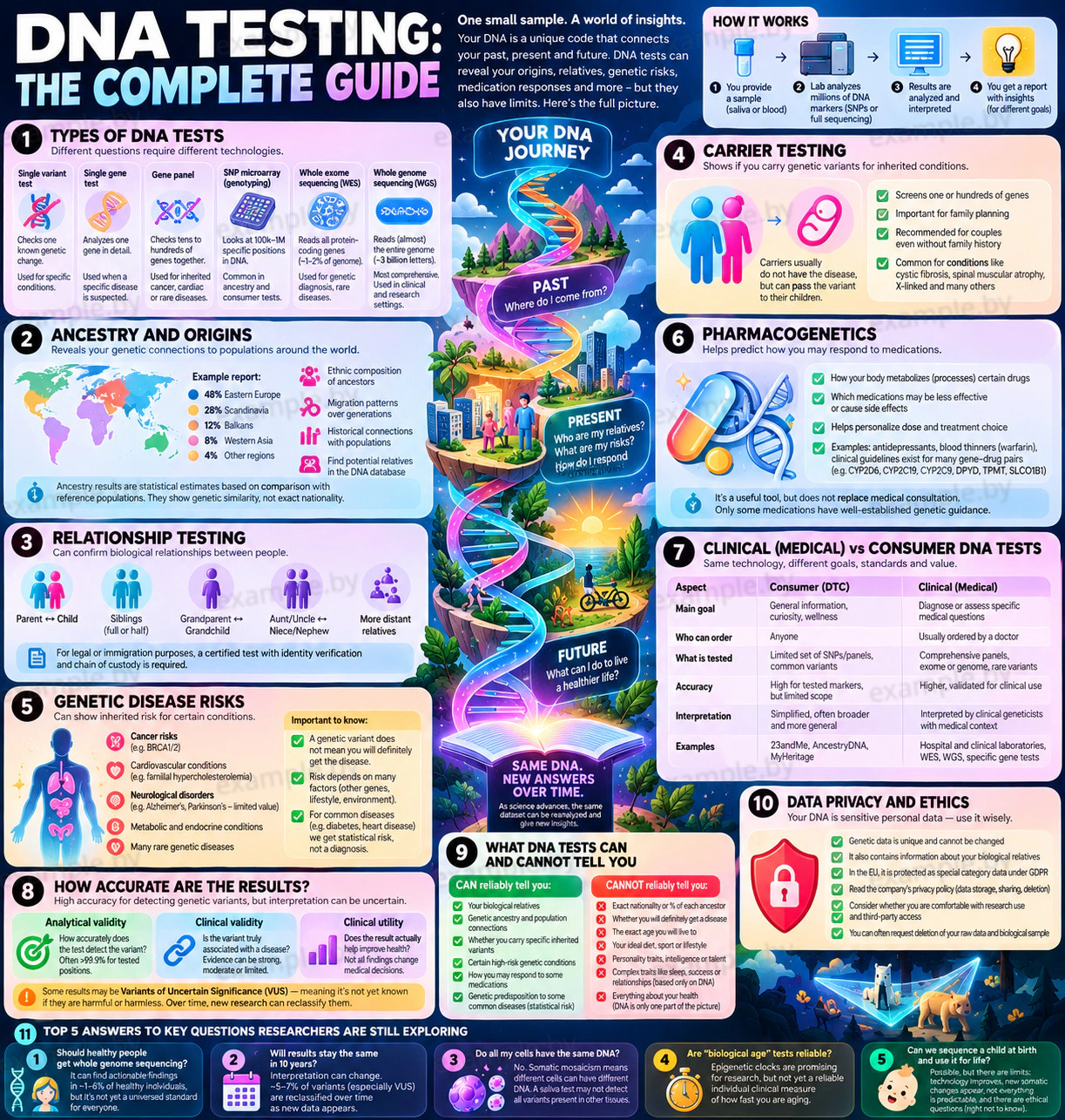
What DNA Tests Can Actually Reveal
 Biology · 19.10.26
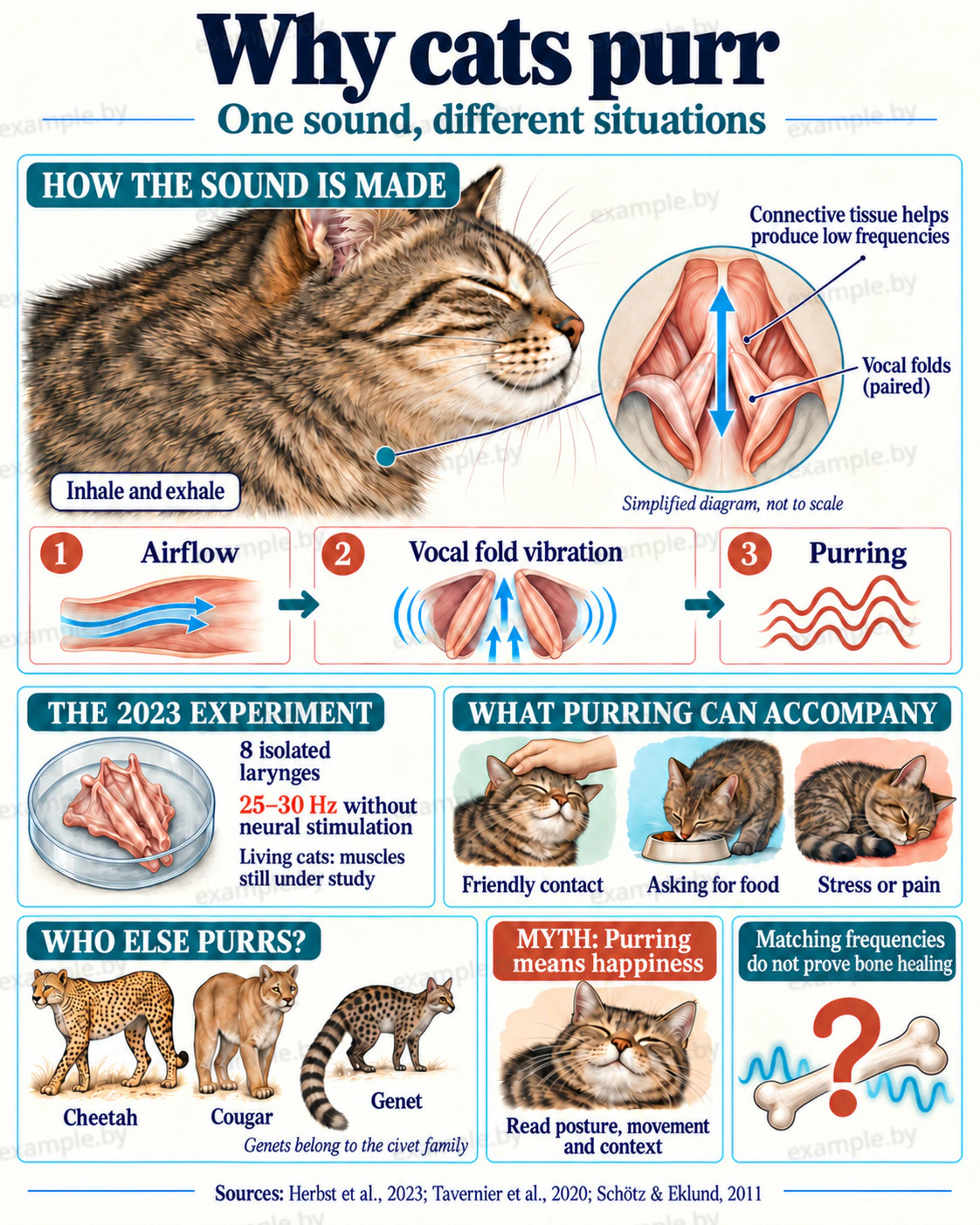
Why Cats Purr and What the Sound Really Means
 Body · 18.10.26
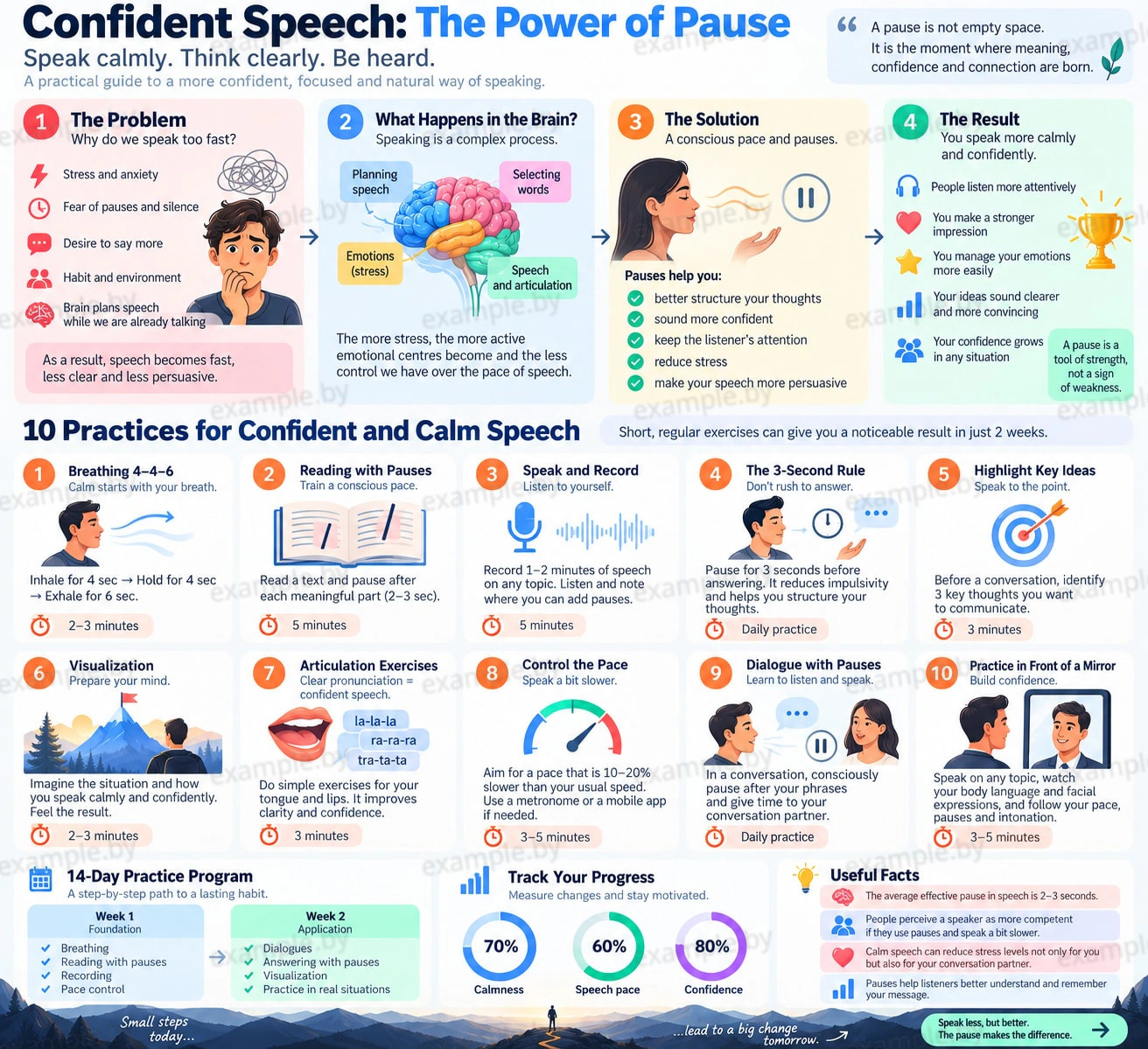
The Art of the Pause: How to Speak Calmly and Confidently
More Than a Cap: The Hidden Network Beneath Your Feet
Biology · 17.10.26
More Than a Cap: The Hidden Network Beneath Your Feet
 Technology · 16.10.26
The Life Cycle of a Star: From Nebula to Black Hole
 Body · 15.10.26
Who Pays for Heat: Why a Lizard Can Be Hotter Than a Bird
 Technology · 15.10.26
How Vector Search Works: Chroma, pgvector and Qdrant
 Technology · 13.10.26
How Smart Scales Track Muscle and Water