Why Cats Purr and What the Sound Really Means
How the acoustics of a cat's purr work, why the sound doesn't always mean happiness, and whether humans can communicate with a cat in a shared language.
- Section
- Biology
- Date
- Reading
- 21 minutes
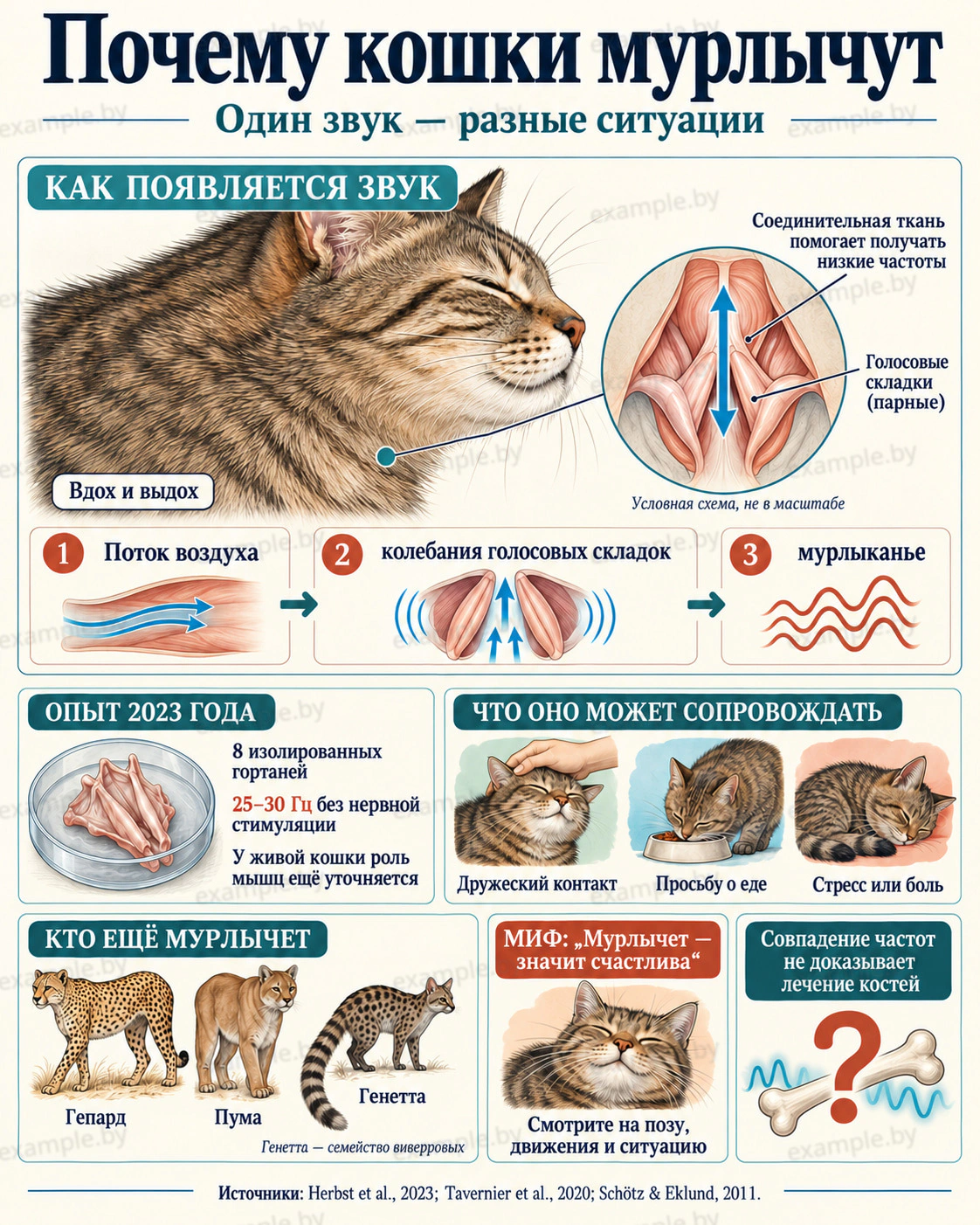
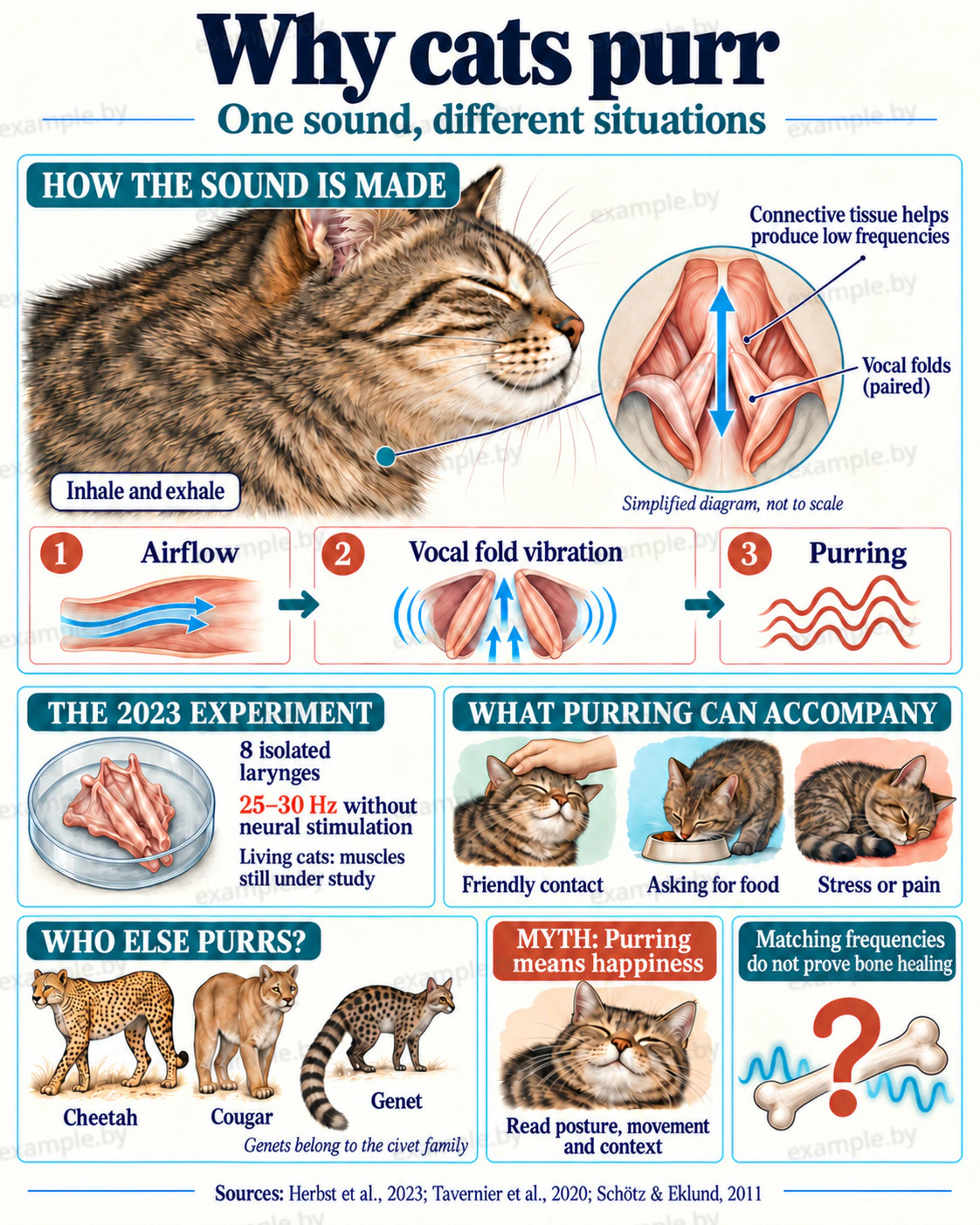
A cat lies beside you, and a familiar, steady rumble comes from her. It seems to be one of the simplest signals in nature: the animal feels good. But this explanation has two problems. Purring also occurs in unpleasant circumstances. And the physical mechanism of a sound people have heard for millennia is still being refined.
In 2023, researchers ran an experiment on eight isolated cat larynges. All of them were able to produce low-frequency vibrations without nerve stimulation. The result was an unexpected twist: part of the work that had been attributed to rapid muscle contractions can be done by the mechanics of the vocal folds themselves. The study by Herbst et al.
Another notable fact: in a 2025 study, an algorithm distinguished individual cats from 557 purr recordings more accurately than from 276 meows. Classification accuracy was 84.6% for purring and 63.2% for meowing. This does not mean the computer understood a cat's mood: it found stable individual acoustic features in a particular set of recordings. Russo et al., 2025.
The main answer has two parts. Purring arises from the interaction of airflow and laryngeal tissues; features of the vocal folds help produce an unusually low sound. Its meaning depends on the situation: it can be friendly contact or a request, and sometimes it accompanies stress or pain. So hearing a purr and understanding a cat's state are different tasks.
Two rhythms that are easy to confuse
Purring has fast pulsations and a slower breathing pattern. An inhalation gives way to an exhalation, and within each phase there are many sound vibrations. Hertz counts vibrations per second, not breaths.
A 2011 study by Susanne Schötz and Robert Eklund examined four domestic cats. The mean fundamental frequency in individual breathing phases was about 21–27 Hz. The cats differed from one another, and the ratio of frequencies on inhalation and exhalation was not the same in all of them. These are data from a small sample, not a rigid norm for any pet. Full text of the study.
The fundamental frequency is the repetition rate of the sound cycle. Besides it, a complex sound contains higher components. So the popular phrase “a cat purrs at such-and-such a frequency” can refer to different measurements. Comparing numbers makes sense only after finding out exactly what the author measured.
Another methodological trap concerns loudness. In the same study the authors declined to compare it between cats: the position of the microphone influenced the result too strongly. A phone recording is useful as an observation, but a decibel figure in an app, without calibration, is not a medical indicator.
What the larynx experiment changed
The traditional hypothesis held that nerve impulses set off rapid contractions of the laryngeal muscles, modulating the airflow. The 2023 study tested an important prediction of this model: is the necessary vibration regime possible without a working neuromuscular system?
Air was passed through the prepared larynges with the vocal folds brought together. Self-sustaining vibrations appeared, including at 25–30 Hz. In the folds the researchers found patches of connective tissue which, as the authors explain, help produce low frequencies. Herbst et al., 2023.
A musical instrument offers a useful analogy here: a constant flow of energy can sustain periodic motion without a separate external push for each cycle. The analogy explains the principle but does not replace anatomy.
The authors state explicitly that the result does not rule out the involvement of active muscle contractions in a living cat. Still less does it mean that the brain plays no part in initiating the behavior or controlling breathing. Showing a physical possibility is not the same as establishing the whole mechanism under natural conditions.
What a quiet conversation is for
A review of feline vocal communication describes purring as a signal of close contact. It appears early in life and occurs in interactions between a mother and her kittens and during friendly exchanges. The mouth is usually closed, and the sound is produced on both inhalation and exhalation. Tavernier et al., 2020.
But one type of sound can serve several purposes. The review also considers hunger, stress and pain. Explanations such as “I am not a threat” or “I am soothing myself” help generate hypotheses, but they do not give a word-for-word translation of every episode.
The difference is fundamental. The observation “a cat purrs in a stressful situation” can be recorded. The claim “she does it specifically to calm herself” requires additional testing. The same outward behavior sometimes arises for different reasons.
So there is no need to replace the old absolute formula “purring means contentment” with a new one: “purring means anxiety.” Both lose the context. To understand a cat, the circumstances, posture, movements and changes in usual behavior matter.
A purr that is hard to ignore
There is also a documented example of how the message changes within a familiar sound. In a 2009 study by Karen McComb and colleagues, researchers examined the purring that accompanies a request for food. Against the low-frequency background there was a higher-pitched component resembling a cry.
The research group at the University of Sussex reports that it was this component that heightened listeners' sense of urgency. A possible explanation is human sensitivity to sounds resembling an infant's cry. The researchers' own description of the results; bibliographic record of the original paper.
This is more interesting than the caricature of the “manipulative cat.” The experiment shows the effect of an acoustic feature on human perception. It does not prove that a cat consciously imitates a baby, understands human psychology, or plans our reaction in advance.
Imagine two equally quiet signals, one of which sounds more insistent. For the listener the priority changes, although loudness explains almost nothing. This is a thought experiment illustrating the difference between the strength of a sound and its structure, not a description of a particular study.
A sound carries both “who” and “what is going on”
In December 2025, a paper was published on how well cats can be told apart by voice. According to the Berlin Museum für Naturkunde, the researchers used automatic sound-recognition methods and tested how reliably a recording could be attributed to a particular animal. In their data, purring turned out to be more informative for identifying the individual than meowing. Statement from an institution that took part in the study; publication by Russo et al.
This adds another layer: a sound can carry individual features even if its general type is familiar to everyone. But successful computer classification does not prove that cats themselves use exactly these features, and it does not mean recognition of pain or pleasure.
For future research this raises separate questions: does distinguishability persist in a different room, with a different microphone, months later? Otherwise the algorithm risks memorizing the recording conditions along with the animal. These are methodological questions about applying the result, not a claim that the study contains an error.
Can you talk to a cat, and do you need a special language?
Yes, communication is possible, but not as a conversation through an interpreter with a “meow = phrase” dictionary. The most reliable shared code develops within a specific pair: a familiar voice, a repeated situation, posture and consequences. In experiments with 16 domestic cats, the animals distinguished their owner's speech directed at them from the same speech addressed to another adult; with a stranger's voice no such difference was found. This reflects experience of communicating with a particular person, not knowledge of the grammar of human speech. de Mouzon, Gonthier and Leboucher, 2023, abstract.
Cats have another useful channel as well. In a 2019 experiment they distinguished their own name from other words on average, although the typical reaction was not to answer vocally but to turn the ears or head. Saito et al., 2019. So the sensible approach is not to meow back but to link a short word, intonation, gesture and action consistently (call the cat, pause, show a familiar signal, reward the right choice). This is teaching associations, not teaching a cat human language.
Myth: humans need to imitate meowing or purring. There is no convincing evidence that a human “meow” becomes an intelligible phrase for a cat. What experiments do show is that cats approach an unfamiliar person more readily when that person uses a visual or mixed (visual-vocal) invitation than when they use voice alone. Vitale et al., 2023. A calm, familiar voice, predictable rituals and the cat's right not to engage are far more useful.
Myth: a slow blink is a universal declaration of love. Slow eye narrowing does look like a positive social signal: in two experiments cats narrowed their eyes back more often, and after such an interaction they approached an unfamiliar person more willingly. But the samples were small, and slow blinking also occurs in other states. It is an invitation to calm contact, not a password that obliges the cat to reciprocate. Humphrey et al., 2020.
The practical approach is therefore simple: look at the whole scene, not at a single sound; repeat the same friendly signal before a familiar action; stop trying if the cat turns away, leaves or is tense. In a study in which people tried to identify the context of individual meows, fewer than half of the participants gave the correct answer. Prato-Previde et al., 2020. Uncertainty here is a normal part of good understanding.
Who else can purr
The domestic cat does not have a monopoly. A 1991 study recorded purring in domestic cats, pumas and cheetahs. This list alone breaks down the everyday boundary between “small purring cats” and “big roaring ones.” The puma and the cheetah are noticeably larger than a domestic cat. Frazer Sissom, Rice and Peters, 1991, abstract of the study.
There are also animals outside the cat family. In the comparative literature, purring is described in genets, which belong to the family Viverridae. They are mentioned, among others, in the acoustic study by Schötz and Eklund. The 2011 study.
However, the word itself is unreliable. Various low, rumbling sounds are called “purring.” In his review, Gustav Peters proposed distinguishing similarity to the ear from shared evolutionary origin. Under the strict approach he adopted, true purring is established in felids and viverrids; similar signals in other mammals may have arisen independently. Peters, 2002, abstract of the review.
This is not a ban on colloquial names. The scientific question is simply more precise: do the breathing pattern, the sound-production mechanism and the origin of the signal all match? Similarity in one feature does not guarantee a match in the others.
Why one small bone is not enough
The popular explanation of the difference between roaring and purring is often reduced to the hyoid apparatus, the set of elements that supports the tongue and is connected to the larynx. Supposedly, all you need to do is see how far it has ossified, and the answer is ready.
A 2023 comparative study paints a more complex picture. Differences between groups were not found equally in all the elements studied; the authors stress the need for further study of the links between bones, soft tissues and vocal capabilities. Deutsch et al., 2023.
An evolutionary caveat matters too: an anatomical feature may occur in related species together with a particular voice, but the mere co-occurrence does not establish a causal mechanism.
One has to be especially careful when reasoning about extinct cats. Bone is preserved better than vocal folds. So reconstructing a sound from a skeleton is a testable hypothesis with limitations, not a chance to “listen” to an animal from the past.
Does purring heal bones?
One of the foundations of this popular idea is a paper by Elizabeth von Muggenthaler, presented in 2001. The report describes recordings of 44 felids and a comparison of sound frequencies with frequencies discussed in studies of therapeutic effects. The author proposed a hypothesis of a possible restorative function. Reproduction of the author's material and conference abstract.
But recording a sound and comparing frequencies is not a trial of treating fractures with purring. From the experiment described, one cannot conclude that a cat speeds the healing of a human bone.
Such a conclusion would require testing the mechanical effect on the relevant tissue, its strength and duration, and then comparing recovery with a suitable control group. An identical frequency does not guarantee an identical dose or result: a light touch and a hard blow can also be repeated at the same rate.
This is a methodological conclusion, not proof that no useful effect is possible. The hypothesis can be investigated; a promise of treatment requires a different level of evidence.
The domestic cat is not just a small wild one
The domestic cat and the African wildcat share a relatively recent common ancestor, yet their meows cannot be considered the same voice in a different setting. In an acoustic comparison, the domestic cats in the sample meowed for a shorter time on average, with a higher fundamental frequency and higher formants, the resonant frequencies of the vocal tract that change the “timbre.” Nicastro, 2004, abstract and bibliography on PubMed.
This is an interesting clue to the history of domestication: a domestic cat lives in a world with an especially large amount of communication with humans, doors, bowls and short rituals of attention. But the study does not prove that humans selected every feature of the sound: specific groups of animals were compared, and voice also depends on age, situation and the individual. The reliable conclusion is more modest: domestic and wild meows already differ measurably.
Female and male cats: can you hear the difference?
Sometimes, statistically, but not as a rule for the owner's ear. In a 2023 study, researchers recorded 11 unsocialized domestic cats during the breeding season: in males the maximum fundamental frequency of the meow was lower, on average 0.37 kHz, versus 0.61 kHz in females. A model built on the recordings distinguished sex better than random guessing. Sedova et al., 2023, abstract of the study.
Another study of meows directed at humans also reported that in its data the mean fundamental frequency was higher in females, and higher in young animals than in old ones. Schötz, van de Weijer and Eklund, 2024, abstract. This is not a “sex detector”: the first sample is small and relates to the breeding context, while in everyday life the sound is shaped at once by body size, age, arousal, habit and the addressee. First we hear a particular cat, not her sex.
Breed sets expectations, not a vocal passport
Breeds have almost no reliable shared acoustic norms: you cannot confidently identify a Maine Coon, a Bengal or a mixed-breed cat from the pitch of its meow. Even breed descriptions speak of behavioral tendencies, not frequency ranges. For example, TICA and CFA describe Siamese cats as especially vocal, and TICA's description of Persians mentions a quiet, musical voice. TICA: Siamese; CFA: Siamese; TICA: Persian.
It is therefore more useful to build a small personal dictionary: what the cat usually says before feeding, at the door, during play and when touched. Such an observation diary is more useful than trying to guess the breed or the state from a single sound.
If your cat has started meowing too much
The aim is not to “train out the meow” at any cost. First compare it with her usual voice. Sudden, nighttime or very insistent vocalization, especially together with changes in appetite, weight, litter box habits, mobility, grooming or reaction to touch, is a reason to contact a veterinarian. For older cats, AAHA separately lists pain, loss of hearing or vision, cognitive changes, hyperthyroidism and hypertension among the possible causes of nighttime vocalization. AAHA, guidelines for senior cats. If there is sudden crying against a background of obvious pain, labored breathing or urination problems, do not wait for behavioral correction.
Once a veterinarian has ruled out a medical cause and it is clear that the cat is demanding food, play or a door opened, consistency works better than scolding:
- Find the trigger. For several days, write down the time, the place, and what happened before and after the sound. This separates “give me breakfast” from anxiety or boredom.
- Provide what she needs in advance. Regular feedings, active play before the usual evening peak, and chances to climb, explore and get food out of a puzzle toy reduce the number of reasons to demand these things by voice. VCA: vocalization and environmental enrichment.
- Don't accidentally reinforce demanding meows. If every cry immediately brings food, play or an open door, the cat learns that it is an effective button. Wait for a brief pause and give attention or a reward for quiet; be consistent. At first the sound may temporarily get louder, a known effect when previous reinforcement disappears. VCA: why behavior may intensify at first.
- Don't punish. Shouting, spray bottles and physical force can add fear and don't explain to the cat what to do instead. It is better to reward quiet contact and remove the cause of tension. VCA: managing cat behavior.
This is a plan for persistent attention-seeking in a healthy animal. It does not replace an examination and is not meant for ignoring a new, worrying cry.
How to listen to your cat more attentively
The practical task is to notice changes, not to work out a mood from the rumble. In AAHA's guidelines on chronic pain in cats, the owner's observations take a central place: they assess the animal's ability to perform its usual activities. AAHA, chronic pain assessment.
You can keep short notes: when the sound appeared, what preceded it, whether jumping, play or movement has changed. If behavior is unusual, a video recording will help you describe the situation to a veterinarian more precisely. The benchmark is the cat's own usual activity. AAHA, signs of pain and the role of home observations.
During interaction, watch for signals to end contact. The Cornell Feline Health Center notes that before aggression during petting, tail movements and ears turned back may appear; at warning signs, contact should be stopped. Do not hold the animal in order to keep the “pleasant” purring going. Cornell, aggression during petting.
It is useful to treat purring as part of observation. It does not cancel out other signs of discomfort and by itself does not establish a diagnosis.
When a meow really changes the outcome: a story without mysticism
There are real stories that do not turn cats into medical instruments. On the finalists' page of the National Cat Awards, the charity Cats Protection gives the account of the owner of a cat named Void: before her seizures or heart episodes he puts a paw on her and meows quietly; this gives her time to lie down and avoid falling. Cats Protection: Void's story. This is an owner's testimony and an award profile, not a clinical trial: it does not prove that the cat recognizes a specific disease or that any pet could do the same.
But the story illustrates a more modest and plausible mechanism. An animal living nearby can notice an unfamiliar smell, movement, sound, routine or state of the person and behave unusually; the person notices this change. The value here lies not in a “sixth sense” but in the fact that a pet's suddenly unusual behavior is sometimes worth checking without panic, just like a cat's own suddenly unusual meowing.
What remains open
We need to connect the capabilities of an isolated larynx to the control of a living voice more precisely; to clarify the functions of the sound in different circumstances; and to extend research beyond small samples and familiar home settings.
The familiar rumble turns out to be a meeting place of physics, behavior and evolution. We already understand enough to give up the idea of a universal translation. When a cat purrs beside you, the best next step is to see what else she is telling you through her behavior.
Sources and limits of verification
- Herbst et al., 2023, full open text of the eight-larynx experiment; the mechanism and its limitations.
- Schötz and Eklund, 2011, full text of the acoustic comparison of four cats; breathing phases and individual differences.
- Tavernier et al., 2020, open-access review of vocal communication and the contexts of purring.
- McComb et al., 2009 and the Sussex group page; the bibliographic record and the authors' account of the results were checked; the full original text was not read.
- Russo et al., 2025 and the museum's statement, individual features of the sound and differences between the meows of domestic and wild cats; the available abstract, indexed content and the institution's statement were used.
- Frazer Sissom et al., 1991 and Peters, 2002, abstracts read; other felids and the boundaries of the term.
- Deutsch et al., 2023, full author PDF of the comparative anatomy of the hyoid bones.
- Von Muggenthaler's material, a reproduction of the author's text and abstract posted by a third-party site; the source of the healing hypothesis, not confirmation of healing.
- AAHA, 2022 guidelines and a 2026 resource, assessing pain from behavior and home observations.
- Cornell Feline Health Center, limits of contact and signs of aggression during petting.
- Nicastro, 2004, comparison of the meows of domestic and African wild cats; abstract read.
- Sedova et al., 2023, 11 unsocialized domestic cats in the breeding season; sex and individual acoustic features. The full text was not available; the abstract was used.
- Schötz, van de Weijer and Eklund, 2024, context, age and sex in meows directed at humans; the abstract was used.
- TICA and CFA: breed descriptions of the Siamese and Persian, behavioral descriptions of voices; these are not acoustic norms for a breed.
- AAHA: senior cats and VCA: vocalization, medical causes of voice changes and behavioral principles; not to be used for home diagnosis.
- de Mouzon, Gonthier and Leboucher, 2023, 16 domestic cats and their discrimination of the owner's speech directed at a cat or an adult; abstract read.
- Saito et al., 2019, discrimination of the cat's own name from other words; the abstract and indexed content were used.
- Humphrey et al., 2020, experiments on slow blinking and approaching a person; the abstract and indexed content were used.
- Vitale et al., 2023, pilot study of visual, vocal and mixed signals from an unfamiliar person; the abstract and indexed content were used.
- Prato-Previde et al., 2020, limited accuracy of humans in recognizing the context of individual meows; the abstract and indexed content were used.
- Cats Protection: Void, an owner's account in an award profile, not proof of medical recognition.
Liked it? Save it for later.
 Medicine · 05.10.26
How Helicobacter pylori Survives Stomach Acid
 Medicine · 03.10.26
What DNA Tests Can Actually Reveal
 Culture · 27.10.26
Why One Family Can Have Different Surnames
 Culture · 18.10.26
How PR Works: Mechanisms, Limits and Trust
 Society · 18.10.26
Cypriot Pound or Lira: A Currency with Two Names
 Body · 18.10.26
The Art of the Pause: How to Speak Calmly and Confidently
 Technology · 16.10.26
The Life Cycle of a Star: From Nebula to Black Hole
 Body · 15.10.26
Who Pays for Heat: Why a Lizard Can Be Hotter Than a Bird
 Technology · 15.10.26
How Vector Search Works: Chroma, pgvector and Qdrant
 Culture · 13.10.26
How Iconic Bands and Artists Got Their Names
 Technology · 13.10.26
How Smart Scales Track Muscle and Water