The Life Cycle of a Star: From Nebula to Black Hole
How initial mass determines a star's fate, why giants burn out within millions of years, and what will be left of our Sun.
- Section
- Technology
- Date
- Reading
- 5 minutes
- Source
- NASA — Stars
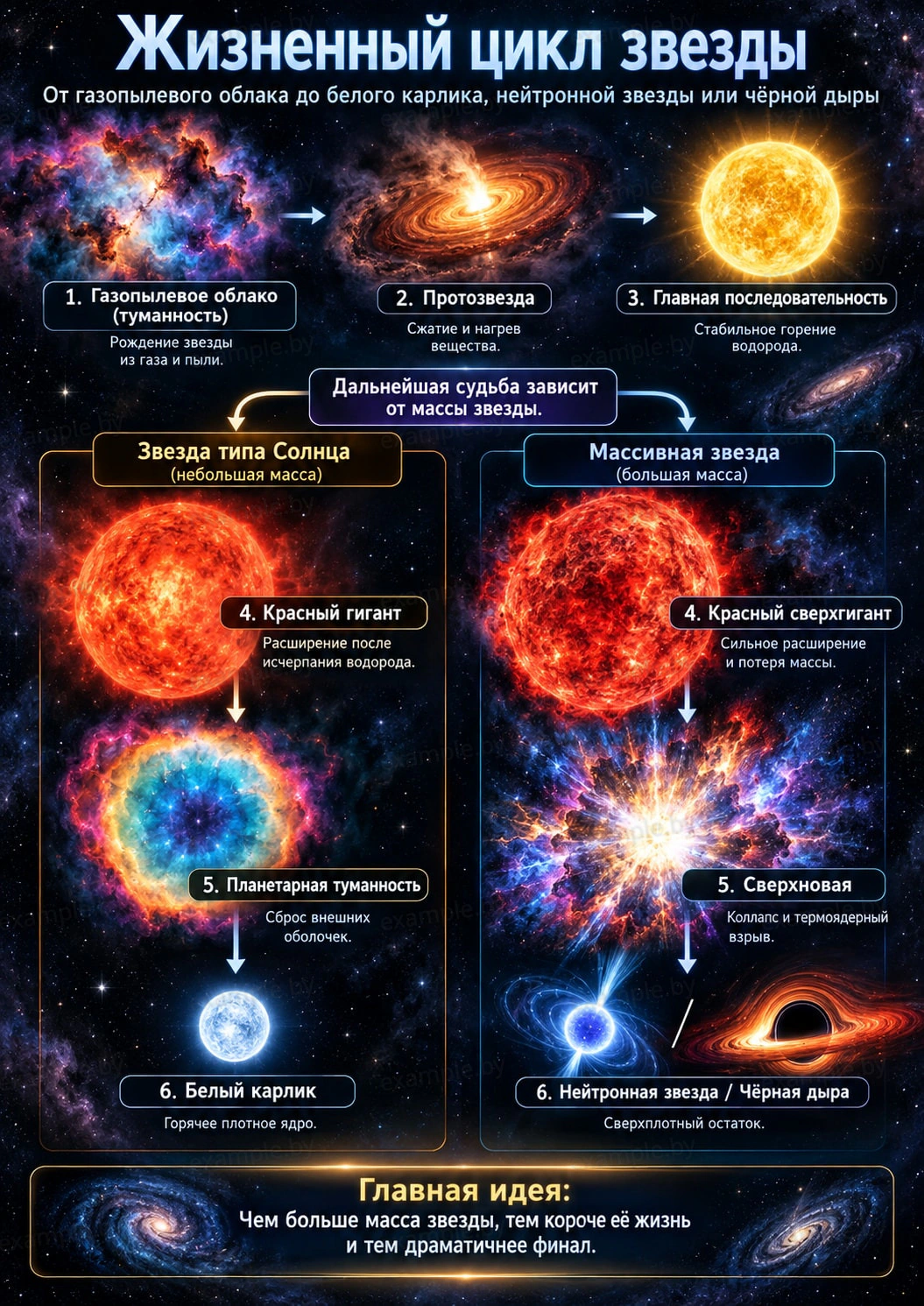
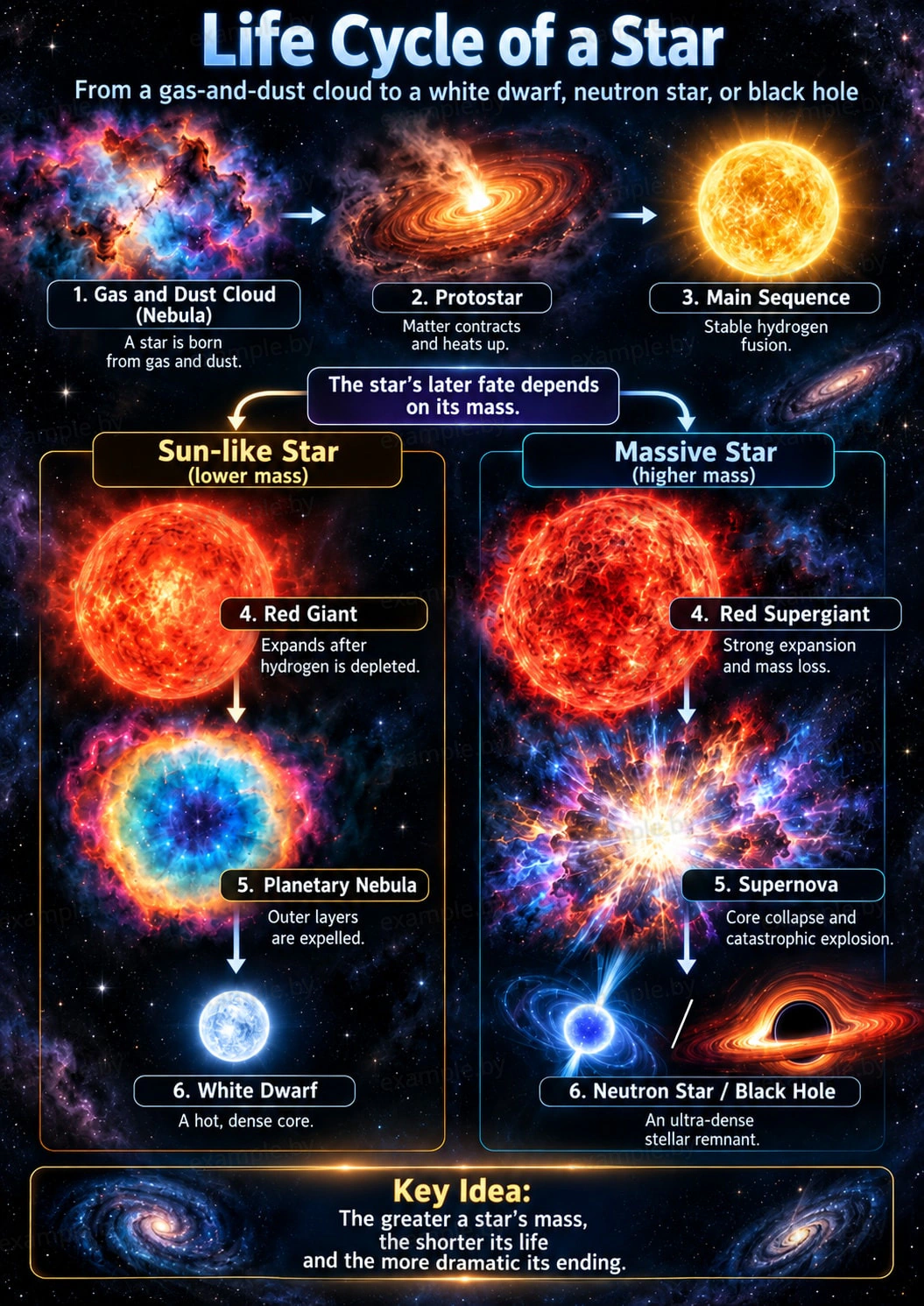
A star is born under the pull of gravity, spends most of its life converting hydrogen into helium, and then changes gradually as its nuclear fuel runs out.
The main sequence is not a separate type of star but the longest and most stable stage of a star's life. This is where our Sun is now.
Most intriguingly, a star's fate is determined above all by its initial mass. A Sun-like star can live for billions of years, while a very massive star goes through its main stages in just millions.
Below is an interactive simulation. You can switch between star types and explore the key stages of stellar evolution.
Three physical laws of stellar evolution
Gravity compresses the star. The greater the mass, the stronger its self-gravity, and the higher the temperature and pressure inside.
Nuclear fusion maintains equilibrium. On the main sequence, hydrogen is converted into helium. Part of the mass is turned into energy according to the formula . The pressure of the hot plasma counteracts gravitational collapse.
Nuclear fuel is finite. When the hydrogen in the core runs out, the star's structure is reorganised. The outcome depends on the initial mass, the loss of material and the chemical composition.
Why massive stars live shorter lives
A massive star contains more fuel, but its luminosity and the rate at which it consumes hydrogen rise so steeply that it gets through this stage far more quickly.
Red dwarfs, the lightest stars, are the opposite: they use up their fuel so sparingly that they live for trillions of years. That is far longer than the age of the universe (about 13.8 billion years), so no red dwarf has yet had time to die of old age.
Three fates of one star
The first stages are the same for all stars: a cloud of gas and dust contracts, nuclear fusion ignites, and the star arrives on the main sequence. After that, the paths diverge.
flowchart TD
  A["Cloud of gas and dust"] --> B["Protostar"]
  B --> C["Main sequence"]
  C --> D["Low mass, like the Sun"]
  C --> H["High mass"]
  D --> E["Red giant"]
  E --> F["Planetary nebula"]
  F --> G["White dwarf"]
  H --> I["Supergiant"]
  I --> J["Supernova"]
  J --> K["Neutron star"]
  J --> L["Black hole"]
The boundaries are approximate: stars heavier than about 8 solar masses end as supernovae, and a black hole is usually left behind only by the most massive ones, from 20 solar masses upward [check: exact mass thresholds for a neutron star and a black hole; they depend on chemical composition and mass loss].
What will happen to the Sun
The Sun is now about 4.6 billion years old, and it has roughly as much quiet life still ahead of it. The temperature in its core is about 15 million degrees, and every second about 600 million tonnes of hydrogen are converted into helium there. About 4 million tonnes of mass are radiated away in the process.
When the hydrogen in the core runs out, the Sun will swell into a red giant: its radius will grow tens of times, and its envelope will engulf the nearest planets. The fate of Earth in this picture is debated: some models say it will be swallowed, others that it will survive but be scorched.
The Sun will then shed its outer layers. This glowing shell of gas is called a planetary nebula, although it has nothing to do with planets (the name is historical). At the centre will remain a white dwarf: a core about the size of Earth but with a mass of roughly half that of the Sun. A teaspoon of its material would weigh about a tonne. From then on it simply cools for billions of years.
[[ill-1]]
How a massive star dies
A massive star is hot enough to "burn" carbon, neon, oxygen and silicon after hydrogen and helium. A layered, onion-like structure forms inside: the deeper the layer, the heavier the element and the faster the fusion. The final stage, silicon burning, takes about a day.
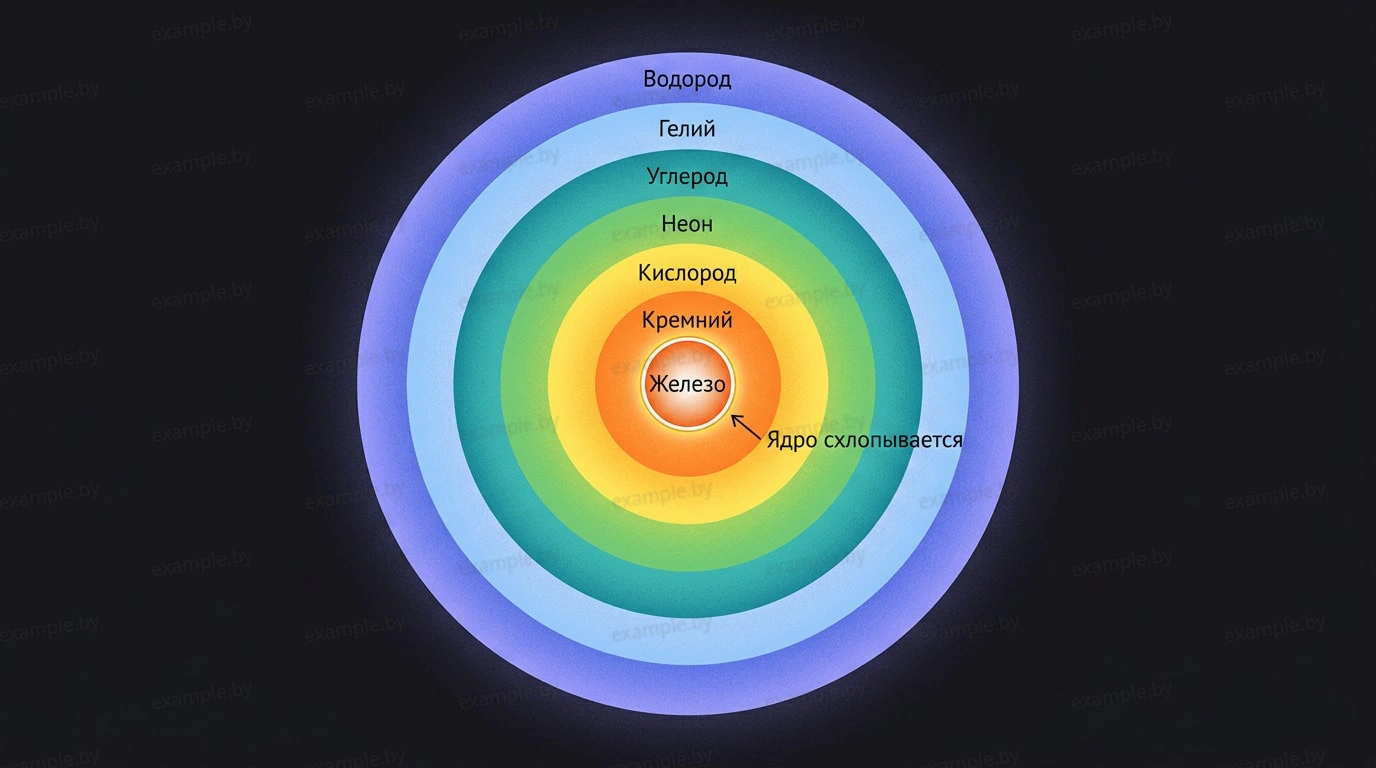
The end comes with iron. Fusing iron does not release energy but absorbs it, so there is nothing left to sustain the pressure in the core. The core collapses in a fraction of a second, matter rebounds off it, and the star explodes as a supernova. For a short time, such an outburst can rival an entire galaxy in brightness.
What remains depends on the mass of the core. A white dwarf cannot weigh more than about 1.4 solar masses (the Chandrasekhar limit); beyond that, gravity wins. The compressed core becomes either a neutron star (more than a solar mass packed into a sphere roughly 20 km across) or a black hole.
Where the heavy elements in us come from
Right after the Big Bang there was almost nothing but hydrogen and helium. The carbon in our cells, the oxygen in the air, the calcium in our bones, the iron in our blood: all of it was made inside stars and ejected by supernovae and shed envelopes.
The heaviest elements, such as gold, are mostly born in collisions of neutron stars. In 2017, one such merger was detected through gravitational waves and light (the event GW170817), and astronomers saw traces of heavy elements in its flash [check: the wording and the contribution of other sources, for example supernovae].
Limitations
This is an overview of the generally accepted picture of stellar evolution, not a report on a single study. The timescales and mass thresholds given here are approximate: exact values depend on a star's chemical composition, rotation, binary companions and mass loss. The forecast for the Sun is based on models, not on observations.
The main takeaway: stars do not simply burn out. They synthesise heavy elements and return part of their material to interstellar space, providing building material for new stars and planets.
Further reading: NASA Stars and NASA Life Cycles of Stars.
Liked it? Save it for later.
 Technology · 15.10.26
How Vector Search Works: Chroma, pgvector and Qdrant
 Technology · 13.10.26
How Smart Scales Track Muscle and Water
 Technology · 13.10.26
How to Gain Reach on UGC Platforms
 Technology · 07.10.26
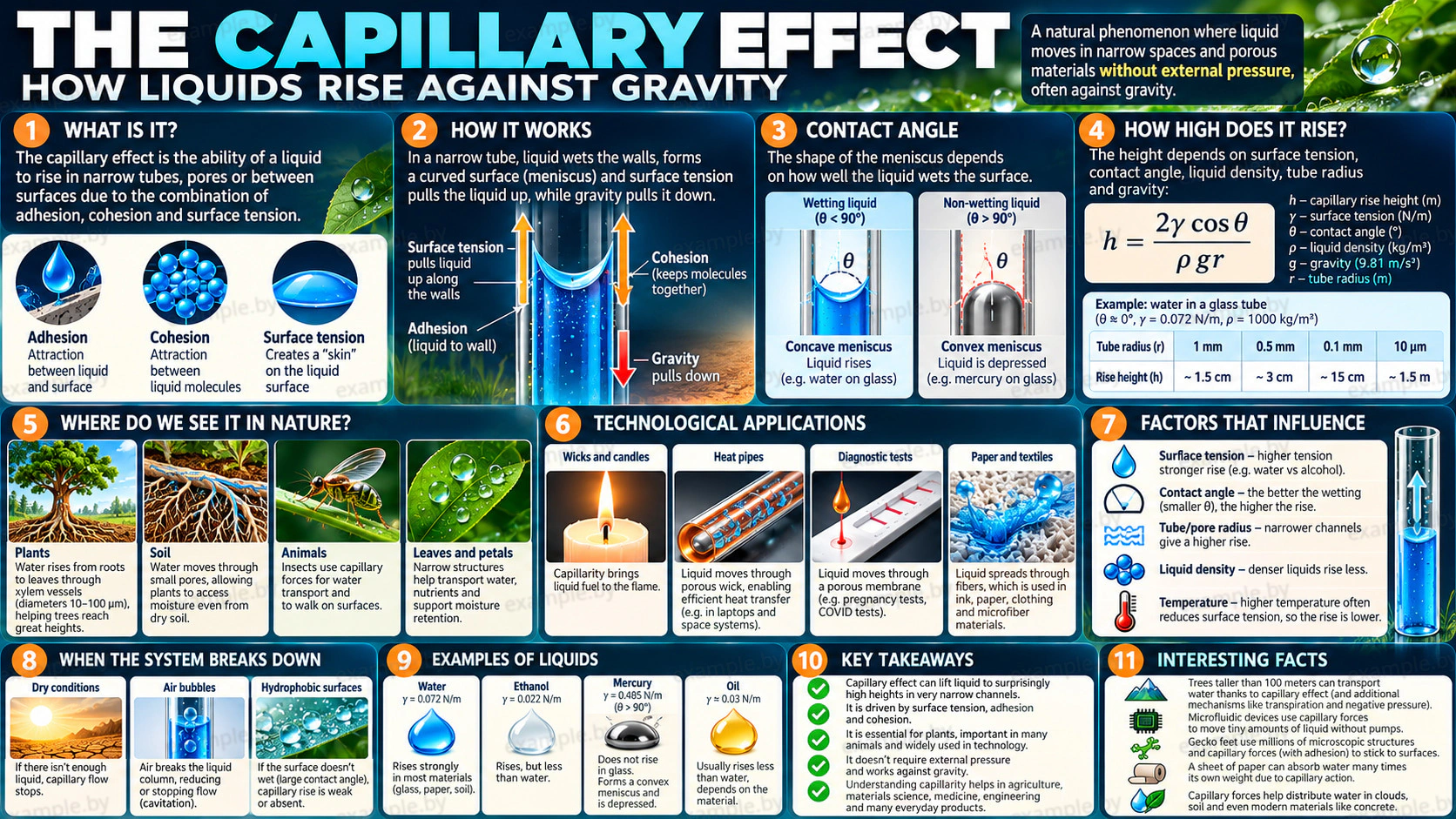
Capillary Action: Why Water Climbs Upward
 Technology · 04.10.26
AI Benchmarks: Testing Models and Why Leaderboards Lie
 Medicine · 05.10.26
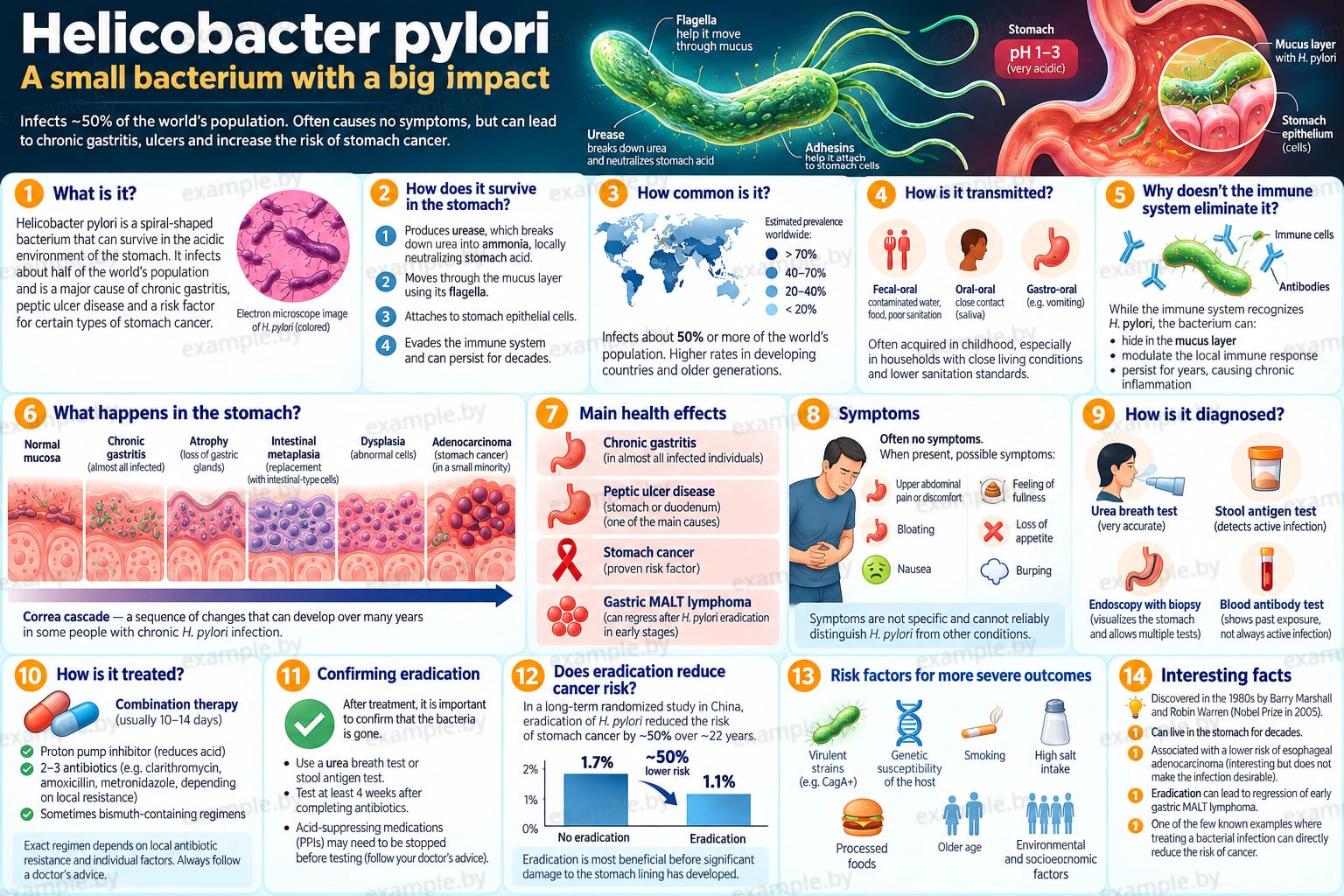
How Helicobacter pylori Survives Stomach Acid
 Medicine · 03.10.26
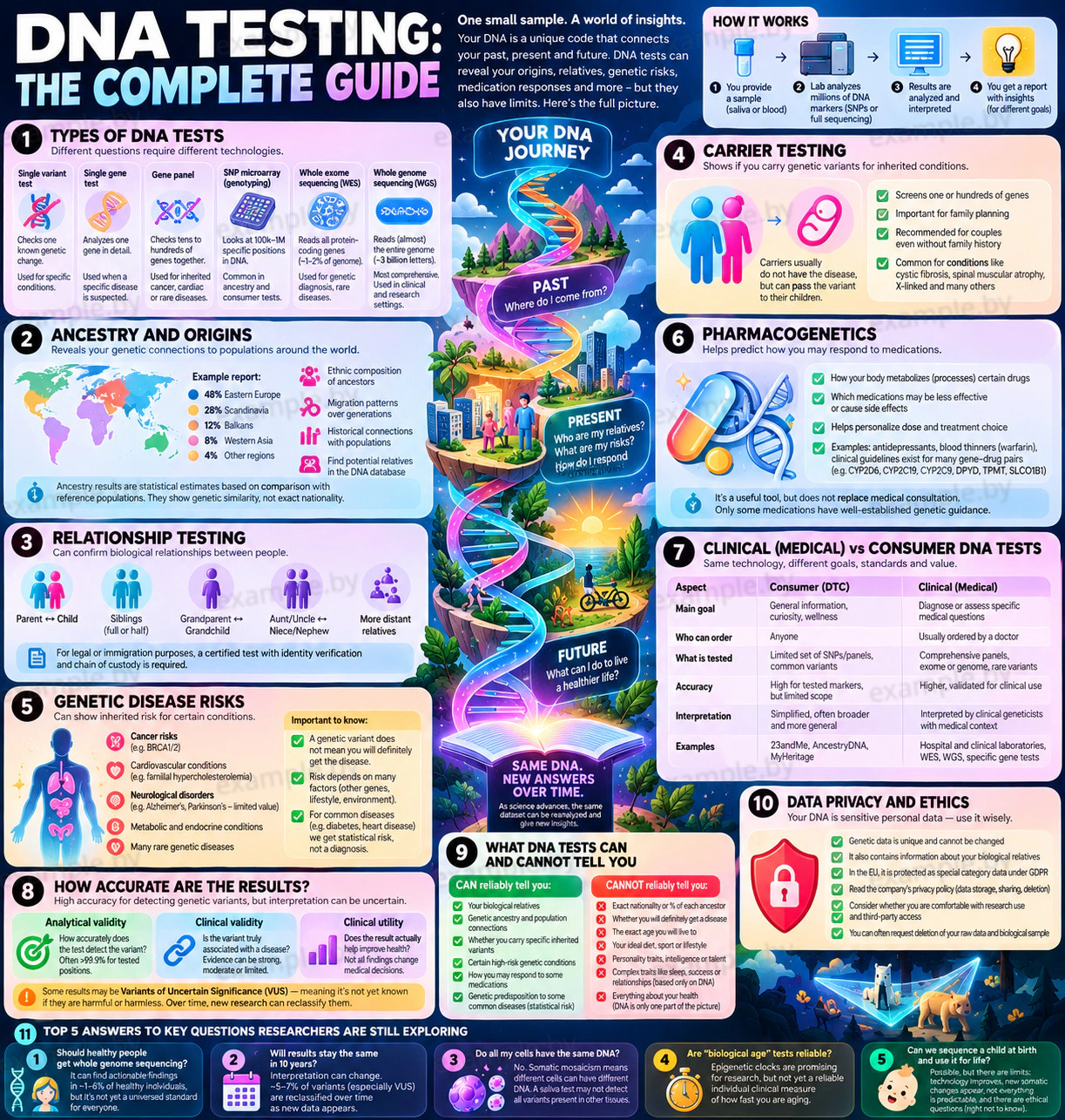
What DNA Tests Can Actually Reveal
 Culture · 27.10.26
Why One Family Can Have Different Surnames
 Biology · 19.10.26
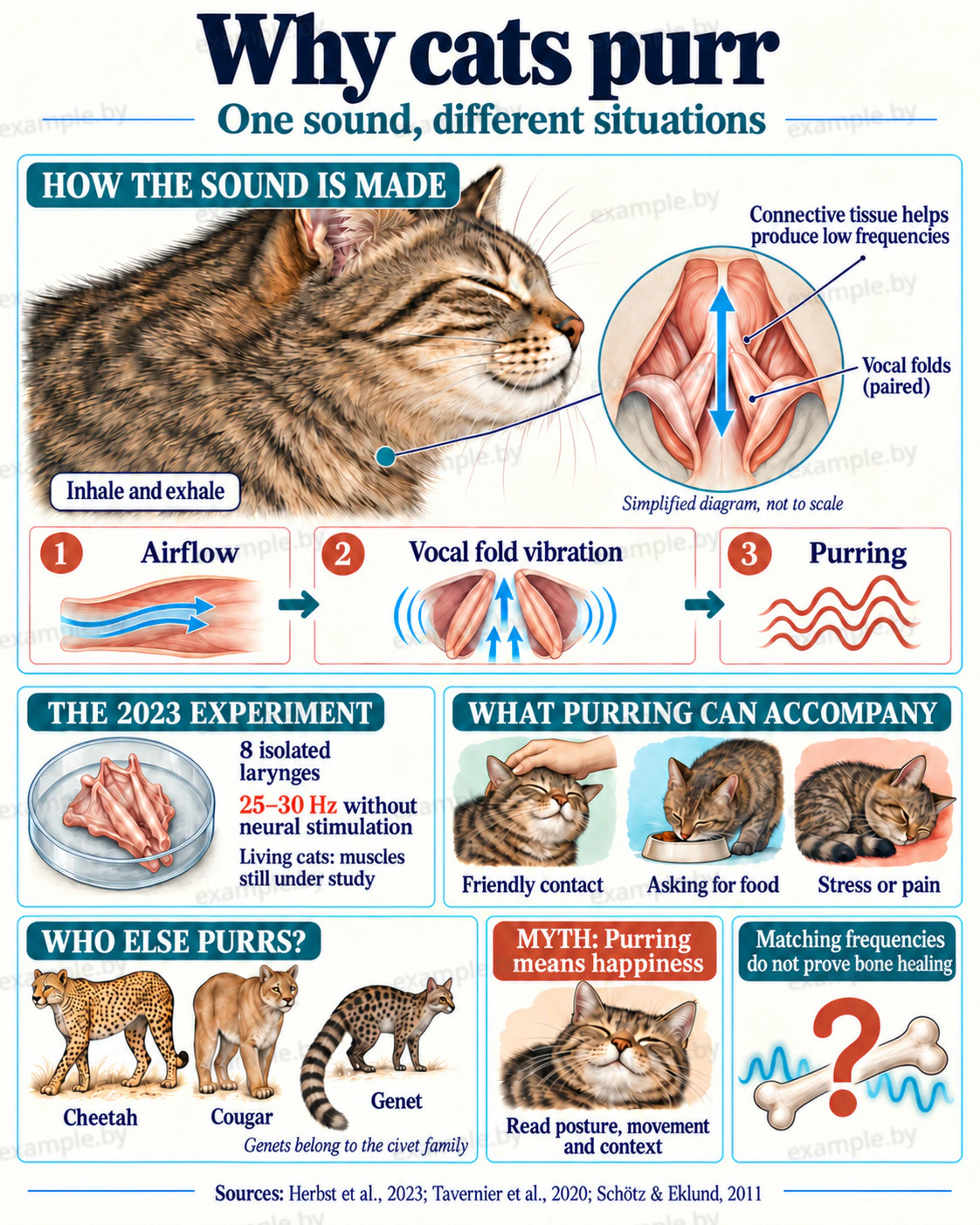
Why Cats Purr and What the Sound Really Means
 Culture · 18.10.26
How PR Works: Mechanisms, Limits and Trust
 Society · 18.10.26
Cypriot Pound or Lira: A Currency with Two Names
 Body · 18.10.26
The Art of the Pause: How to Speak Calmly and Confidently