The Anatomy of Olive Oil: How to Read the Label
Why refined oils can show 0.2% acidity, why pros taste from blue glasses, and why harvest dates matter far more than shelf life.
- Section
- Food
- Date
- Reading
- 6 minutes
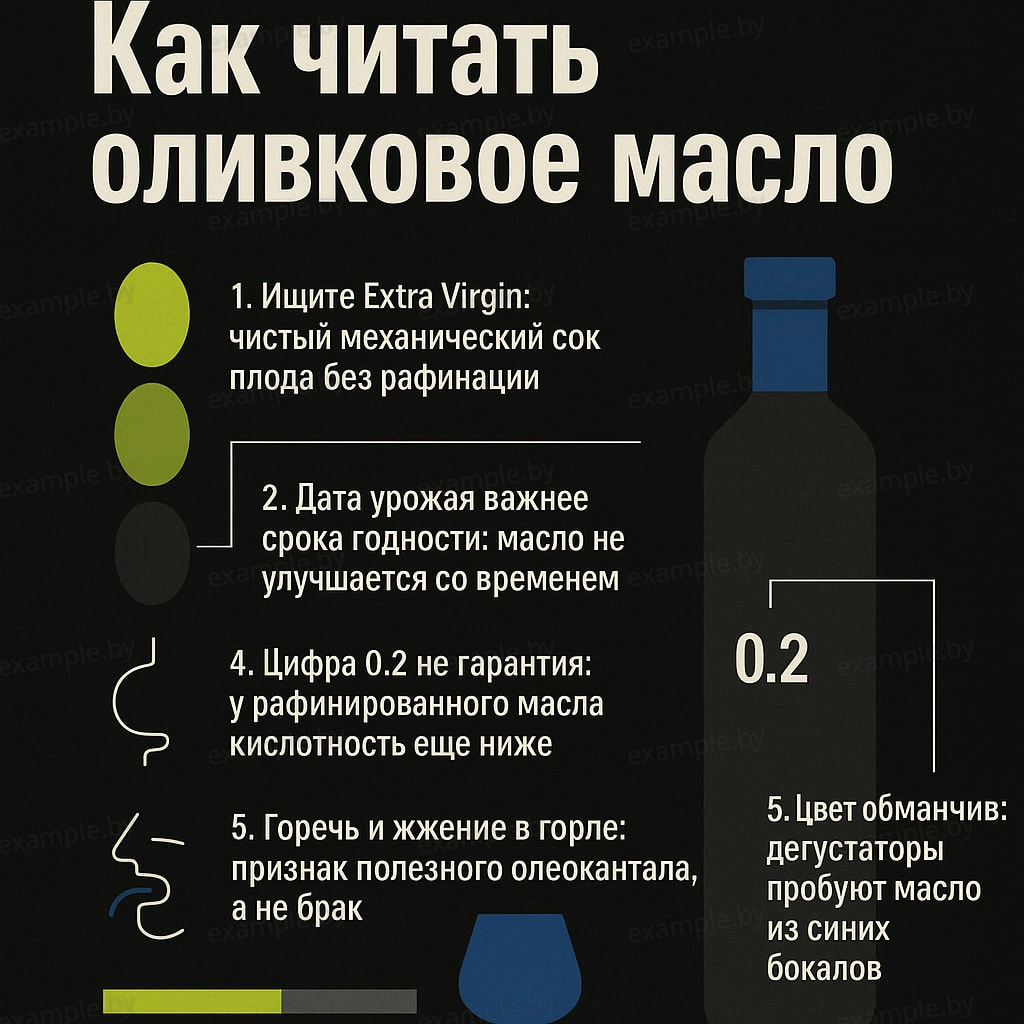
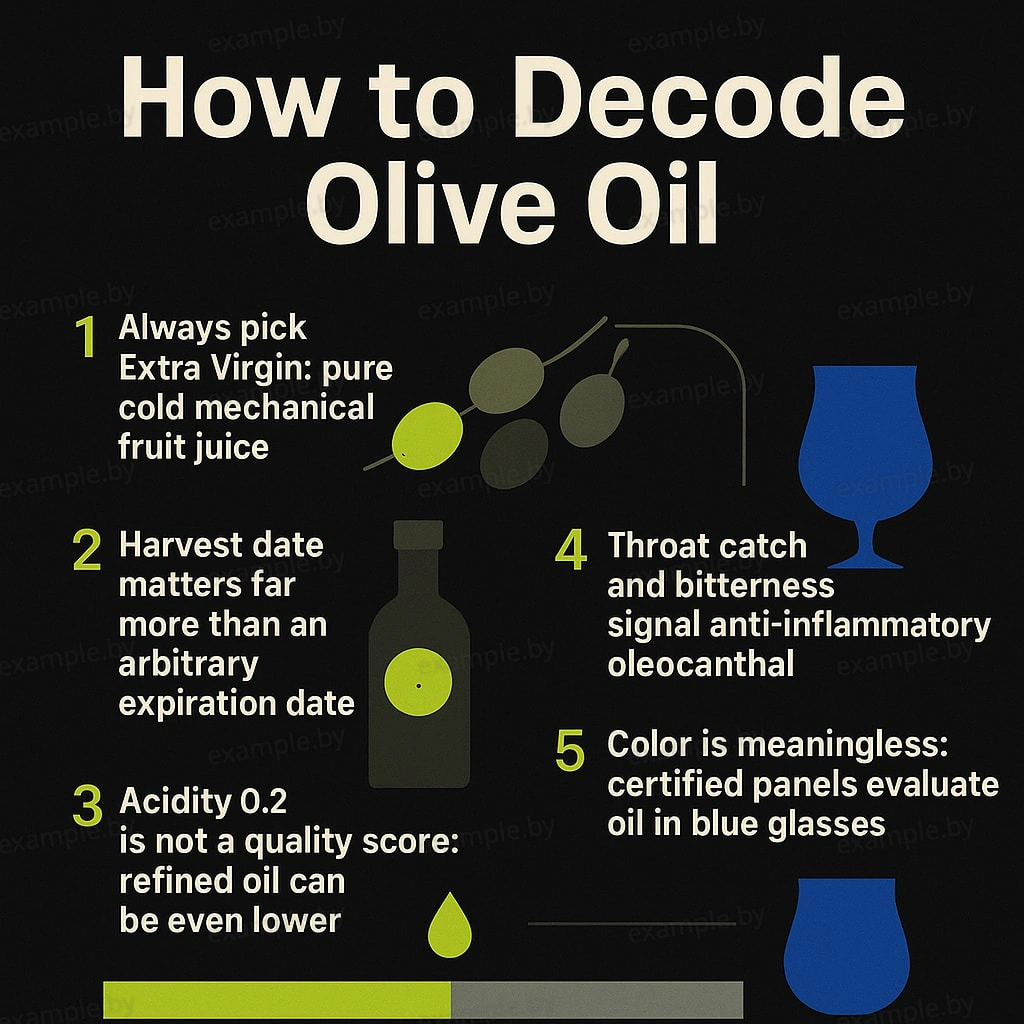
On a supermarket shelf, two dark bottles share the exact same label: Extra Virgin Olive Oil. One costs 600 rubles, the other three thousand. The difference between them comes down not to brand markups, but to fruit biochemistry, harvest timing, extraction methods, and the legal loopholes of European regulations.
Fruit Juice, Not Seed Oil: Olive Biology
Most vegetable oils are pressed from seeds or germs: sunflower, rapeseed, soybean, or corn. Olive oil is different: it is pure juice extracted from the lipid-rich pulp of the fruit. Wild olives were domesticated more than six thousand years ago in the eastern Mediterranean and the Levant, across the lands of modern-day Syria, Turkey, Lebanon, and Israel. The Greeks and Romans turned olive cultivation into a massive industry, using the oil not only for food, but also as lamp fuel, medicine, and a cosmetic base.
An olive tree can live for centuries, but it is notoriously finicky, subject to alternate bearing, where a bumper harvest is inevitably followed by an off year. Because the European Union produces roughly two-thirds of the world's olive oil—led by Spain, Italy, and Greece—a drought or heatwave in Andalusia alone can instantly send global prices soaring across the entire sector.
Green or Black: The Harvest Dilemma
A widespread myth treats green and black olives as different biological species. In reality, they are the exact same fruit at different stages of ripeness: starting out grass-green, then turning pink, violet, and finally nearly black.
Harvest timing determines the trade-off between flavor and yield. An early harvest of green olives yields relatively little oil per ton of fruit. However, this oil is packed with polyphenols and antioxidants, boasting a bold, herbaceous aroma. A late harvest of ripe, dark fruit maximizes volume and delivers a milder flavor, but its phenolic content plummets. Premium producers deliberately sacrifice tonnage for intensity and health benefits.
Grass, Throat Tickle, and Blue Glasses: Organoleptics
Uninitiated consumers are often put off by a bitter taste or a sharp tickle in the throat, assuming the oil has gone bad. In reality, moderate bitterness and peppery pungency are the primary hallmarks of freshness and high quality.
That burning sensation in the throat is caused by oleocanthal, a unique olive polyphenol with proven anti-inflammatory properties. If fresh oil makes you cough slightly, it signals a high concentration of bioactive compounds. A quality profile reveals notes of freshly cut grass, artichoke leaves, green tomato, or almonds.
The color of the oil, however, says nothing about its grade or health value. Ranging from emerald to straw-gold, it merely reflects the balance of chlorophyll and carotenoids. In professional tastings, International Olive Council panelists sample oils exclusively from dark blue glasses so the liquid's hue cannot bias their evaluation.
Cold Extraction: The Press Myth and Closed Cycles
For millennia, olives were crushed by stone millstones and pressed through woven mats called fiscoli. In modern production, this romanticized picture is a thing of the past: air contact rapidly oxidizes fats, and old oil trapped in the mat fibers quickly goes rancid.
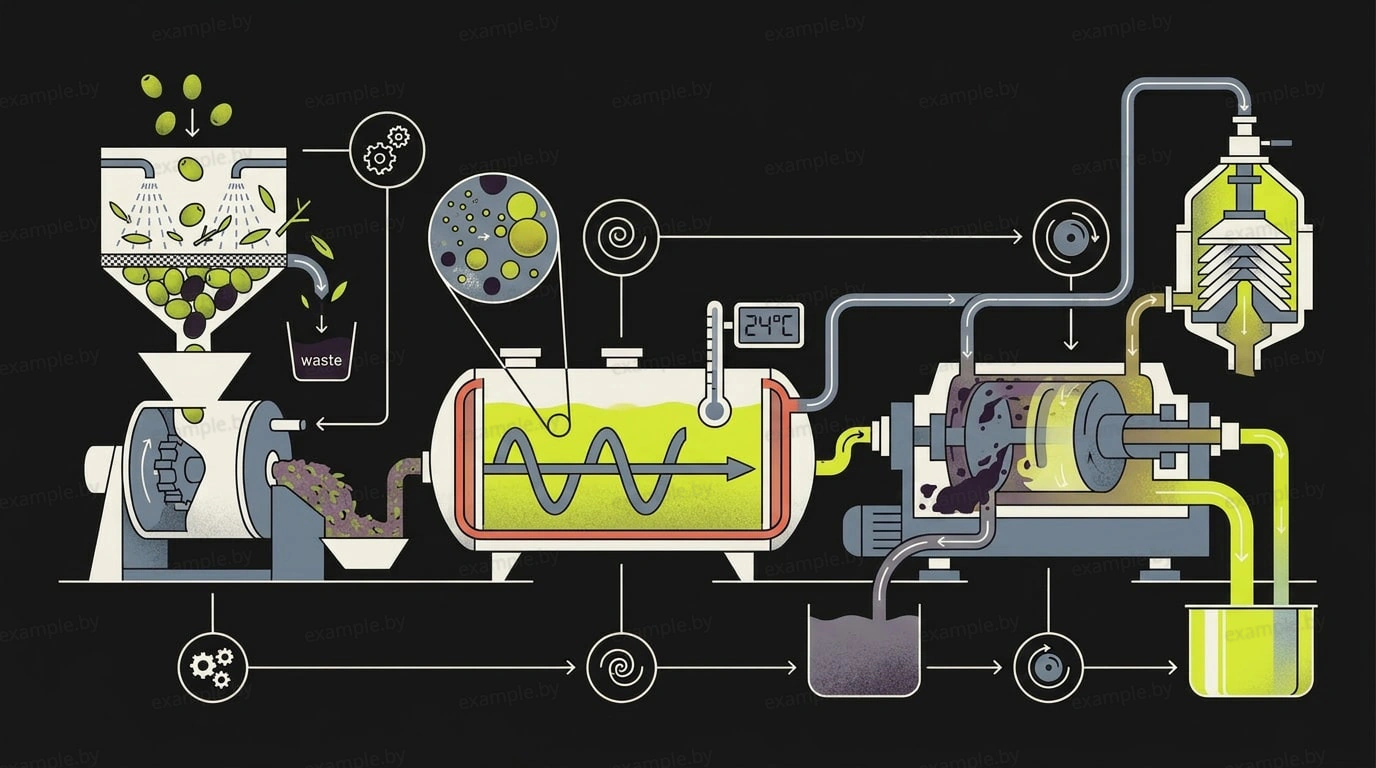
Today, olives are washed, crushed, and sent to malaxation—a gentle, slow churning of the paste at strictly controlled temperatures between 18 and 27 degrees Celsius. Microscopic lipid droplets merge into larger fractions before an airtight centrifuge separates the oil, vegetation water, and pomace without oxygen exposure.
Under European regulations, the label "Cold Extraction" is strictly reserved for processes kept below 27 degrees Celsius. Yet cold processing alone is no silver bullet if the olives were gathered off the ground or left to sit in storage: spoiled raw fruit simply yields cold-extracted spoiled oil.
Unfiltered or cloudy oil is another marketing trap. Suspended sediment may look rustic and artisanal, but residual microdroplets of water and fruit particles accelerate hydrolysis. As a result, unfiltered oil oxidizes and degrades far faster than its filtered counterpart.
The Chemistry of Acidity: The Refined Paradox
Prominent figures like 0.2% or 0.3% on a label are often mistaken by shoppers for a flavor scale or total oleic acid content. In reality, this refers to free acidity: the proportion of fatty acids cleaved from their triglyceride glycerol backbone by lipase enzymes as fruit cells break down. You cannot taste this acidity on your tongue; it is purely a laboratory metric of fruit freshness.
If olives are damaged by hail, stew in transport bins, or start to ferment, free acidity shoots up. In pristine, fresh fruit, it hovers around 0.2–0.3%. But chasing this number blindly is misleading due to a technological paradox.
Any cheap, degraded oil subjected to aggressive industrial refining with alkali and vacuum deodorization can easily drop below 0.2% acidity. Yet it is completely stripped of vitamins, natural aroma, and polyphenols. Under EU law, producers cannot print acidity in isolation; they must also display peroxide value (initial oxidation), wax content, and ultraviolet absorbance values alongside it.
The Hierarchy of Grades: What Is in the Bottle
Extra Virgin status functions like a pass-fail exam with a passing threshold of 60 points. One producer might score 61 and another a benchmark 95, yet both bottles carry the coveted designation. The official classification divides the market into five primary tiers:
Extra Virgin: 100% direct mechanical juice, acidity strictly under 0.8%, with zero sensory or flavor defects confirmed by a blind tasting panel.
Virgin: mechanically extracted with acidity up to 2.0%, allowing for minor flavor defects.
Lampante: spoiled, high-acid oil. Historically burned in oil lamps (giving it its name), it is now sent entirely to industrial refineries.
Olive Oil (or Pure Olive Oil): a blend of industrially refined lampante with a splash of Virgin oil to restore slight color and aroma. Here, "Pure" signifies factory deodorization rather than natural purity.
Olive Pomace Oil: oil chemically extracted from residual dry pomace using organic solvents (such as hexane) and subsequently refined.
Origin and the 30-Second Buyer's Checklist
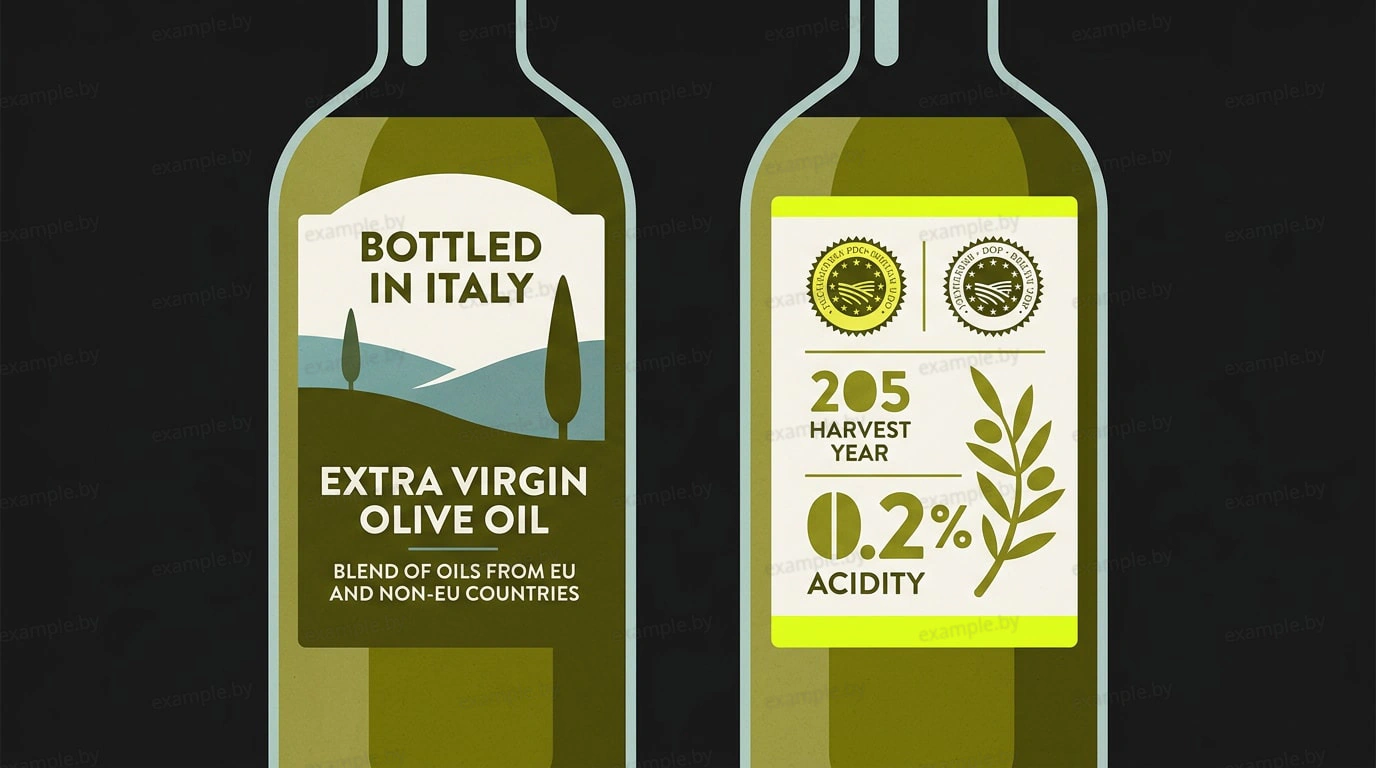
An Italian tricolor, a family crest, and the words "Bottled in Italy" often conceal a bulk blend shipped in tankers from Spain, Greece, or Tunisia. Look closely at the Origin statement: "Blend of olive oils of EU and non-EU origin" is a clear sign of a homogenized bulk commodity. Your safest bet is oil with protected geographical status (PDO, or DOP in Italy; PGI), where both grove and mill are certified by law.
Unlike fine wine, olive oil does not improve with age. Its worst enemies are ultraviolet light, heat, and oxygen. When choosing a bottle on the shelf, run through this quick checklist:
Grade: strictly Extra Virgin.
Harvest Date: far more telling than a Best Before date. Under EU regulations, a harvest date can only appear if 100% of the oil comes from that single harvest. Always choose the most recent season.
Packaging: thick dark glass, tin, or ceramic. Clear glass under supermarket fluorescent lighting triggers photo-oxidation within weeks.
Storage: keep the bottle at home in a dark cupboard away from the stove at 15–20 degrees Celsius. Do not refrigerate Extra Virgin: cold causes it to solidify and cloud over, while repeated temperature shifts ruin its aroma profile.
Liked it? Save it for later.
 Food · 07.10.26
How to Pick Ripe Fruits and Vegetables
 Medicine · 05.10.26
How Helicobacter pylori Survives Stomach Acid
 Medicine · 03.10.26
What DNA Tests Can Actually Reveal
 Culture · 27.10.26
Why One Family Can Have Different Surnames
 Biology · 19.10.26
Why Cats Purr and What the Sound Really Means
 Culture · 18.10.26
How PR Works: Mechanisms, Limits and Trust
 Society · 18.10.26
Cypriot Pound or Lira: A Currency with Two Names
 Body · 18.10.26
The Art of the Pause: How to Speak Calmly and Confidently
More Than a Cap: The Hidden Network Beneath Your Feet
Biology · 17.10.26
More Than a Cap: The Hidden Network Beneath Your Feet
 Technology · 16.10.26
The Life Cycle of a Star: From Nebula to Black Hole
 Body · 15.10.26
Who Pays for Heat: Why a Lizard Can Be Hotter Than a Bird
 Technology · 15.10.26
How Vector Search Works: Chroma, pgvector and Qdrant