How HPV Can Lead to Cancer Decades Later
Most HPV infections clear silently, but persistent high-risk strains disrupt p53 and RB defenses. Here is how the virus causes cancer and how to stop it.
- Section
- Medicine
- Date
- Reading
- 12 minutes
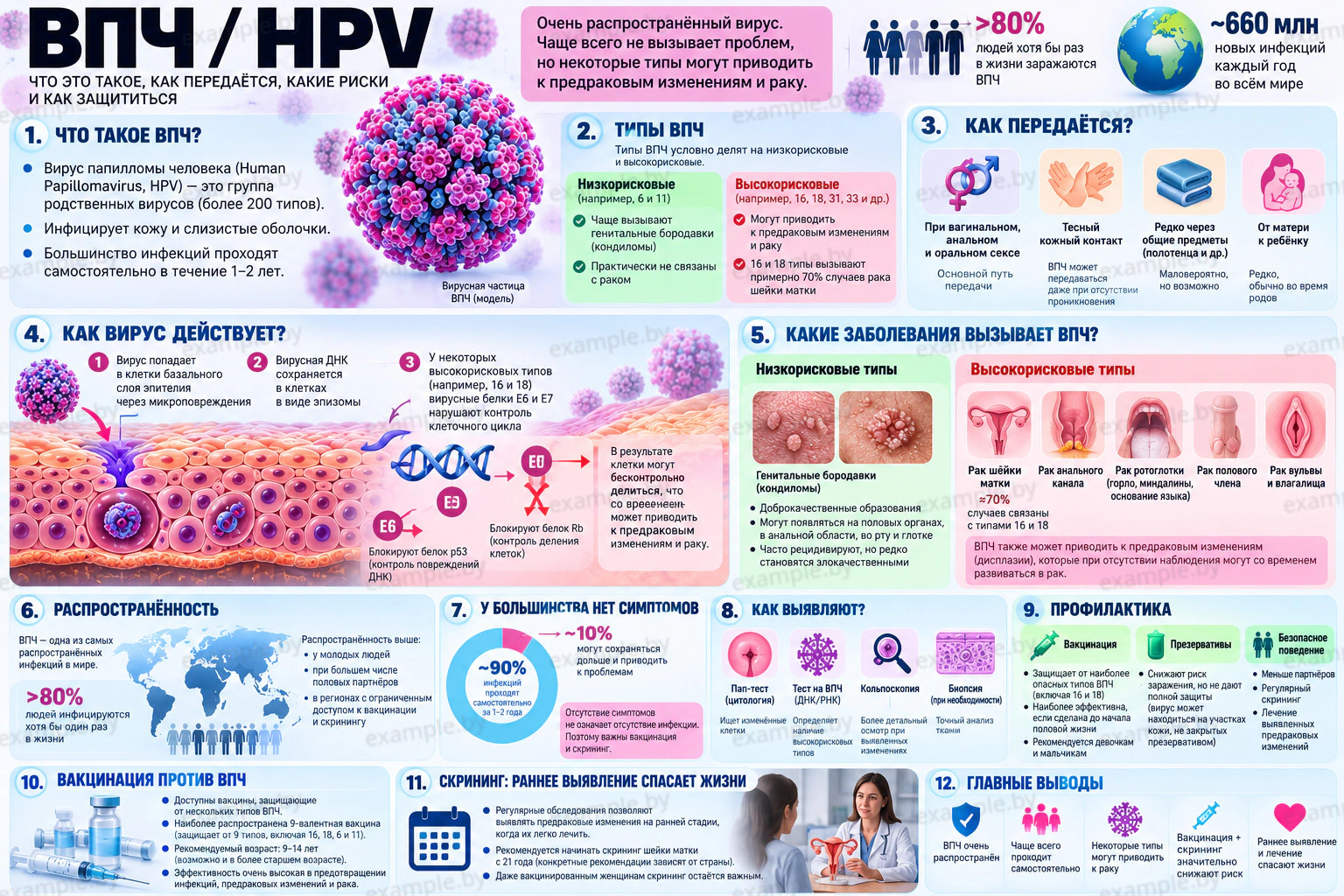
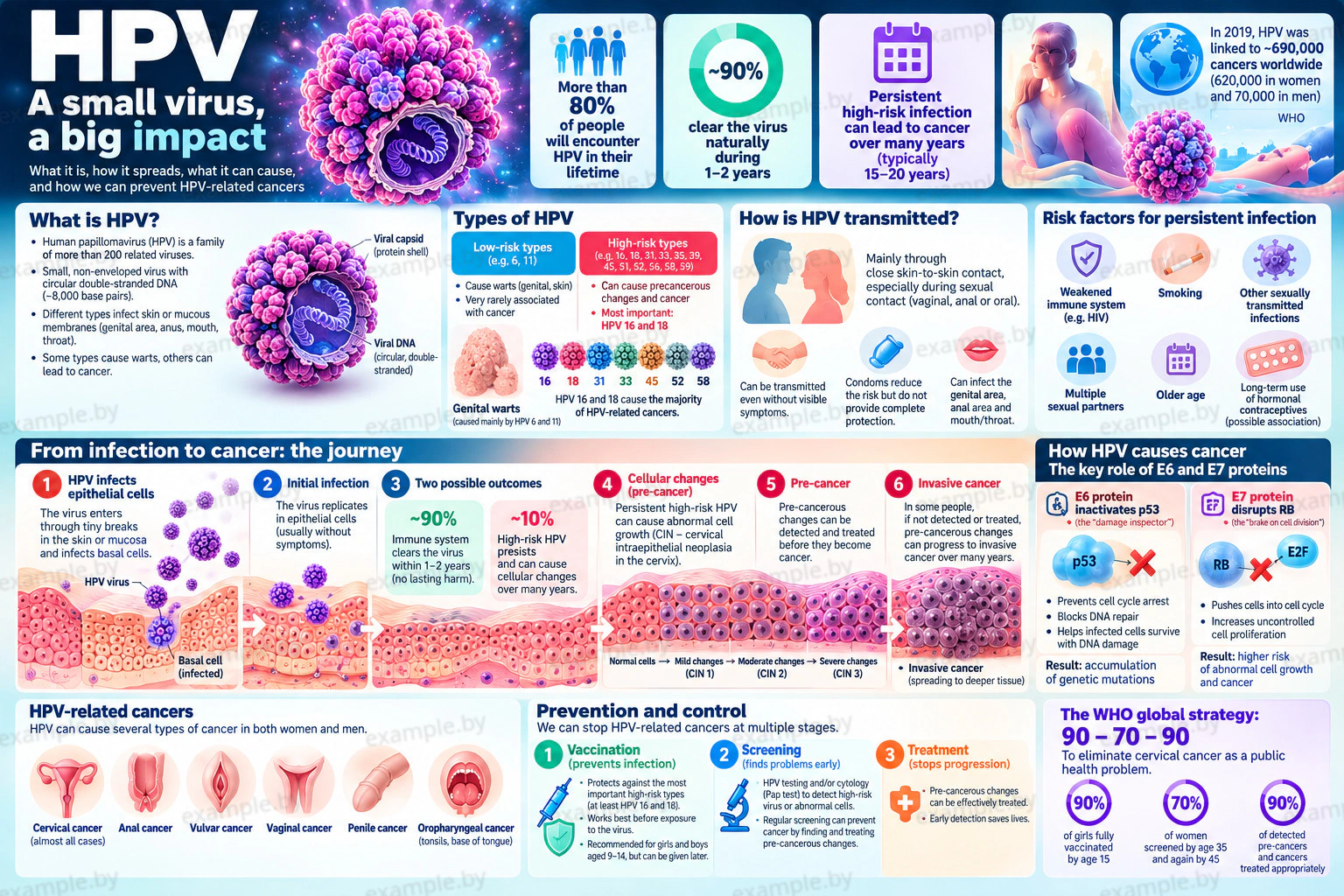
Human papillomavirus (HPV) is not a single pathogen, but a vast family of more than 200 related viruses. Almost everyone is exposed to it at some point during their lifetime, but in about 90% of cases, the immune system clears the infection on its own. The real danger lies in the long-term persistence of high-risk types, particularly HPV16 and HPV18: their oncoproteins E6 and E7 can disrupt two of the cell's most vital tumor suppressor systems, p53 and RB. This makes HPV one of the leading infectious causes of cancer. At the same time, it is a rare example of a malignancy that can largely be prevented through vaccination and regular screening. (Cancer.gov)
HPV: Not Just One Virus
The name human papillomavirus can be slightly misleading.
It refers to a family of more than 200 related viruses. They are small, non-enveloped viruses with circular double-stranded DNA roughly 8,000 base pairs in size. (Cancer.gov)
Different types of HPV have evolved to target distinct areas of epithelial tissue.
Some prefer the skin.
Others specialize in genital mucous membranes.
A few can infect the oral cavity and oropharynx.
Most importantly: different HPV types behave very differently at the biological level.
Broadly speaking, they can be divided into two main categories.
Low-risk HPVs, such as types 6 and 11, can cause warts, but are rarely linked to cancer.
High-risk HPVs can trigger precancerous changes when an infection persists over time. The NCI identifies 12 primary high-risk types: 16, 18, 31, 33, 35, 39, 45, 51, 52, 56, 58, and 59. (Cancer.gov)
The two most infamous among them are:
HPV16 and HPV18.
Together, they account for the vast majority of HPV-related cancers. (IARC)
How Common Is HPV?
This is where the numbers become staggering.
According to the WHO, almost all sexually active individuals contract HPV at some point in their lives, usually without ever realizing it. (World Health Organization)
This points to an essential fact:
An HPV infection on its own is nothing unusual.
What is unusual is something else:
when a high-risk HPV fails to clear and persists in tissue for years.
It is persistence, not the mere fact of being exposed, that lies at the heart of the link between HPV and cancer.
What Happens After Infection
HPV infects epithelial cells.
It targets the basal layer of the epithelium in particular, usually gaining entry through microscopic abrasions on the surface.
From there, the course of infection can follow two very different paths.
Scenario A: The Most Common
HPV → immune response → viral clearance → virus resolves or becomes undetectable.
The WHO estimates that in approximately 90% of people, the body clears the infection on its own, typically within one to two years. (World Health Organization)
Scenario B: Rare, but Dangerous
High-risk HPV → virus persists → years of chronic infection → cellular changes → precancer → invasive cancer in a subset of people.
This process can take a very long time.
For cervical cancer, the WHO notes a typical window of about 15 to 20 years from persistent infection to the onset of cancer, though timelines can vary from person to person. (World Health Organization)
This creates a rare clinical pattern:
the moment of transmission and the appearance of cancer can be separated by decades.
How the Virus Breaks Down Cellular Defenses
Human cells make copying errors all the time.
To keep things in check, they rely on a sophisticated surveillance system.
Two proteins are especially critical:
p53
You can think of it as the cell's damage inspector.
If DNA is damaged, p53 halts the cell cycle to initiate repair, or, if the damage is beyond fixing, directs the cell toward programmed cell death (apoptosis).
RB
This is one of the cell's master brakes on division.
It prevents the cell from rushing into uncontrolled replication.
And this is where two viral oncoproteins enter the picture:
E6 and E7.
In high-risk HPV types, these proteins can disable the cell's most essential checkpoints.
Put simply:
E6 → dismantles the p53 system
E7 → disrupts the RB system
The outcome:
The cell loses its brakes on replication, becomes far less capable of repairing DNA damage, and gradually begins to accumulate genetic mutations.
E6 and E7 are considered the primary drivers of carcinogenesis in high-risk HPVs. (IARC)
It is a striking example of how compact a biological exploit can be.
A tiny virus does not need to transform a cell into a tumor on its own.
All it needs to do is knock out a few key defense mechanisms—subsequent mutations and cellular evolution take care of the rest.
What the Virus Gains from This
The virus does not intend to cause cancer.
For HPV, malignancy is essentially a collateral consequence of its replication strategy.
Because HPV relies entirely on the host cell's molecular machinery, it needs the infected cell to stay in an active cycle that favors viral DNA replication.
To achieve this, the virus meddles with the host cell cycle.
In most infections, the immune system eventually steps in and clears the pathogen.
However, when the virus persists for years, this continuous manipulation creates an environment where dangerous cellular abnormalities can slowly emerge.
Why One Type Causes Warts and Another Causes Cancer
Even though HPV6 and HPV16 are relatives, they are biologically distinct.
The E6 and E7 proteins of high-risk types are far more potent at disabling the cell's anti-tumor machinery.
That is why the statement:
"HPV causes cancer"
is an oversimplification.
A far more accurate way to put it is:
Persistent infection with specific high-risk HPV types can lead to cancer.
Infection Does Not Equal Cancer
This is a crucial distinction.
Testing positive for HPV does not mean you have cancer.
Even high-risk infections are usually resolved by the immune system.
The progression looks roughly like this:
HPV infection
↓
persistent infection
↓
cellular changes
↓
precancerous lesions
↓
invasive cancer
At every stage of this sequence, there is a chance the process will stall or regress.
This is precisely why screening works so well: it catches abnormalities before cancer ever develops.
What Types of Cancer Are Linked to the Virus?
Cervical cancer is not the only outcome.
Long-term high-risk infections can also cause cancer of the:
cervix;
anus;
vulva;
vagina;
penis;
oropharynx, including the tonsils and the base of the tongue. (Cancer.gov)
According to WHO estimates, HPV was responsible for roughly 620,000 cancer cases in women and 70,000 in men in 2019. (World Health Organization)
In other words, HPV is far from being strictly a women's health issue.
A Special Case: Cervical Cancer
Nowhere is the causal relationship stronger than in cervical cancer.
Persistent infection with oncogenic HPV types accounts for nearly all cases worldwide. (IARC)
HPV16 is especially aggressive.
The IARC attributes roughly half of all cervical cancer cases across the globe to HPV16, with HPV18 ranking as the second most common oncogenic type. (IARC)
Recent WHO estimates indicate that in 2024, there were approximately 604,000 new cases of cervical cancer and 280,000 deaths globally. (World Health Organization)
Why the Virus Can Linger Undetected
HPV has evolved to avoid triggering a strong inflammatory response.
Because it replicates locally within epithelial layers, it can persist for long periods without causing any noticeable symptoms.
As a result, most people have no idea they carry it.
There is no pain.
There is no fever.
There is no obvious swelling.
This is why the common assumption—
"if I feel fine, everything is fine"
—does not apply to HPV.
How the Infection Spreads
The primary route of transmission is close skin-to-skin and mucosal contact, particularly through sexual activity.
Transmission does not require visible warts or lesions to be present.
While condoms reduce the risk of transmission, they do not offer complete protection because HPV can inhabit areas of skin not covered by a condom. (World Health Organization)
Why the Immune System Usually Wins
Over time, the immune system detects infected cells and mounts an effective defense, bringing the infection under control.
This is why the vast majority of exposures never become chronic.
In some cases, however, immune surveillance falls short.
The risk of viral persistence depends on an interplay of factors:
HPV type + immune response + age + smoking + co-infections + other host and environmental variables.
For instance, the WHO notes that individuals living with HIV face roughly a sixfold higher risk of developing cervical cancer. (World Health Organization)
Smoking and Cancer Risk
Carcinogens in tobacco smoke cause additional cellular damage and can weaken local immune responses in mucosal tissue.
The result is a dangerous convergence:
an oncogenic virus + DNA damage + impaired local immunity.
This is why the WHO specifically highlights smoking cessation as a way to reduce the likelihood of persistent HPV infection and its complications. (World Health Organization)
Diagnosis: Viral Testing vs. Cytology
It is important to differentiate between two very distinct diagnostic tools.
The HPV Test
Looks for direct evidence of the virus itself, typically detecting its DNA or RNA.
It answers the question:
"Is a high-risk HPV present right now?"
Cytology (Pap Smear)
Examines the morphology of the cells under a microscope.
It answers a different question:
"Have the cells begun to look abnormal?"
HPV testing and cytology evaluate two distinct stages along the same pathway:
cause → effect.
If suspicious changes are found, clinicians use further methods, such as colposcopy and biopsy, to evaluate the tissue more closely.
A Vaccine Against Oncogenic Viruses
HPV represents a rare medical milestone: a disease where science has developed a vaccine against an infectious cause of cancer.
Modern prophylactic vaccines generate robust immunity against the most hazardous HPV types.
Every vaccine recommended by the WHO protects against at least HPV16 and HPV18. (World Health Organization)
The logic is simple:
prevent the infection → prevent persistence → prevent most precancerous lesions → prevent cancer.
In practice, it functions as a vaccine against multiple forms of cancer by eliminating their viral trigger.
Why Vaccination Happens Early
Vaccination is most effective before any exposure to the virus occurs.
Because of this, the WHO's global strategy focuses primarily on vaccinating girls aged 9 to 14. (World Health Organization)
The vaccine is not a treatment for an active infection.
Its role is prophylactic—priming the immune system so it can neutralize HPV upon any future encounter.
Vaccination Does Not Replace Screening
This distinction is critical.
Vaccines protect against future infections from high-risk types covered by the formulation.
Screening identifies existing high-risk infections or early cellular changes that may have already developed.
The two approaches are designed to work in tandem, not as substitutes for one another.
The WHO has outlined a global 90–70–90 target for cervical cancer:
90% of girls fully vaccinated with an HPV vaccine by age 15;
70% of women screened with a high-performance test by age 35 and again by age 45;
90% of women identified with cervical disease receiving treatment. (World Health Organization)
Can We Eliminate This Cancer?
This is where the story becomes unprecedented.
Cervical cancer possesses a unique combination of characteristics:
a well-defined primary cause;
an effective vaccine targeting that cause;
a long, slow-moving precancerous phase;
reliable screening tools; and
effective treatment options for precancerous lesions.
Because of these factors, the WHO has set a goal not simply to lower mortality, but to eliminate cervical cancer as a public health problem entirely. (World Health Organization)
In oncology, that is extraordinary.
The Chain of Events: From Virus to Tumor
If you distill decades of research into a single sequence, it looks like this:
🦠 HPV
↓
infects basal epithelial cells
↓
🛡️ in most people, the immune system clears the infection
END OF CYCLE
However, in a minority of cases:
↓
🧬 high-risk HPV persists
↓
E6 and E7 oncoproteins dismantle cellular checkpoints
↓
⚠️ cells gradually accumulate mutations
↓
precancer develops
↓
🔴 invasive cancer develops in some individuals
Medicine now has tools to break this chain at multiple points:
vaccination → stops the infection before it starts
immunity → clears the virus naturally
HPV screening → identifies persistent infections
cytology/tissue evaluation → detects early cellular changes
precancer treatment → halts progression to cancer
It is a textbook example of how understanding the molecular biology of a disease can turn cancer prevention from a concept into reality.
Summary
HPV is widespread, but an infection does not mean cancer. The vast majority of cases are cleared by the immune system on its own. The primary danger arises when high-risk types persist for years. HPV16 and HPV18 carry the greatest risk, relying on their E6 and E7 proteins to disable critical tumor suppressor defenses. HPV is responsible for cancers well beyond the cervix. Crucially, medicine already possesses the tools to break almost every link in this chain. (IARC)
Liked it? Save it for later.
 Medicine · 05.10.26
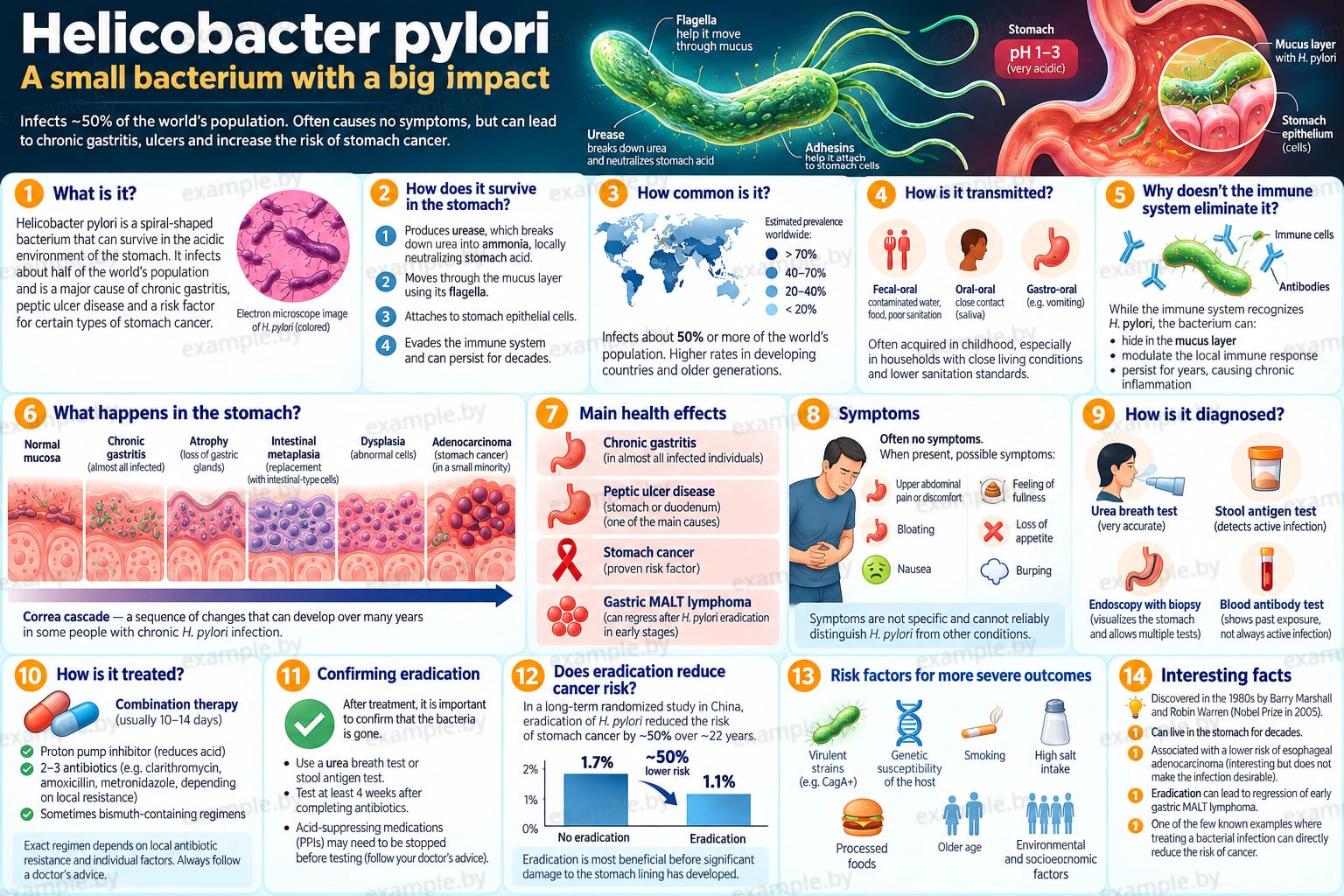
How Helicobacter pylori Survives Stomach Acid
 Medicine · 03.10.26
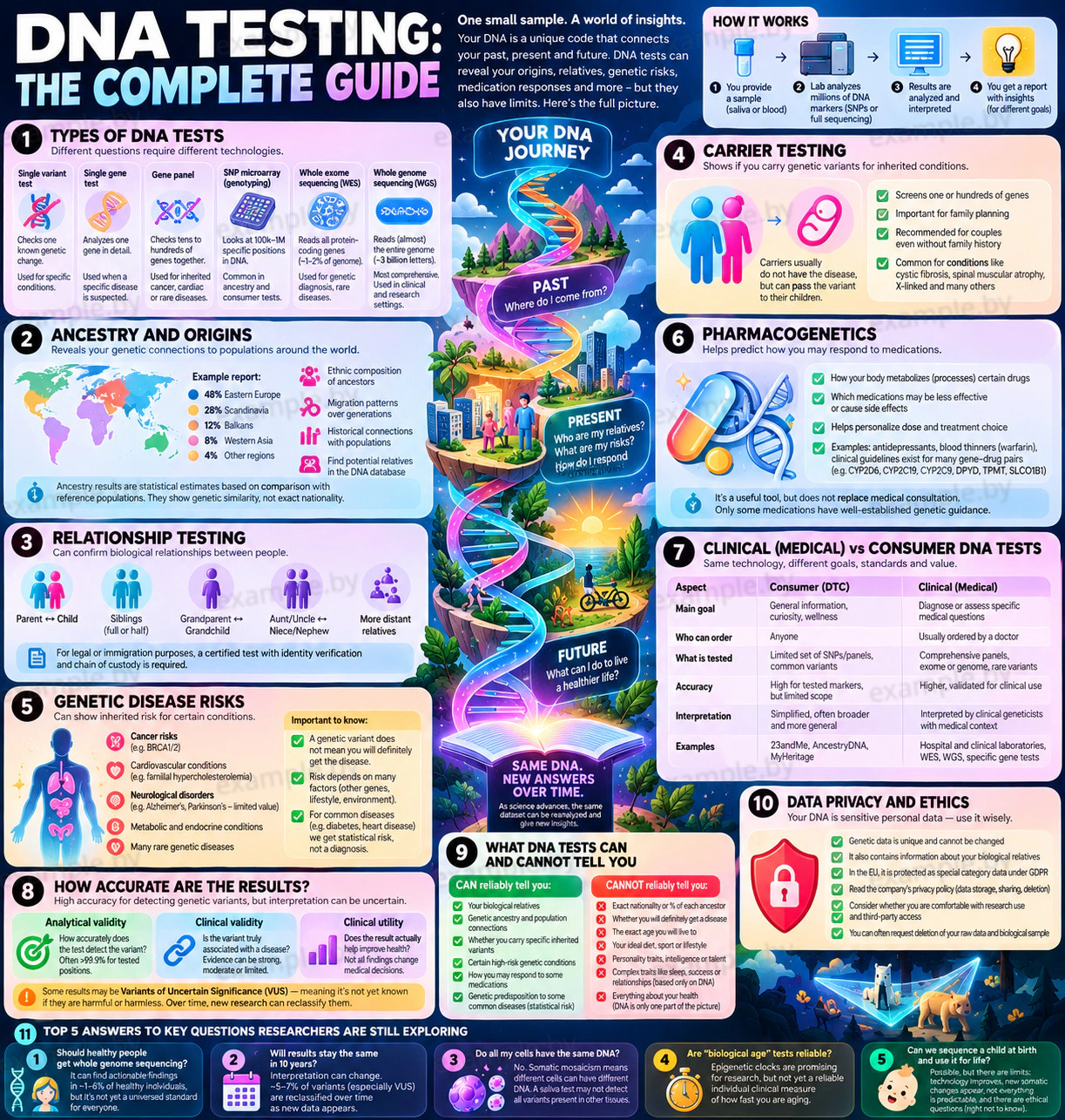
What DNA Tests Can Actually Reveal
 Medicine · 11.10.26
Why Gums Bleed and Where the Real Danger Begins
 Medicine · 11.10.26
How Life Begins: From Conception to IVF
 Body · 10.10.26
Skin Pigmentation: How Cells Talk to the Sun
 Medicine · 03.10.26
Heartburn: Why Stomach Contents Flow Back Up
 Body · 03.10.26
The Science of Tanning: Why There Is No Safe Tan
 Medicine · 03.10.26
ADHD: Why It Is Not an Attention Deficit
 Medicine · 03.10.26
Sleep: What Really Happens to Us Every Night
 Medicine · 03.10.26
FOMO: Why Everyone Seems to Be Doing Better Than You
 Culture · 27.10.26
Why One Family Can Have Different Surnames
 Biology · 19.10.26
Why Cats Purr and What the Sound Really Means