The Science of Tanning: Why There Is No Safe Tan
How melanin protects cells, why a tan isn't a sign of health, how much UV sunscreen blocks, and whether skin can ever fully recover from sun damage.
- Date
- Reading
- 21 minutes
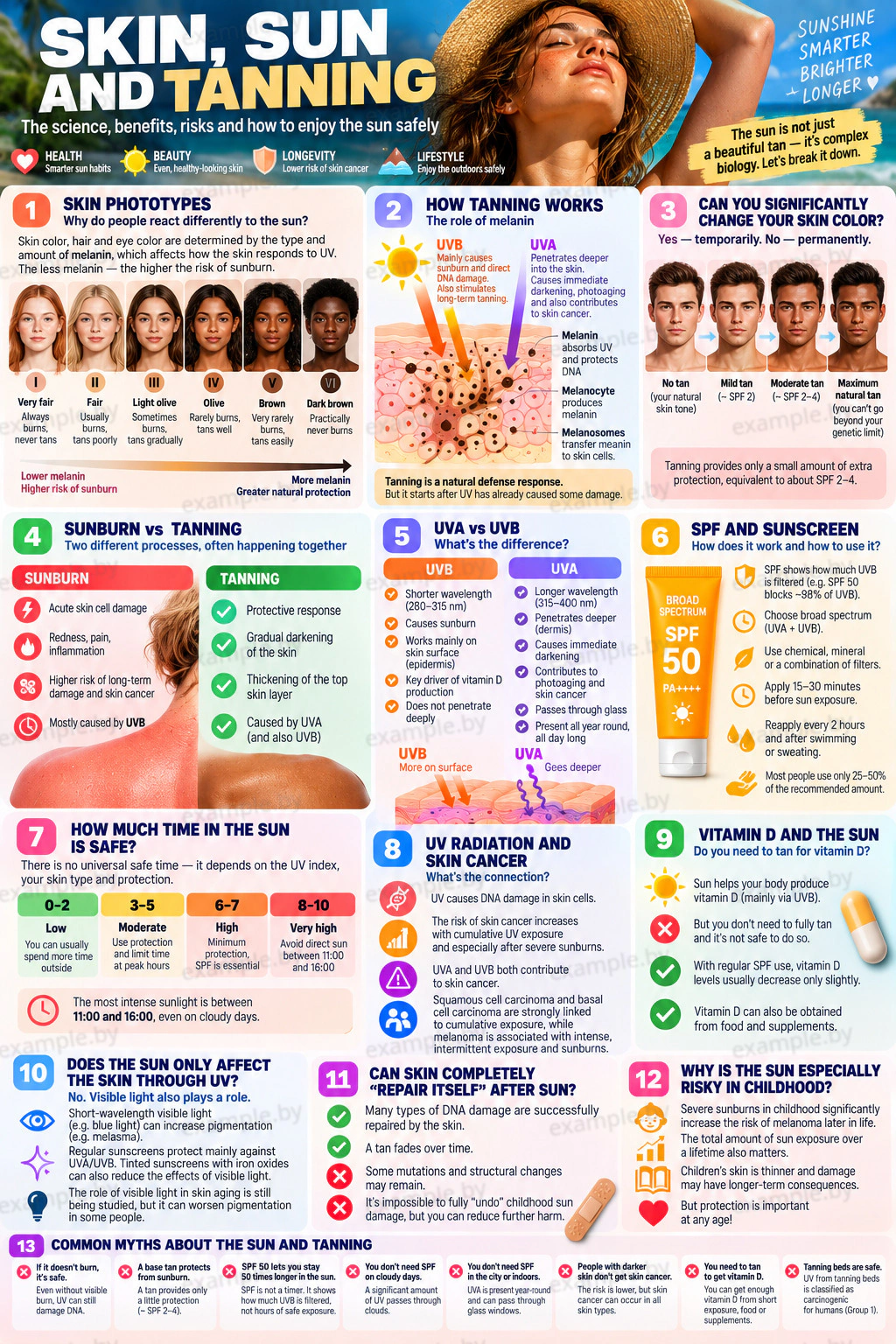
A tan is not a sign of “healthy skin”: in photobiology, it is an emergency defense mechanism triggered by UV damage to cellular DNA that has already occurred. The World Health Organization explicitly states that there is no such thing as a “healthy tan”: skin darkening offers only minimal protection (equivalent to an SPF of roughly 2–4) and does not prevent the accumulation of mutations or photoaging.
Of the potentially harmful ultraviolet radiation reaching Earth’s surface, the vast majority consists of UVA and UVB.
UVA (315–400 nm) accounts for roughly 95% of the solar UV radiation reaching the ground. It penetrates deep into the dermis, generates reactive oxygen species, damages cellular architecture, drives photoaging, and contributes to carcinogenesis. UVA is particularly effective at triggering the rapid darkening of preexisting pigment. (World Health Organization)
UVB (280–315 nm) is absorbed primarily by the upper layers of the skin. It is the chief culprit behind sunburns, direct DNA photolesions, and the subsequent, slower synthesis of new melanin. UVB is also a primary driver of skin cancer. (World Health Organization)
UVC carries even higher energy, but solar UVC is completely absorbed by the atmosphere. (World Health Organization)
This explains why the common belief—“I didn’t burn, so the sun didn’t damage my skin”—is wrong. Visible erythema is largely mediated by UVB, whereas UVA inflicts silent cellular damage without causing noticeable redness.
2. Why Skin Phototypes Exist
Dermatology typically relies on the Fitzpatrick scale (I–VI). However, there is an important nuance to keep in mind.
It was never conceived as a simple “white-to-black” spectrum of skin color, but rather as a clinical tool to measure how skin responds to ultraviolet radiation: how easily a person burns and how readily they tan. Modern studies show that, especially for darker skin tones, this classification system is relatively crude and fails to capture the full spectrum of human pigmentation. (pmc.ncbi.nlm.nih.gov)
In broad terms, the classic scale breaks down as follows: Phototype I almost always burns and rarely tans; II burns easily and tans minimally; III may burn mildly before tanning; IV burns infrequently and tans easily; and V–VI possess significantly higher constitutive pigmentation, conferring greater resistance to visible erythema. (DermNet®)
Yet the difference goes far beyond simply having “more brown pigment.”
3. Melanin Is Far More Interesting Than It Seems
Human skin relies on two main types of melanin.
Eumelanin is brownish-black. It is highly effective at absorbing and scattering UV radiation, and it helps neutralize dangerous free radicals.
Pheomelanin is reddish-yellow. It provides far less photoprotection and, under certain conditions, can actually exacerbate oxidative stress. (PubMed Central (PMC))
Consequently, two people can differ not just in their total melanin count, but in the ratio of pigments, their cellular distribution, and the reactivity of their melanocytes to UV exposure.
The MC1R gene plays a central role here. Specific variants of this gene are common among individuals with very fair skin, freckles, and red or blond hair. A less functional MC1R receptor impairs the molecular switch needed to produce protective eumelanin. As a result, fair individuals accumulate substantial DNA damage long before developing any meaningful tan. (PubMed Central (PMC))
4. Why Fair Skin Often Burns First
In light skin, exposure triggers a race between two competing biological processes.
UV begins damaging cellular DNA immediately.
By contrast, synthesizing and deploying new melanin takes days.
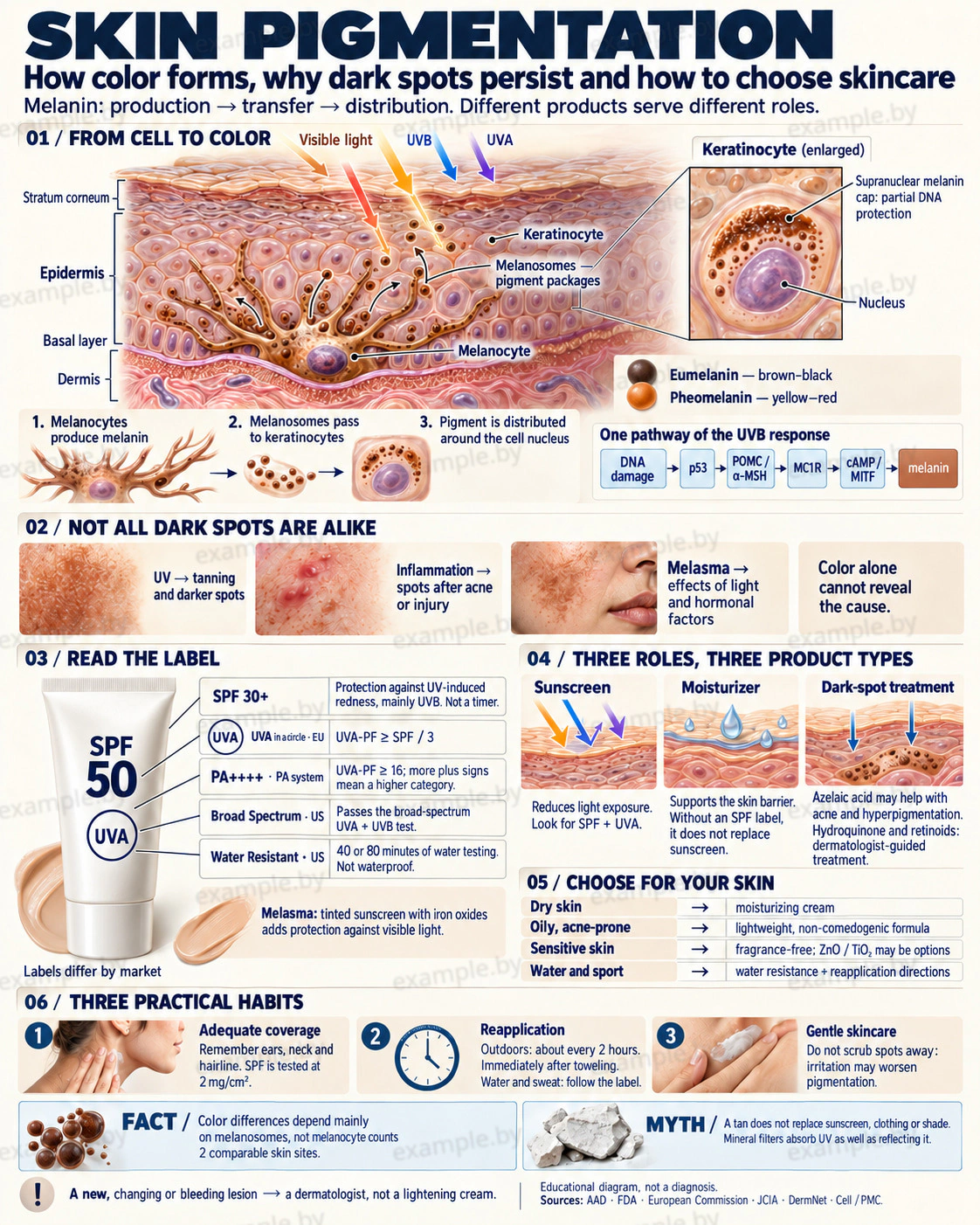
When DNA in keratinocytes sustains UV damage, the tumor suppressor protein p53 is activated. This stimulates the production of POMC and α-MSH. α-MSH then binds to the MC1R receptor on melanocytes, triggering the cAMP → CREB → MITF signaling cascade, which upregulates melanin-synthesizing enzymes, including tyrosinase. Melanin is subsequently packaged into melanosomes and transferred to surrounding keratinocytes. (PubMed Central (PMC))
In simplified terms:
UV → DNA damage → danger signal → melanin synthesis → delayed defense.
This is why the popular phrase
“The skin tans in order to protect itself”
is biologically inaccurate.
In reality:
the skin first sustains UV injury, and only then mobilizes a defense response.
In people with robust pigmentary capability, this process quickly becomes apparent as a tan.
In phototypes I and II, cellular damage and acute inflammation manifest long before any protective pigmentation can form.
5. Tanning Comes in at Least Two Forms
First, there is rapid tanning.
Within minutes of exposure, UVA can trigger immediate pigment darkening. This is primarily caused by the photo-oxidation and spatial redistribution of preexisting melanin, and it often begins fading relatively quickly. (PubMed Central (PMC))
Then there is delayed tanning.
Several days after exposure, the body increases true de novo melanogenesis. This color can last for weeks or even months. UVB is the primary catalyst for this process, although UVA can also contribute to persistent pigmentation. (PubMed Central (PMC))
This explains the familiar sequence after a sunny afternoon:
the skin darkens slightly right away → some of that color fades over subsequent hours → days later, a true, persistent tan emerges.
6. Can Tanning Fundamentally Alter Your Natural Skin Tone?
Temporarily, yes. Fundamentally, no.
Photobiology distinguishes between constitutive pigmentation—your baseline, genetically determined skin color—
and facultative pigmentation—the inducible pigment your skin produces in response to UV exposure. (PubMed Central (PMC))
For one individual, the contrast between midwinter pale and late-summer bronze may be dramatic.
For another, it is barely perceptible.
Yet everyone has a strict biological ceiling on their tanning capacity. Someone with phototype I cannot transform their skin into phototype V through relentless sun exposure.
Attempting to force past this genetic limit does not yield unlimited melanin; it simply accelerates cumulative cellular damage.
Over time, the end result is not an enviable golden glow, but solar lentigines, mottled hyperpigmentation, loss of elasticity, and photoaging.
7. Tanning and Sunburn Are Not Opposites
It is intuitive to think:
tanned = well-adapted; burned = damaged.
In reality, both are markers of UV injury.
A sunburn occurs when cellular damage is severe enough to provoke an acute inflammatory cascade: vasodilation, redness, heat, pain, and occasionally edema.
A tan is the skin's adaptive response to that same cellular insult through upregulated pigment production.
The two can occur simultaneously.
In other words, you can develop a tan and sustain a sunburn at the exact same time.
The WHO stresses that a tan is evidence of UV-induced damage. Furthermore, the resulting pigmentation provides only marginal photoprotection, roughly equivalent to SPF 2–4. (World Health Organization)
That is far too low to prevent meaningful harm.
8. What Does SPF Actually Mean?
One of the most common misconceptions is:
SPF 30 = I can stay in the sun 30 times longer.
The FDA explicitly warns that treating SPF as an exposure timer is wrong. SPF reflects the ratio of the UV dose required to produce erythema on protected skin compared to unprotected skin under standardized laboratory conditions. (U.S. Food and Drug Administration)
Critically, SPF primarily measures protection against UVB, the wavelength responsible for sunburn.
That is why looking for UVA coverage alongside SPF is essential.
In the United States, this is indicated by the Broad Spectrum / UVA + UVB designation. (American Academy of Dermatology)
Under laboratory testing, an SPF 30 sunscreen transmits roughly 1/30th of erythema-inducing UVB, or about 3.3%. The AAD describes this as filtering roughly 97% of UVB rays. (American Academy of Dermatology)
Here is where the math becomes revealing:
SPF 30 → ~3.3% transmission SPF 50 → ~2.0% transmission
This means SPF 50 is not “virtually identical” to SPF 30. An SPF 30 product lets through roughly 67% more residual UVB radiation than an SPF 50 formula (3.3% versus 2.0%).
That difference matters significantly during extended hours under intense sun.
9. Why SPF Underperforms in Real Life
The main issue is underapplication.
The AAD notes that most people apply only 25% to 50% of the recommended amount. In standard SPF testing, products are applied far more thickly. (American Academy of Dermatology)
For an average adult, the AAD recommends roughly 30 ml (one ounce) to cover all exposed skin, though the precise volume depends on body surface area. Sunscreen must also be reapplied approximately every two hours outdoors, and immediately after swimming or heavy sweating. (American Academy of Dermatology)
“Water resistant” does not mean waterproof. Standard water-resistance claims are validated for specific durations of either 40 or 80 minutes of water immersion. (U.S. Food and Drug Administration)
Ultimately, an adequately applied SPF 30–50 that you comfortably use every day provides far better protection than an expensive SPF 100 applied in a whisper-thin layer once in the morning.
10. Sunscreen Is Only One Layer of Defense
In fact, the WHO does not rank sunscreen as your primary defense.
The most reliable strategy relies on multiple layers:
protective clothing + shade + a wide-brimmed hat + UV-blocking sunglasses + sunscreen applied to remaining exposed areas. The WHO specifically cautions against using sunscreen to deliberately prolong exposure to intense sunlight. (World Health Organization)
When selecting a sunscreen, current AAD guidance recommends SPF 30 or higher, broad-spectrum protection, and water resistance. (American Academy of Dermatology)
11. How Long Is It Safe to Stay in the Sun?
There is simply no universal rule such as:
“15 minutes is safe, but 30 minutes is dangerous.”
Total UV dose depends on a complex web of variables: the UV index, time of day, season, latitude, altitude, cloud cover, surface reflection, skin phototype, and protective measures.
This is why modern public health guidelines rely on the UV Index rather than ambient air temperature.
The WHO defines clear operational thresholds:
UVI 0–2: Minimal risk for most people.
UVI 3–7: Sun protection is recommended, particularly around solar noon.
UVI 8+: Very high exposure; direct sun should be avoided during peak midday hours. (World Health Organization)
The higher the index, the faster biologically damaging UV doses accumulate.
Consequently, attempting to calculate a “safe 20-minute window for tanning” is biologically unfounded. There is no scientifically defined safe duration for intentional UV tanning.
This does not mean avoiding the outdoors: walking, swimming, and exercising outside are essential to well-being. The goal of photoprotection is not heliophobia, but eliminating avoidable, high-dose UV damage.
12. Temperature Has Little to Do with It
You can sustain severe UV damage on a cool, windy day.
The skin cannot perceive ultraviolet radiation.
Furthermore, cloud cover offers little protection. Thin or broken clouds barely attenuate UV, and under certain atmospheric conditions, cloud scattering can even amplify surface irradiance. (World Health Organization)
Surface albedo also plays a major role.
According to the WHO, dry sand reflects roughly 15% of UV, sea foam around 25%, and fresh snow up to 80%. (World Health Organization)
This is precisely why you can still get burned while sitting under a beach umbrella.
13. What About Glass?
Here again, UVA and UVB behave very differently.
Standard architectural glass effectively blocks nearly all UVB, but a substantial portion of UVA passes right through it. Consequently, sitting beside a large sunny window delivers steady UVA exposure without the warning signal of a sunburn. The AAD explicitly notes that UVA penetrates standard window glass. (American Academy of Dermatology)
This is one of the reasons UVA is so intimately linked to cumulative photoaging.
14. How UV Directly Drives Cancer
This is not merely a statistical correlation.
UV radiation inflicts direct and indirect damage on DNA. If these lesions are improperly repaired, cells accumulate permanent mutations in genes that regulate proliferation, DNA repair, and programmed cell death.
Over time, surviving mutant clones can acquire malignant properties.
Solar UV radiation is classified as a proven human carcinogen, and the IARC categorizes UV-emitting tanning devices as Group 1: carcinogenic to humans. (IARC)
Different types of skin cancer follow distinct exposure patterns.
For cutaneous squamous cell carcinoma, cumulative lifetime UV dose is the primary risk factor.
For melanoma, acute, intermittent high-intensity exposure and severe sunburns play a pivotal role, though lifetime cumulative exposure remains an important cofactor. (World Health Organization)
15. The True Scale of the Problem
According to current IARC estimates, approximately 1.5 million new cases of skin cancer were diagnosed worldwide in 2024.
Of these, roughly 340,000 were melanoma, which claimed nearly 60,000 lives. (IARC)
While basal cell and squamous cell carcinomas are far more prevalent, melanoma represents the greatest threat due to its high propensity for early metastasis.
16. Are Darker Skin Tones Protected from Cancer?
While higher baseline melanin levels significantly reduce the statistical incidence of UV-induced tumors,
no skin tone confers complete immunity against skin cancer.
The AAD stresses that skin cancers occur across all phototypes. In darker-skinned individuals, melanomas are frequently diagnosed on sun-shielded areas such as the palms, soles, or under the nails (acral lentiginous melanoma)—locations where the link to solar UV is substantially different. (American Academy of Dermatology)
This highlights another crucial distinction: not every melanoma is simply the result of “too much sun.”
“A base tan before vacation protects your skin.” It provides negligible protection—equivalent to an SPF of roughly 2–4—while having already inflicted DNA damage to produce it. (World Health Organization)
“If I tan without burning, it’s safe.” No. Sunburn is not the only marker of injury, and UVA damages dermal architecture and DNA without causing noticeable erythema. (American Academy of Dermatology)
“SPF 50 lets you stay out 50 times longer.” No. SPF measures protection against the UV dose needed to cause sunburn under laboratory conditions, not elapsed time outdoors. (U.S. Food and Drug Administration)
“SPF 100 blocks 100% of UV rays.” No sunscreen filters out 100% of UV radiation. (American Academy of Dermatology)
“Sunscreen isn’t needed on cloudy days.” A substantial portion of UV radiation penetrates through cloud cover. (American Academy of Dermatology)
“People with dark skin don’t get skin cancer.” They do, although the incidence rates and anatomical distribution patterns differ. (American Academy of Dermatology)
“Tanning beds are safer than the sun.” False. UV-emitting tanning equipment is classified by the IARC as a Group 1 human carcinogen. (IARC)
“You need to tan to get enough vitamin D.” The WHO explicitly advises against using tanning as a strategy to obtain vitamin D. The UV dose required for synthesis is far lower than what produces a tan. (World Health Organization)
“One bad sunburn doesn’t matter once the skin heals.” Visible recovery does not erase underlying DNA mutations. Severe sunburns are an established risk factor for melanoma. (Cancer.gov)
“Skin gradually adapts to the sun and becomes immune.” A tan provides a minor increase in natural photoprotection, but it does not shield the skin from long-term mutational damage. (World Health Organization)
Five Deep Questions in Photobiology
1. Is There Any UV Dose That Induces a Tan Without Damaging DNA?
Current photobiological evidence indicates that no such safe threshold exists.
It is essential to distinguish between:
MED (minimal erythema dose)—the smallest UV dose that triggers visible skin reddening—
and
the minimal dose required to induce molecular DNA damage.
These two benchmarks are vastly different.
Studies consistently identify DNA damage at suberythemal exposures—doses well below what is needed to produce visible erythema. Classic UV photoproducts form, oxidative stress surges, and cell-signaling pathways activate, even as a person looks at their skin and thinks, “I haven’t burned at all.” (PubMed)
This leads to a counterintuitive conclusion:
the threshold for visible sunburn is significantly higher than the threshold for biological injury.
Consequently, the rule of thumb:
“I can stay in the sun as long as my skin doesn’t turn red”
is biological nonsense.
Moreover, researchers have identified the phenomenon of “dark CPDs”: cyclobutane pyrimidine dimers that continue to form in skin cells for hours after UV exposure has ended, driven by chemiexcitation pathways linked to melanin degradation products. Contemporary reviews regard this delayed process as a major contributor to the mutational burden. (PubMed Central (PMC))
This does not mean a brief, incidental moment in the sun leads directly to cancer. Skin cells have robust DNA repair mechanisms.
The accurate model is:
UV inflicts DNA damage → most lesions are repaired → some damaged cells undergo apoptosis → a small fraction of mutations persist → repeated exposures gradually compound lifetime risk.
2. Can Skin Ever Fully “Heal” from Extensive Past Sun Damage?
Partially, yes—often remarkably well. But completely resetting the clock to an untouched baseline is impossible.
Cells constantly repair UV lesions. For UVB damage, the primary pathway is nucleotide excision repair, which excises specific photoproducts from the DNA strand.
Thus, the reality is not:
“Every single photon leaves an indelible scar on the skin.”
The vast majority of immediate damage is successfully resolved.
However, if a photolesion fixes into a permanent somatic mutation before repair occurs and that cell survives, baseline repair pathways can no longer restore the original DNA sequence.
Concurrently, deep structural changes occur in the dermis:
collagen degrades and cross-links abnormally;
elastin breaks down (solar elastosis);
the dermal-epidermal junction flattens;
irregular pigmentation develops.
Interestingly, some aspects of photoaging are reversible. Topical retinoids, for instance, can stimulate epidermal and dermal remodeling, improving fine wrinkles and dyspigmentation. However, tissue remodeling is not the same as erasing accumulated somatic mutations. (PubMed Central (PMC))
This provides a crucial distinction:
tans fade → yes. certain signs of photoaging can be reversed → yes. accumulated DNA mutations vanish → no.
This is why adopting proper sun protection is valuable at any age: while you cannot erase historical exposure, you can halt further compounding damage.
3. Is Sun Exposure Really More Dangerous During Childhood?
The answer is more nuanced than a simple “yes.”
Strong epidemiological evidence links early-life sunburns to heightened lifetime melanoma risk. A 2024 systematic review and meta-analysis across phototypes I–IV confirmed significant associations with both sunburn history and cumulative UV exposure. (PubMed)
Extensive research has long demonstrated a correlation between intense childhood sun exposure and later melanoma risk, though disentangling early exposure from lifelong habits remains methodologically challenging. (PubMed)
Therefore, it is a mistake to assume:
“As long as you don’t burn before age 18, adult exposure doesn’t matter.”
That is false.
A more accurate model:
severe burns in youth matter + burns in adulthood matter + cumulative lifetime UV dose matters.
Moreover, the pattern of exposure differs by malignancy.
The WHO notes that squamous cell carcinoma is predominantly tied to cumulative lifetime UV dose, whereas melanoma is particularly driven by intermittent, intense bursts of sun exposure and painful sunburns. (World Health Organization)
In other words, risk depends not only on “how much sun” you receive, but on how that dose was delivered.
An arbitrary 1,000 units of UV accumulated gradually over years is biologically distinct from those same 1,000 units sustained during a few blistering beach vacations.
4. Does Consistent Sunscreen Use Cause Vitamin D Deficiency?
Here, scientific literature offers a more nuanced verdict than is commonly found online.
The underlying mechanism is straightforward:
UVB → cutaneous synthesis of vitamin D.
In theory, an ideal filter blocking 100% of UVB would halt this process entirely.
Under strict laboratory conditions, this inhibition is observable.
Real-world conditions, however, differ markedly: people apply sunscreen imperfectly, miss anatomical areas, spend variable amounts of time outdoors, and obtain vitamin D from diet and supplements.
A recent systematic review and meta-analysis covering 9,470 participants found a slight average reduction in circulating 25(OH)D levels of roughly 2 ng/ml among regular sunscreen users, though individual study results varied widely. (PubMed)
This provides an important corrective to the oversimplified claim that:
“Sunscreen has zero effect on vitamin D levels.”
Mechanistically, it can have an effect.
However, this does not mean that one should deliberately seek sunburns or tan to maintain adequate vitamin D status.
The WHO stresses that physiological vitamin D requirements can be met with far lower UV exposures than those required to produce a tan, and dietary intake or supplements readily address deficiencies. (World Health Organization)
In short:
vitamin D sufficiency ≠ the need to tan.
These are entirely separate biological goals.
5. Is UV Radiation the Only Part of Sunlight That Affects Skin?
No. In fact, this is one of the most compelling frontiers in photobiology.
For decades, dermatology focused almost exclusively on:
UVA + UVB.
Today, researchers are examining visible light (400–700 nm).
The high-energy visible (HEV) spectrum, particularly blue light, is receiving intense scrutiny.
Melanocytes express functional light-sensitive receptors, such as opsin-3 (OPN3). Visible light can directly stimulate tyrosinase activity and upregulate melanogenesis. (PubMed Central (PMC))
Its primary effect is not acute sunburn, but rather:
long-lasting hyperpigmentation and the worsening of conditions like melasma.
Notably, this response is far more pronounced in darker skin phototypes. (PubMed Central (PMC))
This discovery has important practical consequences.
Standard clear sunscreens are formulated to block UVA and UVB, but provide virtually no defense against visible light.
Conversely, tinted sunscreens containing iron oxides can effectively attenuate a substantial portion of the visible spectrum. In clinical studies on melasma, tinted formulations showed clear advantages over UV-only protection. (PubMed Central (PMC))
Still, these findings should not be overstated.
The evidence that visible light triggers pigmentation is compelling.
The evidence linking visible light to skin cancer, however, is negligible compared to the overwhelming body of data establishing UV radiation as a direct carcinogen.
For now, the hierarchy remains clear:
UV → the primary established solar carcinogen affecting human skin.
Visible light → an increasingly recognized driver of hyperpigmentation and a likely contributor to photoaging.
The Key Takeaway from Photobiology
Examining the deeper science makes it clear that skin should not be viewed as a simple four-stage gauge:
fair → tanned → red → burned.
Beneath the surface, at least four independent biological cascades unfold simultaneously:
1. DNA damage can begin well before any visible redness appears.
2. DNA repair continuously works to resolve the vast majority of photolesions.
3. Melanogenesis produces pigment to marginally increase future defense.
4. Accumulation of permanent changes a fraction of mutations and structural alterations persist indefinitely.
Therefore, avoiding a sunburn merely means:
“the threshold for acute inflammatory erythema was not reached.”
It does not mean:
“no damage occurred.”
And that distinction is the single most important lesson that typical conversations about tanning overlook. (PubMed)
Liked it? Save it for later.
 Medicine · 05.10.26
How Helicobacter pylori Survives Stomach Acid
 Medicine · 03.10.26
What DNA Tests Can Actually Reveal
 Body · 18.10.26
The Art of the Pause: How to Speak Calmly and Confidently
 Body · 15.10.26
Who Pays for Heat: Why a Lizard Can Be Hotter Than a Bird
 Technology · 13.10.26
How Smart Scales Track Muscle and Water
 Body · 13.10.26
Full-Body Home Workout with One Kettlebell and a Couch
 Medicine · 11.10.26
Why Gums Bleed and Where the Real Danger Begins
 Medicine · 11.10.26
How Life Begins: From Conception to IVF
 Body · 10.10.26
Skin Pigmentation: How Cells Talk to the Sun
 Medicine · 05.10.26
How HPV Can Lead to Cancer Decades Later
 Body · 03.10.26
Octopuses: Evolution’s Alternative Experiment
 Medicine · 03.10.26
Heartburn: Why Stomach Contents Flow Back Up