Skin Pigmentation: How Cells Talk to the Sun
Skin color is driven by melanosomes rather than extra cells. We explore tanning biology, SPF labels, and effective skincare rules.
- Date
- Reading
- 23 minutes
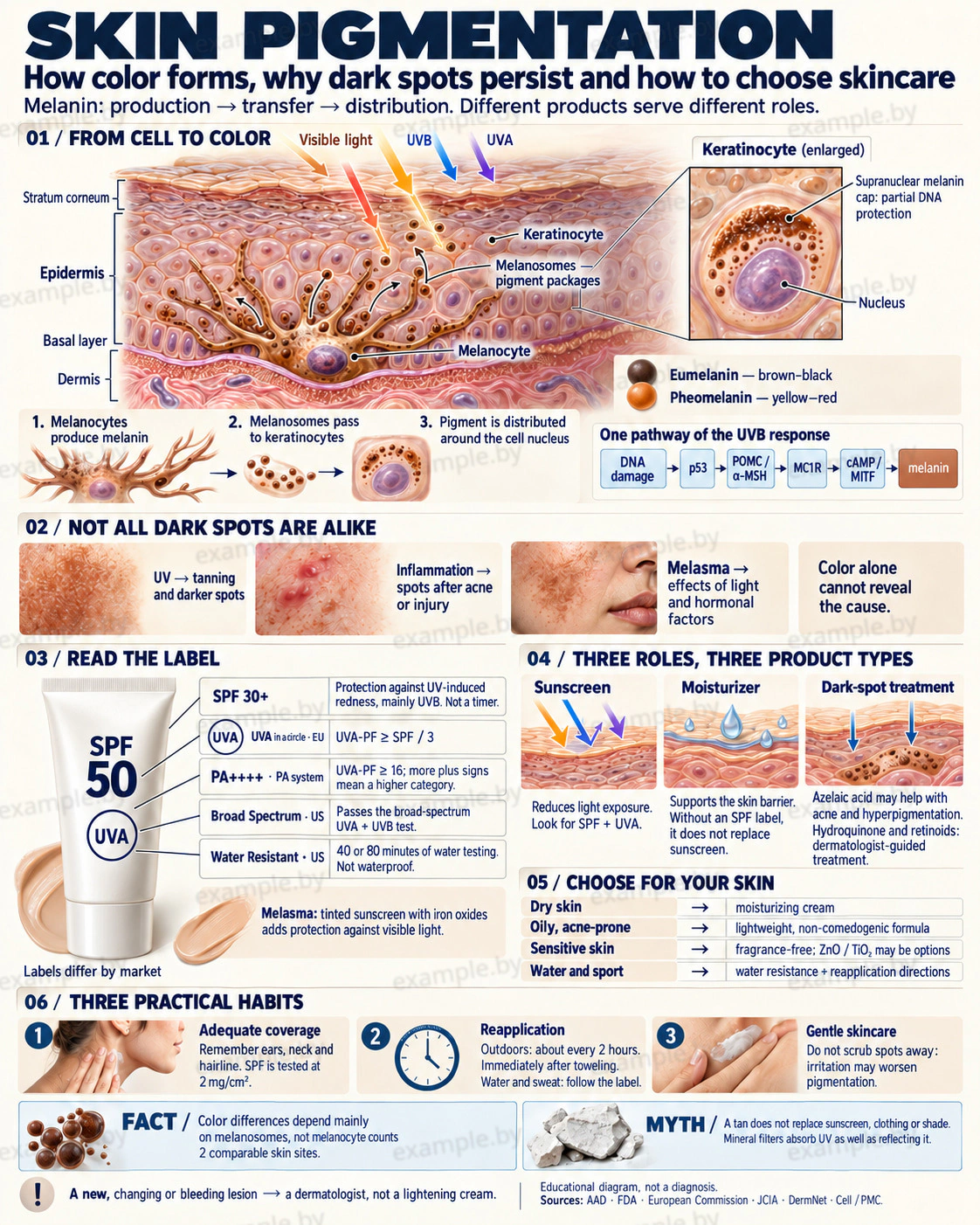
Place two photographs of human skin side by side, and the differences seem stark. At the cellular level, however, the reality is far more surprising: people with vastly different skin tones have roughly the same number of melanocytes in any given patch of skin. The divergence is largely driven not by "extra pigment cells," but by how much melanin they produce, what type it is, how it is packaged into melanosomes, and how it is distributed among surrounding cells.[^1][^2] Skin tone is neither a single binary switch nor a set of rigid "racial" boxes. It is a continuous, fluid system shaped by the intersection of genetics, cell biology, sunlight, inflammation, and population history.
At its core, the process works like this: a melanocyte synthesizes melanin inside tiny organelles called melanosomes and transfers them to keratinocytes, the predominant cells of the epidermis. Inside keratinocytes, melanin arranges itself in part like a microscopic shield over the cell nucleus. Ultraviolet radiation can stimulate this machinery, but a tan is an adaptive response to exposure, including DNA damage; it does not erase the UV dose already sustained, nor does it make subsequent exposure safe.[^3][^4]
Three Players Instead of a Single "Pigment"
It helps to picture the epidermis, the skin's outermost layer, as a manufacturing workshop with a built-in delivery system.
The melanocyte sits at the basal layer of the epidermis. It extends long cellular arms to make direct contact with neighboring keratinocytes. Inside the melanocyte, melanosomes—membrane-bound pigment "capsules"—mature. Once ready, these capsules are transferred to keratinocytes, which gradually migrate toward the surface of the skin, carrying their cargo of melanin with them.[^3]

Melanin itself is not a single compound. Broadly speaking, it is divided into dark brown-black eumelanin and yellowish-red pheomelanin. An individual's visible skin tone depends on the ratio of these pigments, their total quantity, the size and distribution of melanosomes, as well as local blood flow, stratum corneum thickness, and anatomical site. That is why, even on a single body, the face, palms, armpits, or an area healing from inflammation can look markedly different.
This clarifies the common misconception that "darker skin has more melanocytes." For anatomically matched skin sites, that claim is simply inaccurate. In more deeply pigmented skin, what matters most is the size, quantity, persistence, and more uniform distribution of melanosomes inside keratinocytes.[^1][^2] This variation does not point to distinct "biological types"; it reflects subtle differences in how the same cellular machinery is tuned.
Why Skin Darkens in the Sun
A tan is not a simple surface "stain." One well-characterized biological pathway operates as follows:
- Ultraviolet radiation penetrates the epidermis and triggers cellular stress; UVB is particularly effective at causing direct DNA lesions.
- Keratinocytes activate the protein p53, a critical orchestrator of the DNA damage response.
- p53 upregulates the POMC gene, leading to the production of several molecules, including the signaling peptide α-MSH.
- α-MSH binds to the MC1R receptor on melanocytes. Through a cAMP → MITF signaling cascade, genes governing melanin synthesis and melanosome transport are activated.
- Melanosomes are transferred to keratinocytes, where they form a "supranuclear cap" that shields the genetic material from some of the incoming radiation.[^3][^5]
This pathway is an elegant framework, but it is not the entire picture. Pigmentation is also modulated by signals from dermal fibroblasts, nerve fibers, and immune cells, and the strength of this response varies from person to person.[^3] In particular, variants of the MC1R gene correlate with specific hair and skin tones as well as the propensity to tan, though they do not reduce an individual's biology to a single variable.
The most important clinical takeaway is somewhat counterintuitive: an even, golden tan indicates that the skin has already mounted an emergency response to UV assault. The International Agency for Research on Cancer emphasizes that an acquired tan provides only modest photoprotection and is triggered by UV-induced damage; it is no substitute for clothing, shade, or broad-spectrum sunscreen.[^4] The notion of "building a base tan to stay safe later" is a dangerous strategy.
Many Genes, but No "Skin Color Gene"
Pigmentation is a complex polygenic trait. Meaningful contributions come from dozens of gene variants operating across different stages—from melanin synthesis and melanosome structural assembly to organelle pH regulation, trafficking, and cellular handover.[^3][^6] While there are striking examples of single variants exerting outsized effects, none serve as a neat ancestral blueprint.
A textbook example is SLC24A5. In 2005, researchers investigating a hypopigmented mutant zebrafish discovered that the affected gene governed melanosome function; a specific human allele of SLC24A5 was found to correlate strongly with lighter pigmentation in admixed populations.[^6] This was a landmark finding because it linked a cellular mechanism directly to human diversity. Yet it does not mean that one allele dictates skin color in isolation: its phenotypic effect depends on genetic background, and different populations have arrived at similar shades via partially distinct genetic routes.[^7]
This biological nuance sets an important boundary. External skin tone offers no reliable diagnosis of genetic heritage, overall health, individual disease risk, or arbitrary "racial" categories. Human groups have migrated and intermingled throughout history, and their gene pools overlap extensively. Thorough clinical medicine evaluates the individual—family history, active symptoms, and environmental context—rather than relying on surface shade.
Evolution: A Powerful Idea, Not a Simple Storyline
The geographic correlation between baseline pigmentation and ultraviolet radiation levels is one of the clearest macro-patterns in human biology: under intense, year-round UV near the equator, natural selection favored robust photoprotective pigmentation; as human populations dispersed into higher latitudes with weaker, seasonal UV, selective pressures shifted.[^8] Still, the popular summary that "dark skin evolved solely to preserve folate, and light skin solely to synthesize vitamin D" is an oversimplification.
The vitamin D–folate balance hypothesis remains a compelling model: UVB is required for cutaneous synthesis of vitamin D precursors, while UV-induced photolysis and oxidative stress can degrade circulating folate.[^8][^9] Modern evolutionary geneticists emphasize, however, that migrations, dietary shifts, cultural practices, seasonality, population admixture, and polygenic adaptation all acted in concert. Ancient DNA data show, for instance, that the depigmentation of European populations was not a straightforward, single-step adaptation.[^10]
Rather than asserting that "evolution selected the perfect skin color," it is more accurate to say that different human groups navigated distinct trade-offs across ever-changing environments. Today, people often live under UV regimens completely unlike those of their recent ancestors. Ancestry is no substitute for UV protection, and one cannot infer a person's vitamin D status simply by looking at their complexion.
Post-Inflammatory Spots: The Same System in a New Context
Sunlight is not the only trigger that alters pigmentation. Inflammation from acne, irritation, physical trauma, or inflammatory dermatoses can alter signaling cascades to melanocytes, leaving behind darker patches known as post-inflammatory hyperpigmentation (PIH). Hormonal fluctuations and certain medications can also provoke pigmentary changes.[^11] This explains why aggressive, abrasive exfoliation can backfire: sustained mechanical irritation acts as yet another inflammatory cue, driving melanocytes to produce more pigment.
These nuances cannot be evaluated from a photograph alone. Any sudden, rapidly evolving, irregularly shaped, or bleeding lesion—as well as an itchy or non-healing sore—warrants a prompt evaluation by a dermatologist. In-person clinical examination and dermoscopy are far more reliable than trying to deduce the nature of a spot from its color.[^12] Furthermore, skin cancer can develop in individuals of any skin tone, even though risk distributions and common anatomical presentations vary.[^13]
Four Myths That Distort How We See Skin
"A tan is a sign of health." No: a tan is the skin's defensive response to UV-induced damage. Vitamin D synthesis and tanning are not interchangeable, and tanning beds simply add an extra dose of carcinogenic UV radiation.
"Dark skin does not need sun protection." No: higher concentrations of eumelanin provide a higher degree of natural photoprotection, but they do not eliminate the risk of photoaging, hyperpigmentation, or skin cancer. The National Cancer Institute explicitly notes that skin cancer can affect people of all skin tones.[^13]
"Light patches always signal a vitamin deficiency." No: hypopigmented macules have many potential causes, from benign post-inflammatory changes to conditions that require formal medical diagnosis. Self-prescribing supplements cannot replace proper diagnostic work.
"A single scale can accurately predict how any skin will behave." No: while phototyping systems offer a rough estimate of acute sunburn susceptibility, they cannot substitute for clinical examination. Common classification frameworks have documented blind spots when it comes to capturing the full spectrum of global skin tones and clinical risks.[^2]
How to Read Sunscreen Labels and Find What Fits
On store shelves, it is easy to mistake polished marketing for genuine photoprotection. Instead of relying on buzzwords like "anti-aging," "facial," or "all-natural," look for three verifiable criteria: broad spectrum / UVA+UVB, SPF 30 or higher, and water resistance if you anticipate swimming or sweating.[^14] Sunscreen is not an impenetrable shield; it is simply one foundational layer alongside shade, protective clothing, hats, and smart timing.
1. Broad Spectrum, UVA/UVB, or UVA in a Circle: What the Filter Actually Covers
Solar UV radiation is divided primarily into UVA and UVB. UVB causes sunburn and is the primary factor measured by the standard SPF rating. UVA penetrates deeper into the dermis, plays a major role in photoaging, and can trigger or worsen pigmentary disorders. Both spectra inflict cellular damage and carry carcinogenic potential.[^13]
A high SPF alone tells an incomplete story. On US labels, the term Broad Spectrum indicates that a product has met standard testing requirements; the FDA mandates a critical wavelength of at least 370 nm.[^15] This confirms that the formulation provides meaningful proportional coverage across the UVA range, though it does not provide a separate numerical score for UVA strength.
The circular UVA symbol is the European seal confirming that a product meets recommended baseline UVA protection. A key standard requires that the product's UVA-PF is at least one-third of its SPF. UVA-PF (UVA Protection Factor) is determined via dedicated testing protocols; it should not be confused with SPF or the raw percentage of filtered rays. For example, a sunscreen labeled SPF 30 should have a UVA-PF of at least 10. The European Commission set this benchmark as a recommendation to ensure balanced photoprotection, not as a guarantee of complete invulnerability.[^17]
The PA system, developed by the Japan Cosmetic Industry Association (JCIA), grades UVA-PF using plus signs: PA+ corresponds to a UVA-PF of 2 to under 4; PA++ covers 4 to under 8; PA+++ spans 8 to under 16; and PA++++ indicates 16 or higher.[^18] The top tier does not disclose an exact value, meaning two PA++++ formulas can differ in protection. You do not need to hunt for every label simultaneously; simply identify the testing standard used in your region and verify that both UVA and UVB are addressed.
If you manage melasma, there is an additional factor to consider: does the sunscreen protect against high-energy visible light? Visible light from the sun can drive hyperpigmentation, especially in medium-to-deep skin tones. The American Academy of Dermatology recommends using a tinted sunscreen containing iron oxides in addition to SPF 30+ and broad-spectrum coverage.[^19] This does not mean that any standard beige foundation will suffice: color pigments alone do not equal measured UV filters, and proper photoprotection still demands adequate application volume. This finding applies primarily to direct sunlight; it is not a reason to blame standard smartphone screens for skin discoloration.
2. SPF: Not "How Many Hours You Can Lie on the Beach"
SPF is a standardized laboratory metric of protection against erythema (sunburn-induced reddening), which is driven primarily by UVB. It does not calculate your overall reduction in UV cellular damage, nor does it function as a countdown timer or multiply your safe time in the sun. Real-world protection depends on the current UV index, latitude, season, how much cream you apply, the uniformity of the layer, physical friction, sweating, water immersion, and medications that increase photosensitivity.
For daily use, the practical baseline recommended by the AAD is SPF 30 or higher, paired with broad-spectrum protection and water resistance.[^14] An SPF of 50 is a prudent choice under high solar intensity. However, reaching for a higher number is not a license to apply less product or reapply less often: laboratory numbers do not turn sunscreen into "all-day armor."
In standard SPF testing, sunscreens are evaluated at an application density of 2 mg per square centimeter of skin.[^15] In everyday life, the goal is not to calculate microscopic thickness, but to apply an even, generous coat to all exposed areas. The AAD suggests that covering an average adult's exposed skin requires roughly one ounce (about 30 ml); the actual volume depends on body surface area and clothing.[^16] The popular "two-finger rule" can serve as a handy rough guide for the face and neck, but it is not a universal measurement across varied bottle nozzles, product textures, and face sizes.
It is always worth reviewing the product's Directions. US labeling instructions typically advise applying sunscreen 15 minutes before sun exposure, with reapplication after swimming, heavy sweating, towel drying, or after a specified duration.[^15] Instructions can vary between jurisdictions; reading the manufacturer's verified instructions is far more reliable than relying on generic social-media hacks.
3. Water Resistant: What 40 and 80 Minutes Actually Promise
Water resistance does not mean a product is "waterproof," nor does it guarantee indefinite durability. Under the US regulatory framework, "Water Resistant 40 Minutes" or "Water Resistant 80 Minutes" indicates that the sunscreen retained its stated SPF level through standardized immersion tests lasting that duration.[^15] The formula does not suddenly stop working at minute 41 or 81; rather, the rating defines the verified testing window and dictates the reapplication schedule. Other regions use different regulatory frameworks to evaluate and label water resistance, so the absence of a "40/80" note on a European package does not imply it washes off immediately.
Here is how to interpret these claims:
- Water Resistant (40 minutes): Standard instructions require reapplication after 40 minutes of swimming or sweating.
- Water Resistant (80 minutes): Offers a longer tested interval; instructions call for reapplication after 80 minutes of swimming or sweating.
- After towel drying, reapply immediately, regardless of how much time has passed. In dry conditions outdoors, reapply at least every two hours. The FDA strictly prohibits claims like "waterproof" or "sweatproof."[^15]
Even an 80-minute rating cannot rescue an inadequate layer. Friction from towels, sand, and clothing readily removes sunscreen in ways laboratory bath tests do not mimic. The practical rule is simple: after swimming or sweating, check the label time and reapply; after towel drying, reapply immediately; otherwise, follow label instructions—typically at least every two hours while outdoors.[^15]
4. Mineral, Organic, or Hybrid: Not About "Chemicals vs. Nature"
Formulations labeled mineral or physical rely on active inorganic filters: zinc oxide, titanium dioxide, or both. These are frequently well tolerated by sensitive or reactive skin; tinted mineral formulas are also a practical option for those prone to hyperpigmentation. The term chemical is everyday shorthand for organic UV filters. Many modern formulations are hybrids that combine both. According to the AAD, all of these categories provide effective photoprotection provided the product is broad-spectrum, rated SPF 30+, and applied generously.[^16]
The belief that mineral filters solely "reflect rays like mirrors" while chemical filters exclusively "absorb them" is an oversimplification. Optical research demonstrates that zinc oxide and titanium dioxide protect against UV primarily through absorption; their ability to scatter visible light is distinct from their primary mechanism of UV attenuation.[^23] For the consumer, skin tolerability and confirmed ratings matter far more than theoretical marketing divisions. If a product causes stinging, rash, or dermatitis, do not power through the discomfort: discontinue use and consult a dermatologist. If your skin is easily irritated, look for fragrance-free formulations and patch-test new products on a small area first.
5. Formulation Is Not a Cosmetic Detail
The most protective sunscreen is the one you are willing to apply in sufficient quantities and reapply consistently. Choose a vehicle matched to your lifestyle and skin type:
- Creams and lotions are generally well suited for dry skin and facial application;
- Gels often work better on oily skin or hair-bearing areas;
- Sticks offer precise application around the eyes, nose, ears, and lips (when formulated for lip use);
- Sprays are convenient for hard-to-reach areas, though it is easy to apply them too thinly. The AAD recommends spraying until the skin glistens visibly, then rubbing it in by hand. Never spray directly near the face or mouth, avoid inhaling the aerosol, and never use sprays near an open flame.[^16]
If you are prone to acne, check for non-comedogenic claims; if you experience dry skin, prioritize moisturizing vehicle bases. These labels help you find a comfortable texture, but they never replace the core trio of broad-spectrum coverage, adequate SPF, and water resistance.
A Quick Shelf Algorithm
- First, check for SPF 30+ and certified UVA protection; if you expect sweat or water, check for water resistance and review its reapplication directions.
- Match the format to your context: water resistance for swimming or sports; a comfortable daily texture for the face; tinted formulas with iron oxides if you manage melasma.
- Screen the ingredient list to avoid known personal allergens or contact irritants.
- Review the reapplication instructions. If a texture feels unpleasant on your skin, you will rarely apply enough of it for it to be effective in practice.
Finally, remember that no sunscreen makes extended direct sunbathing safe. Under high UV index conditions, on open water, around snow, or at high altitudes, non-negotiable protection includes shade, protective clothing, wide-brimmed hats, and UV-rated sunglasses. Sunscreen covers the exposed gaps; it does not replace common sense.[^13]
Three Tasks for Creams: Protection, Barrier, and Spot Correction
The word "cream" describes a product's physical form, not its biological mode of action. A sunscreen, a daily moisturizer, and a prescription topical can have identical textures while targeting completely different mechanisms. When asking "which cream fades dark spots?", it helps to divide the objective into three distinct goals.
1. Minimize new radiation triggers. This is the job of broad-spectrum sun protection. Sunscreen will not erase existing melanin overnight, but it stops UV and visible light from continuing to trigger hyperpigmentation. In melasma management, rigorous photoprotection is a primary therapeutic pillar, not an optional bonus.[^21]
2. Support the skin barrier. Moisturizers work by reducing transepidermal water loss and soothing the outermost layer of the skin. Richer creams suit dry skin types, while lighter emulsions or gels suit oilier skin; comfort and tolerability matter far more than price tags or "organic" slogans.[^22] Standard moisturizers do not suppress melanin synthesis, and without tested broad-spectrum filters, they cannot substitute for sunscreen. However, their indirect role is critical: ongoing irritation fuels post-inflammatory pigment production, so damaging the barrier with harsh products in the name of "brightening" only worsens discoloration.[^19]
3. Target the underlying cause of hyperpigmentation. Azelaic acid exhibits anti-inflammatory and mild tyrosinase-inhibiting properties, making it useful in acne and post-inflammatory hyperpigmentation; it can, however, cause initial stinging, and its regulatory status varies by country and concentration.[^20] For conditions like melasma, dermatologists may prescribe hydroquinone, topical retinoids, or fixed-combination therapies. The appropriate treatment depends on the diagnosis, pigment depth, health history, and personal tolerability. These are targeted clinical tools, not ingredients to mix haphazardly at home.[^21]
The functional division is clear: sunscreens minimize external stimuli, moisturizers preserve barrier integrity, and targeted actives address underlying cellular pathways. While multi-benefit products exist, each claim must hold up on its own. A "brightening serum" cannot substitute for an SPF, and an expensive sunscreen cannot cure all types of hyperpigmentation.
Practical Habits Without Miracle Promises
Watch for missed spots, not just the number on the bottle. The ears, back of the neck, hairline, and tops of the feet are frequently overlooked. Applying an adequate, even layer is essential because SPF ratings assume a standardized application density; a sheer drop of SPF 50 will not deliver SPF 50 protection. Apply thoroughly before heading outside, and remember that sunscreen works alongside clothing and shade.[^15][^16]
Tie reapplication to specific triggers. For exposed skin outdoors, plan to reapply roughly every two hours, and immediately after towel drying; when swimming or sweating, follow the label's water-resistance timeframe. Setting a phone timer helps as a prompt, but remember that it tracks elapsed time, not the physical wear and tear on your sunscreen layer.[^15]
Do not equate stinging with efficacy. A burning or tingling sensation is a sign of irritation, not proof that an active ingredient is "working deep down." For those prone to melasma or PIH, irritation can trigger further darkening. Fragrance-free, gentle formulations help prevent unnecessary inflammation, though mild care alone will not resolve deep-seated pigmentation.[^19]
Track changes under consistent lighting. Skin tone looks different depending on ambient light, superficial blood flow, and optical scattering. If you are monitoring a dark spot, consistent lighting and angles make progress photos far more reliable. This is a practical tracking tip, not a diagnostic tool: any new, changing, asymmetrical, or bleeding spot requires a formal medical checkup, regardless of how it appears on camera.[^2][^12]
What You Can Actually Do
Caring for your skin does not require chasing an unattainable, airbrushed standard. A sensible daily approach rests on a few core habits:
- Reduce direct UV exposure using shade, protective clothing, wide-brimmed hats, and sunglasses;
- Apply an appropriate broad-spectrum sunscreen to exposed skin and reapply as directed, especially after swimming or heavy sweating;[^13]
- Avoid tanning beds entirely—they do not provide a "protective base";
- If your skin is prone to hyperpigmentation, stick to gentle skincare and avoid picking at blemishes, scrubbing aggressively, or using unverified "bleaching" creams;
- Monitor spots for changes: serial photos under consistent lighting can help you track evolution, but they never replace a dermatologist's evaluation.
Skin pigmentation is a classic reminder that biology rarely fits into tidy categories. It reflects cellular logistics, intricate genetics, deep evolutionary history, and the simple reality of yesterday's weather. Rather than chasing a mythic "ideal" skin tone, our efforts are best spent understanding how skin protects itself—and giving it the support it needs.
For scientists, pigmentation remains an active field: expanding genomic datasets are refining our understanding of how traits evolved, while clinical research is working to improve diagnostic accuracy across all skin tones. As with most things in medicine, thoughtful questions matter more than snap judgments: What has changed, how quickly did it evolve, what triggered it, and what other symptoms accompany it?
References
[^1]: What Controls Variation in Human Skin Color?, Journal of Investigative Dermatology / PMC, a seminal review on melanocytes and melanosomes. [^2]: Effect of skin color on optical properties and implications for medical optical technologies, PMC, a modern review covering melanosome quantity, size, distribution, and the limitations of skin typing scales. [^3]: UV signaling pathways within the skin, PMC, examining the p53–POMC–α-MSH–MC1R pathway and melanosome transfer. [^4]: Sunlight and ultraviolet radiation, IARC/WHO, addressing UV radiation, tanning, and solar carcinogenicity. [^5]: Central role of p53 in the suntan response and pathologic hyperpigmentation, Cell, original study on p53 and tanning mechanisms. [^6]: SLC24A5 affects pigmentation in zebrafish and humans, Science, foundational paper on SLC24A5. [^7]: The Genetics and Evolution of Human Pigmentation, Biology, review of polygenic architecture and convergent evolution. [^8]: Human Skin Pigmentation as an Adaptation to UV Radiation, National Academies / NCBI Bookshelf, overview of global UV patterns and evolutionary frameworks. [^9]: The evolution of human skin pigmentation, PubMed, contemporary assessment of the vitamin D–folate hypothesis and its boundaries. [^10]: Skin colour and vitamin D: an update, PubMed, ancient DNA insights into the non-linear history of European depigmentation. [^11]: Pigmentation disorders, DermNet, clinical guide to causes of hyper- and hypopigmentation. [^12]: 10 skin care secrets for healthier-looking skin, American Academy of Dermatology, warning signs that warrant professional dermatologic evaluation. [^13]: Sunlight, National Cancer Institute, UV risk factors and baseline sun safety recommendations across all skin complexions. [^14]: How to select a sunscreen, American Academy of Dermatology, outlining the three key criteria: broad spectrum, SPF 30+, and water resistance. [^15]: Labeling and Effectiveness Testing for OTC Sunscreens, FDA, definitions of Broad Spectrum, Water Resistant (40/80 minutes), and standard reapplication instructions. [^16]: Sunscreen FAQs, American Academy of Dermatology, guidance on vehicles, active filters, tinted formulas, and spray safety. [^17]: Sunscreen products, European Commission, regulatory scope of the EU UVA seal; assessment of UV protection regulations, NVWA, September 3, 2024, regarding the recommended ratio of UVA protection to SPF. [^18]: UVA protection measurement and PA classification, JCIA, 2012, effective 2013, primary industry document establishing UVA-PF ranges for PA+ through PA++++. [^19]: Melasma: Self-care, American Academy of Dermatology, visible light, tinted photoprotection with iron oxides, and managing irritation. [^20]: Azelaic acid, DermNet, clinical use in acne and hyperpigmentation, anti-inflammatory mechanisms, and irritation profile. [^21]: Melasma: Diagnosis and treatment, American Academy of Dermatology, pairing photoprotection with individualized medical treatments; role of differential diagnosis. [^22]: How to pick the right moisturizer for your skin, American Academy of Dermatology, barrier hydration, creams vs. gels, and product tolerability. [^23]: Cole, Shyr, Ou-Yang. Metal oxide sunscreens protect skin by absorption, not by reflection or scattering, 2016, primary optical research demonstrating absorption mechanisms in mineral filters; laboratory optical properties vs. finished clinical formulations.
Liked it? Save it for later.
 Medicine · 05.10.26
How Helicobacter pylori Survives Stomach Acid
 Medicine · 03.10.26
What DNA Tests Can Actually Reveal
 Body · 18.10.26
The Art of the Pause: How to Speak Calmly and Confidently
 Body · 15.10.26
Who Pays for Heat: Why a Lizard Can Be Hotter Than a Bird
 Technology · 13.10.26
How Smart Scales Track Muscle and Water
 Body · 13.10.26
Full-Body Home Workout with One Kettlebell and a Couch
 Medicine · 11.10.26
Why Gums Bleed and Where the Real Danger Begins
 Medicine · 11.10.26
How Life Begins: From Conception to IVF
 Medicine · 05.10.26
How HPV Can Lead to Cancer Decades Later
 Body · 03.10.26
Octopuses: Evolution’s Alternative Experiment
 Medicine · 03.10.26
Heartburn: Why Stomach Contents Flow Back Up
 Body · 03.10.26
The Science of Tanning: Why There Is No Safe Tan